Earlier posts · Page 11
A shocking and resonant loss buried on bearish site
Metals Haven’t Crashed This Hard Since the Great Recession
Prices for copper, tin and other metals plummeted last week as recession fears grow.
A nice historical study
A Century of Stock Market Liquidity and Trading Costs
Charles M. Jones, Graduate School of Business, Columbia University
First version: May 1, 2000
This version: May 22, 2002
I assemble an annual time series of bid-ask spreads on Dow Jones stocks from 1900-2000, along with an annual estimate of the weighted-average commission rate for trading NYSE stocks since 1925. Spreads are cyclical, especially during periods of market turmoil. The sum of halfspreads and one-way commissions, multiplied by annual turnover, is an estimate of the annual proportional cost of aggregate equity trading. This cost drives a wedge between aggregate gross equity returns and net equity returns. This wedge can account for only a small part of the observed equity premium, but all else equal the gross equity premium is perhaps 1% lower today than it was early in the 1900’s. Finally, I present evidence that the transaction cost measures that also proxy for liquidity – spreads and turnover – predict stock returns one year or more ahead. High spreads predict high stock returns; high turnover predicts low stock returns. These liquidity variables dominate traditional predictor variables, such as the dividend yield. The evidence suggests that time-series variation in aggregate liquidity is an important determinant of conditional expected stock market returns.
Surface conditions
news that will not be highlighted. market no longer in a bear. down 19% from beginning of year at 3854 versus 4750.
highly relevant quote of day from Beating the Market, 1926, R. McNeil: "It is only by buying when surface conditions to the market show stocks to be unattractive - that one may graduate from the ranks of the lambs."
Multiple vectors of deflation
another shibboleth beats the bush:
Huge Global Studies Find Low-Carb or Keto Diets Could Lead to Shorter Lifespan
i use know everything about racket sports. hobo keeley dubbed me the greatest all round racket player of all time (i beat Marty Hogan in a showdown when I was limping from an injury) but now i don't know anything about racket sports either. the games and strikes have changed.
in the supreme insult, my son aubrey won't listen to me about tennis. he says his high school coach disagrees with me about belting every shot. She says it's good even though he misses 99% of first serves.
tremendous deflation in last hew days. its good for whispering guy with a temper. regulatory capture will be greater. and his betting odds increased by 4% to 14.4% versus field for big position.
Stakeholder Capitalism Isn’t Working as Planned
Virginia Postrel has it right as always, and this calls for a proper scientific study of how the extent of shareholder values that a company strives for versus stakeholder values effects shareholder return. somehow this study will not be undertaken at Harvard.
Stakeholder Capitalism Isn’t Working as Planned
It’s a prescription for culture wars, political backlash, managerial paralysis and human-resources nightmares. And it’s anything but nice.
Freak wave, from Jeff Watson
There are many cautionary tales and market lessons in the first minute or so of this video.
Freak Wave Steamrolls Lineup (Opening Scene) – Uluwatu
Henri Poincaré

Henri Poincaré (1854-1912) made diversified contributions in many fields of resonance and relevance today including chaos theory, graphical solutions of differential equations, special relativity, topology, astronomy, probability theory. He made discoveries by ignoring detail and pretending that he was mountaineering, going form one peak to another. "logic limits ideas": he believed in the subconscious solving problems. he worked 2 hours in the morning and 2 hours in late afternoon every day. he went from onw peak to another and while mountaineering, the facts he discovered clustering around the center of the mountains were instantly and automatically pigeonholed in his memory. he visualized everything and his creative habits were similar to the great 19th century musicians like Beethoven, Brahms.
A conjecture, from Sushil Kedia
There is a doubting Thomas in everyone's heart, since no one ever has taken any trades without some risk. It is this risk that always creates doubts in all minds. In day to day flow of the markets the doubts do not get much chance to surface up. But whenever there is an unusual holiday gap, i.e. a longer than normal weekend, a significantly large enough number of minds get the chance to live up to their subdued doubts. Irrespective of whether one is long or one is short, the extra holiday provides the opportunity for one to think enough to choose to act differently than one had been. So long holiday gaps tend to create reversals. Someone might choose to test this. Perhaps a good way to do this might be to create filters such as If prior 5 day returns before a long weekend were <0, then 5 day returns after the long weekend are >0 or vice versa.
Vic responds:
Sushil Kedia elicits an ingenious theory that before holidays humans tend to change their minds. I tested the theory as it mite be highly relevant today. fortunately the multivariate thing i discovered and used for forty years is perfect for testing the theory.
From 2011 to current there were 43 occasions when S&P was up big in 10 days before holiday, and on average 20 days later the market was down 6 points. there were 21 occasions where S&P was down big in 10 days before holiday. after big down, the average 10 days later was up 2% and up 3% 20 days later, with probabilities of 80%.
The Fed, inflation, the market
nobody asked me, but: (1) the Fed and the boy who cried wolf bark bigger than bite. (2) so typical of an agrarian admin to go for price controls. see The speculator as hero and why Antwerp fell when specs stopped "drilling" and citizens stopped economizing consumption with high prices.
the 'chairman' back from Kinderland but still ignorant of economics says that "core inflation is a much better prediction of future inflation than headline inflation." what evidence is there that is true? why are energy and food transitory? are they more effected by policies? when were the studies updated? and what is the confidence that commodity and energy regress?
half of the monetary economists in the world are on the Fed's payroll, but I would be willing to provide an objective evaluation of the fed's view about core inflation being a better predictor.
S&P is a long way from 3801 yesterday at 3pm est. perhaps there was a leak of positive info that caused the 140-pt rise. that's 4% - are we not still in a bear market? perhaps suppress that.
Nobody asked me, but…
there's a bit of deflation in grains and oil and crypto.
the ppi gang got the message to tweak the comparisons favorable to the Big One after the cpi gang forgot. too bad the cpi announcement came before the ppi announcement. the importance of the path.
with a major pharma self reporting that one of their major treatments for Covid doesn't work, the time has come for an outside, unbiased statistician to perform an unbiased estimate of the costs and benefits of the panoply given the number of boosters and original dose. a study that will not be covered.
ok we're in a definition of a bear market. but what is the expectation going forward? i don't use % so i will rely on the wsj report that it's up an average of 3% with a 70% prob one month later and even more bullish for 2 months and end of year.
If Thursday, Friday, and Monday are all down, what is Tuesday? from Big Al
For SPY since inception (1993):
observations: 127
positive: 79
% positive: 62.2%
mean move: 0.37%
sd: 1.61%
z vs all SPY days: 3.19
Jeffrey Hirsch comments:
Filtering for magnitude might be instructive.
Michael Brush suggests:
Would it need to be Thurs Fri Mon down ahead of a Wed Fed meeting? That seems to be the salient factor. For months markets have been weak in the days leading up to a Fed meeting, and then…
Kim Zussman adds:
There may also be a size effect, i.e., not just down, but down small vs big %.
Touching the bull
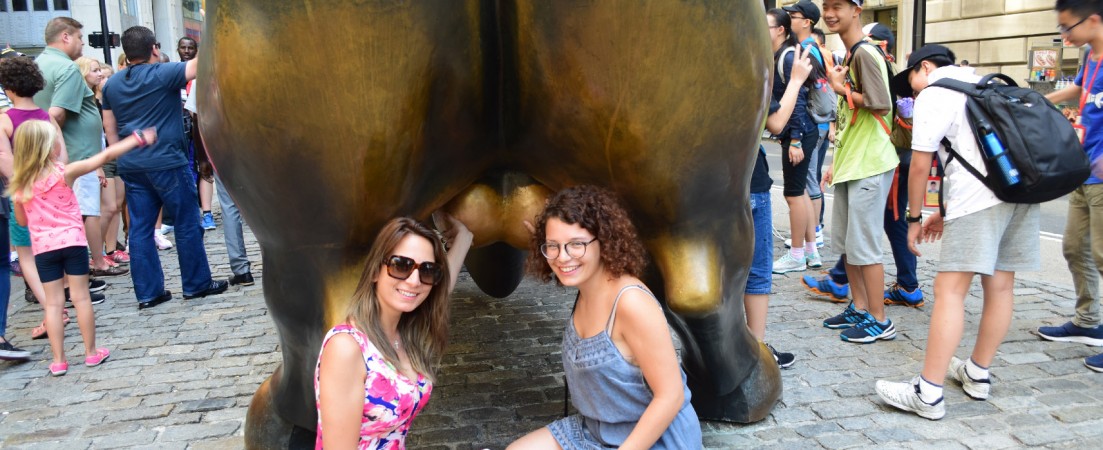
It now attracts tourists posing for photographs and investors superstitiously rubbing its horns for good luck. The bull is now seen as a symbolic mascot for New Yorkers and for world.
Originally published on TheWelcomeBlog, 03/19/2020.
much touching of bull this weekend and myself at near 100 for good luck
Ask me anything on Trading Psychology with Dr. Brett Steenbarger
Ask me anything on Trading Psychology with Dr. Brett Steenbarger
Three big down days in a row

one is almost speechless. with 3 big down days in a row. only happened 3 times since 2011: 8-24-2015, 3-9-2020, 1-21-2022. all three up big on next day. I have an unusual, unique take on why it happened. has to do with the Jan 6 Hearings. Not good enough to to sink the opposition, violence engendered by those incentivized to teach Kavanaugh a lesson, too close to home. So only thing that will save the fair party is a desperate remedy. Not a smiling performance with friend on TV.
All the king’s horses
looks like all the kings horses provided input to tweaking the cpi number, especially with the recall it becomes triply important to unravel the decline in it.
the 3 musketeers championing the Idea that has world in its grip are as concerned about Inflation as they have traditionally been about equality, diversification, and climate. with their laser-like attention on inflation, and the track record of helping their mentors along, one looks for some finagling on the cpi on Friday. It would be bad indeed to start another weekend off with the weather gage with the quarry.
one finds that since 2011 there have been 11 occasions when there has been no 50-day max within 110 days. as for the forecast going forward on those occasions, we'll leave that up to ags and other bears when they wish to kibitz with a foundation.
New CBOE floor, from Jeff Watson

Sneak peek: The new CBOE open outcry trading floor opening in June
A reader asks:
What % of the floor space is the SPX pit?
Jeff Watson replies:
No clue. The CME is moving what’s left of their trading floor back to the old South Room, where the CBOT bond pit was 40 years ago before the new floor opened in 1982.
[A related link. -Ed.]
FLOORED The Complete Documentary Film
A world that's more riot than profession, the trading floors of Chicago are a place where gambling your family's mortgage is all in a day's work. FLOORED offers a unique window to this lesser-known world of finance. Traders may not have degrees, but they've got guts, and penchant for excess. But like many aspects of our economy, technology is changing their business, and these eccentric pit denizens aren't the type to take kindly to new tricks. Computerized trading may take the emotion out of the job, but it may also take these old-timers out- they are dinosaurs in a young man's game. FLOORED is a gripping, honest look behind the curtain of the trading floor that few have ever seen.
Jeff Watson adds:
A new trading floor in 2022 and I’m stoked.
Stefan Jovanovich offers some history:
Chicago Stock Exchange Trading Room: Reconstruction at the Art Institute of Chicago
Just not cricket
SEC Weighs Sending Retail Stock Orders to Auctions for Execution
• Plan under consideration could impact major trading firms
• Agency has been reviewing rules underpinning stock market
that's not cricket. the major purpose of markets is for the infrastructure to prosper at the expense of the public.
Payroll Tax Receipts, from Bill Rafter

How are they going to paint this as a strong economy?
[Data source. -Ed.]
Andy Aiken responds:
It's not, but it gives the Fed a pretext to hold off on rate increases in an election year.
Vic adds:
46 leaked the numbers in his speech on Powell. they get the numbers several days in advance.
A reader asks:
Bill, how have ten year yields reacted in the past when the number is both negative year over and continuing to accelerate down trend? It seems this could be the catalyst that causes the long end to flatten out/rally as the Fed continues to raise the short? Does that hypothesis bear out in testing?
Bill Rafter replies:
Thanks for the question. I will not know until I test.
George Zachar asks:
oddly, the y/y% change in private eci wages has roughly doubled since late 2020, now at 5%. can you square the circle?
Bill Rafter replies again:
I will have to look at it. The payroll taxes are most the macro I can tap, so I tend to put their veracity on top.
Paolo Pezzutti comments:
I was hoping an Api could download the file from the treasury website. There are a number of Api's in Python or R to download datasets in json, csv, xml from FRED and other websites as alternative data to find relationships and regularities with stock index prices. Some of these keys are premium. I wonder if this approach provides real added value with respect to counting based on the idea that prices represent the synthesis of all market players actions and views.
High School Mile Record, from Stefan Jovanovich
It Actually Happened… || Gary Martin Breaks LEGENDARY Record Of Jim Ryun
Larry Williams clarifies:
He’s really not faster than Ryan—look at the cinder track Ryun ran on vs the new, and much faster one, where the new record was set.
Stefan Jovanovich allows:
LW knows track.
Larry Williams adds:
If I could only run fast. Dyrol Burleson, college roommate—first American to break 4 minutes in the USA—ran, as a college senior, against Ryan, beat him, but told the reporters he was not the story, Ryan was. What he did on those old track and old shoes was amazing.
Speaking of shoes, the new carbon plate ones (Nike Alphafly) are a real game changer - more records to be shattered. Thet are so much easier on your legs.
Gurus, from Nils Poertner
Monty Python's Life of Brian 1979 Alright I am the Messiah
deep seated desire by humans to find a guru in life, in trading, in spirituality, whatever - consciously or not (have the same really, I suppose). eg, friend followed Demark (cult) and his indicators religiously and only later realized he had to tweak it and adjust it and figure things out for himself.
Larry Williams disagrees:
Dead wrong on DeMark.
Nils Poertner responds:
experienced traders like yourself figured out how to use Demark i'm sure. was just trying to say that for most there is a tendency of humans (incl traders) to lean on somebody else but the journey is always a personal one. maybe the obvious.
Larry Williams writes:
Agree we all want someone else to make it easy for us!
How to use DeMark? Tom and I created it together. I was there at day one—we developed it pre computers, talking on the phone every night. He was in Racine Wisconsin, I was in Kalispell Montana—we poured over charts every night making notes, etc. Since then Tom has taken over and thanks to his mind and computers it has gotten even better—-original model gave a buy at the recent low.
Bears, Yankees, myths
it seems that even more than usual, bears permeates the firmament. the three times that employment has been bad for S&P since 2011 (after thur up), the market has gone up abut 4% the next 4 days. Please tell me why bonds were way down and why they are not bullish.
nobody asked me but… (1) The Yankees are much overrated and ultimately their holes in the lineup with gallo, chapman, and Hicks will cause losses. (2) Having read Joseph Campbell who was fastest half miler in US in 1925, I don't understand the relevance of his main themes to actual myths. plse help. (3) Suzyn Waldman 76 and John Sterling 85 are very good to me as a calming influence while trading in the nite. Their relation is like that of a caretaker (Suzyn) taking care of parent (John) in an old age home. and he is very appreciative and can still keep score.
The first strike
my daughter Kate just asked me if the first strike is significant. the team that scores the first basket in basketball wins something like 60% of time. i tested it for the first tick in the S&P, i.e., 930 to 931. if up, quite bullish for the rest of the day. if down, quite bearish. the difference in means is 3. can you think of any others?
the first strike is half the battle. now that i think of it, i always tried to get the first point in squash. then i'd continue and try to get up 5-zip. was very successful that way forcing myself to try hard at the beginning.
The usefulness of sports
I keep a tennis racket and ball in my desk so I can entertain my 13 grand kids. today I got some extra use out of the racket as the lawn mower people come on tues at the close and the only way I was able to stop them was to alert them to stop with a backhand lob.
of all the schools that my family has matriculated in I have often believed that Williams was the one that gave them the best ed and happiness. The reason to me is the policy of making everyone there participate in at least one sport. if secondary schools insisted that all students joined at least one sport I predict that there would be 99% drop in violence.
Lots of lessons to learn about stocks from this Bull Rider, from Larry Williams
The Best Bull Rider of All Time: J.B. Mauney
He’s changing the game. He does things no one else does. There’s not a title in the world that he can’t win. The best bull rider in the world, J.B. Mauney is a throwback cowboy from Moorseville, North Carolina. VICE Sports traveled with J.B. to check out his atypical workouts, his superior technique and unrivaled work ethic that has taken him to unprecedented ground in the bull riding community.
Stefan Jovanovich checks his vitals:
5 ft 10 in (1.78 m) and 140 pounds (64 kg).
Peter DeBaz adds:
The one-way ticket to his first PBA remind me of the burning ships of Cortes.
Something Deeply Hidden, from Zubin Al Genubi
Something Deeply Hidden, by Sean Carroll has changed my understanding of reality more than any book I've ever read. Its the latest explanation of Quantum Fields and wave theory for laymen. For probabilistic thinkers like Spec Listers, it should be readily accessible as probability is the basis of quantum field theory.
The whole world is one quantum wave which evolves according to Schrödinger's formula solves the probability of a reality is the square of the energy wave. Relativities distinctions between matter/energy are gone. Time and space are emergent phenomena of the quantum wave not real things.
Its mind blowing stuff and so different than everything I learned my whole entire life. Highly recommended.
Also interesting are Erwin Schrödinger's lectures, What is Life, describing life, dna, evolution, sentience and consciousness from a quantum physics perspective.
Stefan Jovanovich links to an alternate view:
Q&A: Gerard ’t Hooft on the future of quantum mechanics
The laws of quantum mechanics seem to tell us that there is a fundamental random component to the universe. But Gerard ’t Hooft, who received the Nobel Prize in 1999 for his work on gauge theories in particle physics, is not convinced that physicists have to abandon determinism.
In his new book, The Cellular Automaton Interpretation of Quantum Mechanics (Springer, 2016), ’t Hooft suggests that we may simply be lacking the data that would turn quantum probability distributions into specific predictions.
Nils Poertner adds:
Trading in the Zone, by Mark Douglas, touches on this as well. nice chapter on "Belief vs Truth" in context of possibilities and probabilities. good to be surrounded by folks who stimulate oneself in that direction, too, friends, colleagues, this group here, etc.
Tipsters
Wall Street Stories, by Edwin Lefevre, 1901. the book tells stories of personages very similar to today. the tipster and Pikes Peak or Bust are quite resonant of the useful idiots who proliferate today. In those day, the tipster and the plunger ended up at Trinity Church.
Tipsters in those days ended up in a graveyard, or walking aimlessly from New Street where the bucket shops were to the Brooklyn Bridge. Today they wear suits and are respected columnists and heads of research in big financial firms.
As the result of much thought about his losses Gilmartin became a professional tipster. To let others speculate for him seemed the only sure way of winning. He began by advising ten victims—he learned in time to call them clients—to sell Steel Rod preferred, each man 100 shares; and to a second ten he urged the purchase of the same quantity of the same stock. To all he advised taking four points’ profit. Not all followed his advice, but the seven clients who sold it made between them nearly $3,000 over night. His percentage amounted to $287.50. Six bought and when they lost he told them confidentially how the treachery of a leading member of the pool had obliged the pool managers to withdraw their support from the stock temporarily; whence the decline. They grumbled; but he assured them that he himself had lost nearly $1,600 of his own on account of the traitor.
For some months Gilmartin made a fair living but business became very dull. People learned to fight shy of his tips. The persuasiveness was gone from his inside news and from his confidential advice from Sharpe and from his beholding with his own eyes the signing of epoch-making documents. Had he been able to make his customers alternate their winnings and losses he might have kept his trade. But for example, “Dave” Rossiter, in Stuart & Stern’s office, stupidly received the wrong tip six times in succession. It wasn’t Gilmartin’s fault but Rossiter’s bad luck.
At length failing to get enough clients in the ticker-district itself Gilmartin was forced to advertise in an afternoon paper, six times a week, and in the Sunday edition of one of the leading morning dailies. They ran like this:
WE MAKE MONEY
for our investors by the best system ever devised. Deal with genuine experts. Two methods of operating; one speculative, the other insures absolute safety.[ … ]
Little by little his savings grew; and with them grew his desire to speculate on his own account. It made him irritable, not to gamble.
He met Freeman one day in one of his dissatisfied moods. Out of politeness he asked the young cynic the universal query of the Street:
“What do you think of ‘em?” He meant stocks.
“What difference does it make what I think?” sneered Freeman, with proud humility. “I’m nobody.” But he looked as if he did not agree with himself.
“What do you know?” pursued Gilmartin, mollifyingly.
“I know enough to be long of Gotham Gas. I just bought a thousand shares at 180.” He really had bought a hundred only.
“What on?”
“On information. I got it straight from a director of the company. Look here, Gilmartin, I’m pledged to secrecy. But, for your own benefit, I’ll just tell you to buy all the Gas you possibly can carry. The deal is on. I know that certain papers were signed last night, and they are almost ready to spring it on the public. They haven’t got all the stock they want. When they get it, look out for fireworks.”
Gilmartin did not perceive any resemblance between Freeman’s tips and his own. He said, hesitatingly, as though ashamed of his timidity:
“The stock seems pretty high at 180.”
“You won’t think so when it sells at 250. Gilmartin, I don’t hear this; I don’t think it; I know it!”
“All right; I’m in,” quoth Gilmartin, jovially. He felt a sense of emancipation now that he had made up his mind to resume his speculating. He took every cent of the nine hundred dollars he had made from telling people the same things that Freeman told him now, and bought a hundred Gotham Gas at $185 a share. Also he telegraphed to all his clients to plunge in the stock.
It fluctuated between 184 and 186 for a fortnight. Freeman daily asseverated that “they” were accumulating the stock. But, one fine day, the directors met, agreed that business was bad and having sold out most of their own holdings, decided to reduce the dividend rate from 8 to 6 per cent. Gotham Gas broke seventeen points in ten short minutes. Gilmartin lost all he had. He found it impossible to pay for his advertisements. The telegraph companies refused to accept any more “collect” messages. This deprived Gilmartin of his income as a tipster.
Presidential Elections and the Stock Market, from Alex Castaldo
Financial Analyst Journal, Vol. 26 No.2, pages 111-113:
The above Tables I and II […] show that the traditional Wall Street belief concerning the market's preference for Republicans is in accord with observed market movements surrounding Election Day.
If this Republican bias were justified, one would expect the market to perform significantly better during a Republican administration than during a Democratic one. To test this hypothesis, we looked at every year since 1897 and classified it by party in power and by its yearly position in the administration. The following table summarizes the results:
Year Republican Democratic
1 6.88% 10.35%
2 10.18% -1.21%
3 -6.84% 20.76%
4 7.15% 3.50%There appear to be no systematic differences in the performance of the market during Republican and Democratic administrations, except that during the third year of Democratic administrations the market performs significantly better than during the third year of Republican administrations. Thus, there appears to be no long term pattern in market movements which would justify Wall Street's Republican bias.
For those who would like to know: This article was written by Victor Niederhoffer, Steven Gibbs and Jim Bullock. It was published in the March-April 1970 issue of FAJ.
Zubin Al Genubi comments:
This year is on track with regularity. Will next year be up big contrary to all the bearish pundits?
Markets, sports, and the Great Idea
you wouldn't know it from the chronic bears and pessimists but the S&P is at a 17-day high and bonds at a 30-day high up for the month.
nobody asked me but…if there is one player in the major leagues who has lost his temper and disgraced baseball more than Josh Anderson, I missed it. and the universal reaction to the latest is indicative of the idea that has world in its grip and other recent events.
terrible news for those who support the idea that has world in its grip this week. we got back 6% this week and end with S&P up on the month and bonds and crude at a high. we finally got a week up and 1600 S&P left for a new high.
chickens come home to roost. all the masters 100 support of taking away parents rites at schools leads to tragedy . and I still say with Donaldson-Anderson, universal condemnation of the former was a key.
to make matters worst for supporters of the idea, the betting odds are now 4 to 1 that one or the other of the top two against the incumbent will win.
Nobody asked me but…the increasing trend of equality and diversity in professional sports makes the average athlete feel anomie as to sports and loses all sense of healthy competition and makes him or her a leaf floating in the wind.
it's hard to feel anything but contempt for your team when your role model athletes are billionaires complaining about the National Anthem and Americanism. That's why I say Donaldson-Anderson had much wider repercussions. query: did recent fatherless give up sports?
I will give a cash prize and a signed book to the best answer
i will give a cash prize and a signed book to the best answer to the question: Now that the coaches, announcers, and tv and radio stations have joined the masters 100, the disneys, and now the insurance companies, how does this influence the game?
Reply to: Vic's twitter feed
john G
@dukeofoakes
Less opportunity for the white or non-woke as they add no value for the 100. Level of play decreases as the talent/deserving get replaced by those that serve the 100s interests.
Konrad Kuciej - Value Masochist
@KonradKuciej
Over the last several decades, with the advent of cable tv, internet and all of its applications the amount of advertising revenues for sports has skyrocketed, ticket sales and merchandise sales have taken the back seat. Because of the amount of money being generated all sports outcomes have become more and more clustered around a mostly “known” or at least “presumed” outcomes that drive the most “interest/viewers” and that allow the audience to feel they are part of the spectacle…games have become less “random” and more “staged”, all participants know.
Leet1337
@clozzi_24
The suppression of players expression of free views…. Anti secular & anti political except for those that are pro “wokeness”…… Still basketball except for no meaning behind the game that don’t serve corporate media.
packmansam
@PackManSamm
chasing advertising dollars by subscribing to the current thing amidst a decades long decline in viewership adds to the urgency for the league and refs to make sure the large market teams make the playoffs and ultimately the finals.
DarkWeb Trader
@Darkweb_Trader
Wokeness is for winners. A strength that creates competitive advantage. And a prerequisite for winning the right way and future political candidates. The only game in town.
Rodrigo Sotomayor
@Soto888
Favorite teams tend to generate higher commercial and marketing revenues, putting natural pressure on the refs calls even if unintended./p>
Ox
@OxEquities
Please the advertisers.
john G
@dukeofoakes
The 100 would favor most any team playing against the outspoken vaccine critic Aaron Rodgers.
the winner of the contest is John G. He will receive cash prize of $1000 and signed book. All the other contestants were very good also. They will all get signed books. send me address so I can send it.
The idea that has the world in its grip
i haven't seen an update on this in 20 years. i believe its relevant.
The World in the Grip of an Idea Revisited
Socialism Destroys Institutions, Societies, and Individuals
chalk up the losses of the yankees to the unholy assuaging of the idea that has the world in its grip. its shameful that a manager can't support his players, but this is part of the idea that certain personages are entitled because of the masters 100 and disney syndrome.
Laurel Kenner writes:
I have long wanted to do a study of Sweden, the darling of US socialists.
Peter Saint-Andre adds:
I read an article in the last ~2 years about Sweden (perhaps in Reason magazine?) which argued that these days the country is not nearly so socialistic as "progressives" think.
Jeff Watson comments:
I like Sweden’s system of private roads, and the fact that everyone, rich and poor, has to pay the same rate of taxes.
Andre Wallin writes:
my parents immigrated to the US when Olof Palme was prime minister. they claimed they moved in large part because of his socialistic policies. he was assassinated in 1986 by "Skandia Man" who they only figured out who it was in 2020 posthumously. my uncles do pretty well in sweden as small business owners these days, but nothing compared to what is possible for so many in the US.
Henry Gifford responds:
Some years ago I attended a lecture by two people from Sweden, who argued that Sweden has high taxes, but it is worth it for all the services the government provides. But they did not convince me that they paid lower taxes than we pay in the US – sounds like we pay higher taxes here. They were shocked to hear about paying high real estate taxes with money that has already been taxed.
Yes, Sweden is the darling of socialists in the US. But most articles I’ve read say that Sweden is an example of socialism that works, then include nothing to back up that claim, and don’t even reference it later. I’ve heard that Sweden toys with socialism every 20 or 30 years, finds it is a disaster, and gets as free of socialism as fast as possible. If this is true, it wouldn’t discourage a socialist from claiming that Sweden is socialist.
One time I was talking about “government” schools in the US. Politically incorrect to call them what they are. I might have quoted Cato’s finding that government schools cost twice as much as private schools. A guy was talking about a wonderful “public” school, and I asked if it was a government school. He said he didn’t know. I asked if it was on land or floating around on a boat. He said it was on land. I asked him who owned the land. He said he didn’t know. I assured him that his level of dishonesty qualified him for being a very good comrade. He didn’t object. Some level of dishonesty seems a prerequisite for people who claim to believe that socialism is a good idea.
Bo Keely comments:
After traveling the world to 105 countries, I've concluded it's not a matter of Socialism vs Capitalism. It's a matter of people. Some peoples can make a socialism work and do it. Other peoples at their best cannot make capitalism work nor desire it. So, one should look at squares and circles before deciding which hole they should fit into. I personally prefer the lone wolf life.
Symmetry, from Zubin Al Genubi
Symmetry is a characteristic property of the universe. The 24 May dip and bounce was good as it reflected a similar move 19 May. Question is will the big bar move of 18 May get reflected back up soon? Bears seem tired. Plus the news is all bearish and my brother is law wants to sell.
Getting the start today of completion of symmetry big bar.
Doug Martin suggests:
Maybe the folks at Davos gave the all clear signal, last friday's low was a nice looking pattern.
Michael Brush is bullish:
Let's get ready to rumble. This is from noon yesterday:
Strong insider buying suggests a 15% rally in the S&P 500 from here
One of the troubling things about this market downturn is that as brutal as it got, corporate insiders never showed much interest in their discounted stocks. That’s changed in a big way. They’re bullish now — signaling the stock market is oversold and due for at least a short-term bounce if not more. Using history as a guide, the S&P 500, the Dow Jones Industrial Average, and the Nasdaq Composite stand to advance 15%-20% over the next three months.
Bears, bonds, and crypto
a representative bearish story from the bearish data provided:
The Tech Rout Isn’t Just Cyclical—It’s Well-Earned, and Overdue
30-year shows amazing strength given strength in crude and stocks. only down 1 tick on a day at 20-day high.
in retrospect the bell weather for crypto was when it didn't soar in the face of big Florida convention and Rumpelstiltskin saying that crypto was his major bull thing. and laudatory article saying Rumpelstiltskin is always rite on the future memes.
Atomic Annie, from Stefan Jovanovich
‘Atomic Annie’ Was the World’s First and Only Nuclear Gun
Twenty were made, but only one fired a nuclear shot.
Minutes, markets, charts and trash talk
last minutes were down 16 on day and -60 on 2 days. serial corr is -0.52 on one day and -0.44 on 2 day basis.
nobody asked but trash talk in other major sports like basketball and football is infinitely worse and more prevalent than baseball.
minutes apparently revised to help masters 1000 and professional sports and alphabet agencies and regulatory capture boys along—- but nice deception at 3915.
in old days a company currently an acquisition candidate reported earnings without deducting expenses for salaries. one notes that there is a negative provision for Service expense and negative operating revenues. query: are they still able to report with this largesse?
many lobogola:

i didn't know how to read that cryptic chart myself. like most brokerage houses i have been unable to speak to a human there. but their margins of 5% of the big options house is alluring.
so much disappointment that we will not have a seventh down week in row for sp. all because of backlash against donovan. everyone who plays a team sport is kidded with a nickname highlighting an exuberant or weak moment.
nobody — the mad dog sports announcer is about as useful as El Erian — and both are very knowledgeable and predictably with the idea that has world in grip. makes professor particularly useful tomorrow.
A specialist in panics, from Steve Ellison
“You are a ‘Specialist in Panics,’ which means you buy in panics and at no other time. Whenever you are tempted to go in, ask yourself whether a panic exists. If the answer is Yes, then buy; if No, don’t buy.” – from the Magazine of Wall Street, circa 1908.
“Bull markets start in panics and end in booms.” [From the same source. -Ed.]
How common are selling climaxes?
a page from past:
Fishing in Troubled Waters: What is a Selling Climax?
make mine an old fashioned…
how common are selling climaxes? I looked at it in multifarious ways. (1) it never happened on a non-quarterly expiration. (2) if one defines it as down 50 big S&P points from close to 1 pm, and up 50 big S&P points from 1 pm to close, it happened 5 times since 1996.
(3) you mite think I should use % rather than algebraic but I don't think so. You lose and make the same amount relative to margin and capital regardless of the % move. (4) what was particularly nefarious about this one was that it was down 120 big S&P points from open before closing up.
(5) Nasdaq closed down 1% on the day after being down 3% as of 1:30, and bonds closed at a 20-day high moving up continuously thru the day. (6) The S&P was down 7 weeks in a row. never before. (8) Putting it all together and looking at expectations going forward, what does one see and why?
many things that never happened before make predictions difficult. especially never before 7 weeks in a row down, and big reversal during afternoon during non-quarterly expiration. the one thing that trumps everything is stocks going down big because bonds going down big. but bonds way up.
the one constant is bonds are at a 20-day high in reality. that's extremely bullish for stocks. happened 29 times since 2019 and 81 times since 2011. S&P up 3/4 of time one week later. about 1-2% in magnitude.
you can almost feel the unholy desire of the establishment to see a close at a 20% low bringing us to an "official bear".
After Meltdown, Tech-Bottom Signals Have Yet to Scream ‘Buy Now’
the betting odds remain at more than 2 to 1 in favor of 45 versus 46. (39% versus 15%) and the one constant is no matter what a company does they are urged to unionize above all.
The best brokerage houses
it was a time when the best brokerage houses of the 19th century hastened to get prices to their customers:
There were no tickers in those days. The quotations were circulated by men who got them from the brokers, wrote them down on pads and then went from office to office or from man to man with them. These men, who had the latest prices, were called pad shovers. They came up to you and shoved the pad with the quotations on it right under your nose, hence the appellative. They were the walking tickers. Rushing the pad, they used to call the process. It was not so quick as the ticker, but the brokers who furnished the quotations to the pad shovers were conscientious and careful, and nobody could or ever did question their honesty. The pad shovers were paid for their services by a commission on whatever business they took to the two-dollar brokers, from the offices of other brokers. They received one dollar per hundred shares; hence the term, split-commission broker. The Stock Exchange ruled against this kind of business eventually, and with the advent of the ticker the pad shover went the way of the fluid lamp and the stagecoach.
(from Edwin Lefevre)
The worst brokerage house today won't let you get current prices unless you pay $1000+ a year to the Exchange no matter how many times you're already paying for it. there were panic sin those days as in current. The best brokerage houses would carry their customers and allow them to be way below required margins on grounds that their customers were friends and would rise again. Some panics were the Northern Pacific where the stock rose from 40 to 2000 in one day, the start of the first world war and the 1907 "silent panic". The worst brokerage houses today will not give you the sweat off their testicles if you are under margin for a second.
A Tale of Two Brokers
It was the best of brokerage houses. It was the worst of brokerage houses. It was the age of brokers refusing to let their customers panic. It was the age of giving customers 1 second to meet their 10-times-as-high margins. it was the season of raising money for the great coming industries: the railroads, the autos, the chain stores. It was the age of assuring customers that there was nothing before us but inevitable declines. It was the time when brokers would fight for the best executions for their customers. It was the time when it was impossible to speak to a human.
one brokerage house was memorialized by Edwin Lefevre in The Making of a Stock Broker, written in 1909, and is apparently the forerunner of Merrill Lynch. The other is the notorious present day options leader.
Lefevre tells the story of a dentist. he was long steel at 40. it reached 39 7/8. the dentist did a 4-inute mile to the broker's office. "sell everything!" he shouted. he was still studying the quotation and smiling, not because he had lost but because everything had gone still lower. Next to making money is the pleasure of watching others lose much more. "what did you do with your patient? leave him in the chair?" "Like hell! He heard you say 39. He was long one thousand steel. He beat me to the building by 20 yards."
A lot of the business of the Street in my youth was done in the open air, particularly in Broad Street, where we had the original and real curb market. Business there began right after the close of the Exchange at three, and lasted about an hour and a half. It was a sort of postscript market and at times the volume of business was quite large, almost as much as we did on the floor. In a way it was like a big fair, where everybody was acquainted. The small fry may have admired the big fish, but they usually called them by their first names. Most of the habitués were members of the I-Knew-Him-When Club. The ticker did a lot of social leveling in those days. I might be walking down Wall Street and I’d hear somebody yell ‘J.G.! J.G!’ Looking up, I’d see one of the alert split-commission brokers hurrying after a dark little man with very bright eyes and a black beard - the great Jay Gould, one of the greatest geniuses that ever operated in Wall Street, the sinister figure of whom old Daniel Drew in a moment of financial agony said, ‘His touch is death!’ A very rich and very powerful person, and yet all a man had to do if he wished to speak to him was to yell ‘Jay Gould!’ and the great Jay Gould would wait for him there in the Street.
Markets, war, baseball
Friday close happened 8 times since 2015. bullish for monday.
it was unique week for markets: bonds up 2 1/2 big points, S&P down 100, crude up all-time hi at 110 a barrel. S&P down 6 weeks in a row as of friday. never happened before. much bear commentary. putting it all together, very bullish. especially 5 weeks in row down-very bullish, only 5 times since 2011.
The Winds of War, by Herman Wouk - very good audible - shows FDR to be completely duplicitous: "i will say again and again, your boys will not go to Europe." against certain faiths. Like 43. very shrewd, only 300000 lost very similar to current. highly recommended.
nobody asked me but there is a terrible flaw in analytics that suggests closers like Chapman for Yankees rather than letting the pitcher from the eighth inning pitch one more good inning. same is true for markets. stay with it. (recency bias for Yankees re Riviera.)
Help and envy
does anyone share my belief that the camp kindergard people at the Fed and Treasury will do everything in their power to help the november along? and that they have plenty? in the old days they asked all the dealers what they wished for.
a real behavioral bias, not the contrived ones that Kahneman and colleagues validate by giving college students self-validating questionnaires, is the envy phenomenon. much more than the endowment effect but related to it is unholy wish to see others who once were rich fall and fail.
Fed pivots, from Michael Brush
…also get sold: spring 2001 and fall 2007.
Zubin Al Genubi responds:
The great bull market ran from 82-2000, but during the mid 80's Volker ran rates up to 17% T Bonds. Lots of pain in real estate but the stock market stayed strong.
Laurel Kenner comments:
I still remember the free toasters banks gave out in 1979 and the 13% money market rates. My dad lost his job and pension for refusing to give inflated commercial RE appraisals for his REIT. The California government, perhaps greedy to participate in the housing bubble, raised property taxes so high that it led to the Prop 13 revolt in 1978, helping set off the Reagan revolution. Oh how the bureaucrats cried over that. By 1984 the Fed had to turn the money back on.
Inflation can result from a complex of factors. Supply issues, government spending, demand for the nation’s products (as in WWI & II, though the latter was temporarily suppressed by price controls). John Steele Gordon did a nice summary of US inflation this month for Hillsdale College’s Imprimus.
Steve Ellison provides the link:
Inflation in the United States, by John Steele Gordon
Nobody asked me but…
nobody asked me but…many of the great composers - brahms, beethoven - say the way to write great music is to spend hours in the woods.
Nobody asked me but same true of trading on day like this. it was what i like to call a healthy day. all inflation things were down highlighted by 8% down in crude and 2% in all the grains. S&P tucked in slightly below the round one monday min - very bullish.
nobody asked me but at least there's one federal agency that's apparently very competent. the Federal Marshalls service always gets their quarry. crude goes from 20 day high to 8 day lo in one day. bonds up 2 1/2 from Monday low of 13500 to close 137 1/2.
Quantifying the regularities of this market
it was most unusual of times on Friday. S&P closed basically unchanged for the week, while bonds were down 3 big pts on week, 7 big on 2-week basis. S&P is down a bit over 10% and the bonds down 25 big pts since the beginning of the year. calls out for systematic quantification of the regularities.
Here are regularities: S&P down a little on Friday but at 20-day low - bearish for Monday until 1 pm, but then bullish for next days. S&P down 10% in last 90 days and bonds down 20 pts - bearish for next 90 days. One cautions against selling short as that loses 10,000-fold a century.
Baron Coleman, great American
Served as a teacher to the illiterate. CEO of family business, Tennessee Building Products, Inc. with subsidiaries Tennessee Glass Co., Better-Bilt Aluminum and Kabinart Corp. One of the Founders and Chairman of Hospital Affiliates Int'l. One of the Founders of Health America. Involved in numerous organizations and charities: Board Member of The Temple for many years; Board Member of The Jewish Federation of Nashville & Boca Raton, Florida; Board Member of the Jewish Community Center; President of the Woodmont Country Club; Chairman of the Israel Bond Drive for many years; Life Director Emeritus of the Florida Philharmonic Orchestra; Honorary Benefactor of Lynn University Conservatory of Music.
one of great unsung heroes of america. started out as a peddler and became multi-billionaire. no mention of him on Wikipedia. He had a great sense of humor. when you asked him how he was, he'd say "everything's up except my widdler." i wish I had revered him more when i sold one of his businesses but didn't realized his greatness. It was a Barron Coleman day. My perfect wife is still sexy to me after 50 years. but my stroke makes it a Barron Coleman day all around.
100 Years Old and Still Running, from Jeff Watson
This is the most positive and heart warming thing I’ve seen in months. This guy’s spirit is noteworthy.
100-year-old NJ native and WWII veteran runs in Penn Relays
Jeffrey Hirsch responds:
Amazing!
Paul O'Leary concurs:
Indeed. Looking forward to Larry’s victory in the early 2040’s!
Particularly reprehensible
i am an active trader but get live prices from my two brokers. this is a symptom of Bacon's rule that the public has no right to lose this much. somehow my prices are sticky and all sorts of firewalls exist to prevent live prices. No wonder the big social info company was bought into the Exchange. As mentioned all the rules that are designed to put the public at a disadvantage will ultimately backfire.
the way required margins are implemented is particularly reprehensible for the public.
Methinks he doth protest too much
Supreme Court chief justice directs marshal to investigate leak, calls out 'egregious breach of…trust'
Chief Justice John Roberts called the leak a 'betrayal of the confidences of the Court'
The Marshall of the supreme court strikes me as likely to come up with deleterious info on the colleagues as the Inspector General of the Fed or comparable self-policing people as the alphabet agencies. The one we could trust is the Handicapper General of Kurt Vonnegut.
Max Brand
Max Brand was a giant who wrote 5 million words at 5 cents a word about mythic cowboy heroes who grow from ordinary people into Homeric heroes in the course of his 250 novels. Faust (one of his 15 pseudonyms) was in writing what Babe Ruth, Red Grange were in sport.
max brand wrote 75 novels, many of them westerns The Untamed and The Black Muldoon, Dr. Kildare. "a good tennis and squash player, he lived in a Olympian villa in Florence, could write a novel in a week, a short story in an hour, i rec." (The Life and Times of Fred Faust)
None of his novels have a locus of place or nature in them like Kelton or Schaefer (or even Lamour) but they are always pure adventure of a Greek-like hero.
Bears across the spectrum
all across the spectrum from Tudor Jones to art Laffer (as well as all the useful idiots and chronic bears, all bearish). I only lathered half of my face and didn't shave when I noted 4129. bullish.
Big Stock Bears Say S&P 500 Bottom Still Another 700 Points Away
It’s a fact of life in struggling markets: someone is always saying things will get worse. According to a number of prominent equity strategists, they’re about to get a lot worse.
The final plank:
El-Erian: Fed Has No Choice But to Raise by Half-Point
Mohamed El-Erian, a Bloomberg Opinion columnist, says the Federal Reserve's long-term policy decisions will get harder.
looks like camp kinderland meeting decided to help usual suspects along mainly by bonds.
A gambling problem
The sage says crypto investing is stupid and evil— why? it doesn't give tangible wealth like a factory or railroad or ice cream slurry. some one is going to explain to the two old timers that liquidity and accessibility and hedging against disaster is valuable. the two centenarians are likely to join the big guy in a cry of "get off my grass". Didn't hear the almost centenarian bemoan that his secretary pays higher service rate than him — and promote an increase in service rates as a panacea. meeting at camp Kindergard right now to see how they can help big guy along.
"a gambling problem," that's the diagnosis of the two centenarians. but the real cause is not greed. It's a symptom of the market infrastructure, the strong being set up to take from the public.
Trading lessons from a bull rider, from Larry Williams

Bob Mitchell chasing PBR rookie honors
"I try not to think about much at all, just staying on," Mitchell told The Billings Gazette and about the moments before he climbs on a bull.
"I just stay focused and always say a prayer before I get on. When you start thinking, it never turns out very good at all."
Moral certainty, from Zubin Al Genubi
Moral certainty is always a sign of cultural inferiority. The more uncivilized the man, the surer he is that he knows precisely what is right and what is wrong. All human progress, even in morals, has been the work of men who have doubted the current moral values, not of men who have whooped them up and tried to enforce them. The truly civilized man is always skeptical and tolerant, in this field as in all others. His culture is based on “I am not too sure.” - H. L. Mencken
(Quoted in Bejan, Time And Beauty: Why Time Flies And Beauty Never Dies)
Duncan Coker writes:
I recently spent time at a conference on a college campus that included input from many grad and undergrads. I was expecting intolerance towards any but the most agrarian of ideas. I was pleasantly surprised to find more openness, nuance, and free speech that I had anticipated, leading me to change a few my own preconceptions. Point is, it's good to get out in the wild and test long-held beliefs, empirically. The virtual world can become a confirmation bias factory.
Nils Poertner comments:
quite often we just learn things from our ancestors (societal beliefs) which we take for granted - but by closer inspection, they aren't necessarily true and are far more fluid. it seems as if society is run by the lowest common denominator at any point if time (as if we are afraid of ourselves or the greatness of the other human fellow). but perhaps one needs to see "through" this and try solve some of our own little paradoxes and take it easy. see also the early Carlos Castaneda on that - before he experimented with drugs.
Letters From A Self-Made Merchant To His Son
Letters From A Self-Made Merchant To His Son (also online here): This is a wise book which every father should share with his children when they reach teen age. Many of the kids won't appreciate it until they are fathers and they have suffered the slings and arrows of business. It was written by George Lorimer who brought the Saturday Evening Post from a 1000 subscribers when he took over in 1902 to more than a million when he passed away in 1938. Lorimer must have been a friend of the Head of Armour or Swift and learned a lot from the road to success these meat packing and processing giants. As a side I note that many of the fortunes on the Chicago commodity exchanges started out in these packing plants. By following the advice of the self-made merchant, no wonder they were so successful.
Having been in business and visited many of the principles that Lorimer teaches, I can attest to their wisdom. The book consists of a series of 20 letters to his son which starts out with his son telling his dad about a business idea, his father warning him against pitfalls, then telling a story with metaphors that illustrates his point.
I will concentrate on his advice about Change, the commodity pits, and Wall Street.
What every man does need once a year is a change of work—that is, if he has been curved up over a desk for fifty weeks and subsisting on birds and burgundy, he ought to take to fishing for a living and try bacon and eggs, with a little spring water, for dinner.
He relates stories about gambling systems, gold brick speculation, and short squeezes engineered by his son and himself. His son asks for advice on a system his friend had figured out by logs and trigs and calculus that he learned at Harvard but he just didn't have enough money to carry it to its inevitable profitable conclusion. Graham tells the kids that the only thing the system provides is losses: "All the men who come to me with systems can only tell me about the losing end. The race horse, the faro tiger, and the poker kitty have bigger appetites than any critter has a right to have. Following these systems is apt to lead to the poor house or the Jail House." He gave hs son $1,000 to lose at 5% interest which he took out of his salary.
There is further advice about never selling short and never investing in a mining business you don't know about. Highly recommended.
Constructal theory, from Zubin Al Genubi
For a finite-size system to persist in time (to live), it must evolve in such a way that it provides easier access to the imposed (global) currents that flow through it.
- Adrian Bejan
At Chair's suggestion I am enjoying some of Prof Bejan's books:
Time And Beauty: Why Time Flies And Beauty Never Dies
As applied to current markets it had some trouble breaking the 4500 big round last few times and that is a big constructal round.
The "Professor" defines the Constructal law: Every system flows in a design that evolves to improve flow. Examples of flow systems are river deltas, blood circulation, heat transfer, economic systems, and the stock market. The "flow" of the stock market is to provide capital transfer from investors to companies to run business. Chair says that the flow has evolved to transfer wealth from the public and to cause them to do the wrong thing.
The standard time price tape bar chart might not be the best visual to track the increase in capital flow. A good type of chart would be in money flow defined as dollars flowing to companies ie total net stock sales less vig which would measure the increase and decrease of capital flows in and around the system. The underlying principle is based on simple economics. Growth leads to higher profits and prices.
The variations in price are needed to maximize the flow so participants can put money (energy) into the flow at a price they like. Sometimes buying the bottom isn't best if one needs a lot of money. Stated another way there may not be sufficient liquidity at bottom tick. Our new chart should show available and new liquidity or loss. Analysis should find areas/times/ prices of liquidity and when that leads to higher prices and profits. I'm not sure if the standard money flow charts do this.
Flow systems often look like trees or rivers. Binomial statistics would be a useful tool. Ralph Vince used binomial statistics and branch analysis for his risk analysis. I don't fully understand the derivations but appreciate the outcomes. A branch chart would show points of high and low money flow and branch to profit or loss outcome at each branch. Binomial analysis would show direction for profit higher price path.
In markets infrastructure is to flow commissions to brokers. Maximum flow will occur in a range. That is why ranges around 50's are so common. Its in the middle. Its a time of uncertainty.
Jeff Watson adds:
Which segues nicely with what my mentor told me in the 70’s that markets will move in the direction that will maximize the number of trades in that period. If there is more stuff to be traded at .6, the market will not be moving away from .6 to trade at .2, it’s going to clear out the .6 trades before it moves away, either way, from the price. This supports the maximization of commission for the brokers.
Why the public always loses to the infrastructure
Dear Victor: "i got stopped out of long position in S&P on Tues when the market dropped 67 points from 3pm to 4:15pm and another 15 pts from 4:15pm to 5pm. my margin was raised to $22,000 a contract at 4:15; by the start of night trading after 15 minutes market was back". an example of why the public always loses to the infrastructure. the strong take from the weak. but things like this eventually will decimate trading by the public. the most the S&P has ever fallen in a day is 150 big points or $7500 a contract.
The public has no right to lose this much
as bacon would say "the public has no rite to lose this much". as I would say, the vig is key. the infrastructure must take money from the public. note the costs of 5 billion compared to 1 billion from timing. this in a bull market.
Retail Trading in Options and the Rise of the Big Three Wholesalers
Svetlana Bryzgalova, London Business School - Department of Finance
Anna Pavlova, London Business School; Centre for Economic Policy Research (CEPR)
Taisiya Sikorskaya, London Business School
Date Written: April 12, 2022
Abstract
This paper documents rapid increases in (i) retail investor trading in options and in (ii) payment for order flow (PFOF) for options transactions received by the U.S. retail brokerages. PFOF comes from so-called wholesalers/internalizers — market makers who execute order flow for a retail brokerage. Exploiting new reporting requirements and transaction-level data, we isolate wholesaler trades and propose a novel measure of retail investor trading in options. We find that retail traders prefer cheaper, weekly options, the average quoted bid-ask spread for which is a whopping 12.3%, and lose money on aggregate. The inflow of retail investors also coincides with an increase in call options left suboptimally unexercised. Market makers (and other arbitrageurs) exploit these mistakes via the so-called `dividend play' trades, producing (virtually) riskless arbitrage profits. Puzzlingly, they forgo 50% of these profits, leaving money on the table for option writers. Our findings suggest that the arbitrageurs behave non-competitively and that the Big Three wholesalers, whose share in PFOF for options surpassed 85%, seem to benefit disproportionately from the growth in retail trading.
A new post from Laurel Kenner on Substack
Laurel Kenner on Substack: Nobody Asked Me, But…
Nobody asked me but…
nobody asked me but… (1) no better indication of ever changing-cycles is the performance of companies in the pandemic and after. the ones up the most in the pandemic are down the most in last 6 months. (2) Rumpelstiltskin and his followers have renewed their habit of very subtly creating canceling of info by not sending any info to new followers. my followers has been steady within 1 for last 2 weeks.
Lucky call
the compliments about my lucky call for a rally today reminds me of the good old days when i was a big operator and had a big staff and when I could visit somewhere and have a good chance of beating anyone in tennis without nowadays likelihood of having an ambulance sent.
in the good old days, I received 6 calls in one day from brokers. 3 told me that they were monitoring my trades so they could follow me. and 3 brokers called to warn me that they were monitoring all my trades on the floor so that they could copper me.
i receive a heads up from a most astute relative that says that if twitter now would stop censoring trades, i would be a miracle and great. i have to hand it to them the way they subtly censor me and presumably countless others. If the tweet is not 100% for the masters 100 and the business roundtable and the alphabet agencies et al, my tweet doesn't get circulated to any but my current followers.
isn't this the aim of the infrastructure also in the market — to scare the public out of positions though volatility that the public can't stand (and possible margin calls) and to create fear galore with the pantheon of bears previously lampooned.
a typical Mencken and Nock quote: "The whole aim of practical politics is to keep the populace alarmed (and hence clamorous to be led to safety) by menacing it with an endless series of hobgoblins, all of them imaginary."
Mr Parisian: in your mentorship of the People did you learn from the People's boat building-skills and do you apply it to markets? I learn much from Jack Aubrey's tactics. he was always ready to change tactic when victory was in jeopardy. and he always had an escape route.
However in all deference to my sagacious relative, I refer him to Mencken and Nock and Jefferson. The powers that be aren't corrupt when they join the agrarian societies. they become corrupt when they become part of the buying of votes in exchange for providing alms.
"Like all predatory or parasitic institutions, the state's first instinct is that of self-preservation. All its enterprises are directed first toward preserving its own life, and, second, towards increasing its own power and enlarging the scope of its own activity." a typical Mencken and Nock quote. "The whole aim of practical politics is to keep the populace alarmed (and hence clamorous to be led to safety) by menacing it with an endless series of hobgoblins, all of them imaginary."
isn't this the aim of the infrastructure also in the market — to scare the public out of positions though volatility that the public can't stand (and possible margin calls) and to create fear galore with the pantheon of bears previousoly lampooned?
Tremendous decline in odds
Tremendous decline in chance of the big guy's presidency from 15% to 10% in one day. No wonder the market was down big - regulatory capture less likely. 16 million bet so far from combined sources.
The problem with robots

the problem with robots is they don't take into account ever-changing cycles. true in markets and why I've challenged any robot to a single combat with real money in markets.
in baseball, Yankees are robot-like in decision making: they didn't pitch to Cabrere and LA took Kershaw out in seventh while pitching a perfect game. have the robots no appreciation for fans cming back to the game and hating Yankees for denying them the oportunity to see the 3000th hit? no wonder baseball interest is declining 20% a year. same would be true if infrastructure lets hfq and infinite captalized banks have open sesame with public. all the big exchanges efforts to prevent public from getting timely prices (except with fee) a horse from same garage.
What happens when you enter after Ackman Exits? from Kora Reddy
Trading Strategy Rules: Bill Ackman Strong Risk Management skills triggers and he exits the stock from his portfolio. We buy the stock & hold for one year. Below are the prior 4 instances, when the trading system got a buy signal, and a comparison with SPY:

One notes Bill Ackman exited Netflix , with the following note on risk management practices of Pershing Square:
One of our learnings from past mistakes is to act promptly when we discover new information about an investment that is inconsistent with our original thesis. That is why we did so here.
[Note: We are not able to get the details on Borders Group.]
Books for markets and life
books read on a weekend trip to see grand child #13 and Professor, all are highly recommended for markets and life:
The Forest Unseen: A Year's Watch in Nature
The Tree: A Natural History of What Trees Are, How They Live, and Why They Matter
Infrastructure: A Guide to the Industrial Landscape
Professor's 31st book, Time And Beauty: Why Time Flies And Beauty Never Dies, explains why even ratios and round numbers are attractors.
About basketball
is occurs to me that the growth of talent in the NBA is a manifestation of professor Bejan's constructal law.
Aubrey (my son) has been insistent that NBA players are better these day. and it brings up what Uncle Howie always told me "i agree with you that you don't know anything about basketball." i used to think that shooting 3 pt shots was a losing strategy. I didn't appreciate Curry at all because he seemed to shoot wristy shots which are very bad in racquets. At least I was right about saying that the two Knicks of 10 years ago who shot inordinate 3's were losers - Porzingis and Gallinari. the latter always high fived himself after a make. seed of destruction.
the one thing I said about basketball that Uncle Howie agreed with me on was that D'Antoni was the world's worst coach. I gave him a pass when he followed me like I am now giving the upside down man. after I played a conga in his honor I agreed not to ridicule his bear any further.
The Autobiography of Charles Darwin, from Peter Saint-Andre
I've uploaded the Autobiography of Charles Darwin to my website of public-domain books, optimized for reading on phone or tablet. Enjoy!
Laurel Kenner applauds:
Thank you, Peter, and thanks for letting us know about the site. It's a treasure, full of interesting books.
Peter Saint-Andre responds:
Thanks, Laurel. I'm always adding more books and suggestions are welcome.
Bo Keely comments:
I'll read it again because it's worthwhile.
Peter Saint-Andre adds:
Oh, and I've discovered that Francis Galton wrote an autobiography, too. I'll add that to my publication roadmap.
J.T. approves:
Most definitely
Tax day effect, from Zubin Al Genubi
I recall a study we did years ago on April 15 effect of everyone cashing in to pay the tax bill.
Jeffrey Hirsch responds:
No effect anymore from our studies.
"The first half of April used to outperform the second half, but since 1994 that has no longer been the case. The effect of April 15 Tax Deadline (April 18 for 2022) appears to be diminished with numerous bullish days present on either side of the day. Traders and investors are clearly focused on first quarter earnings and guidance during April. With conflict in eastern Europe and the Fed raising rates, companies may lean conservative with guidance during this upcoming earnings season."
From my blog and newsletter.
Skills transfer, from Big Al
Carlsen has a great poker face:
World Number One Magnus Carlsen Stuns Everyone With His Poker Skills
Every time you watch the world chess champion, Magnus Carlsen, he never fails to amaze. It’s like he is the best in everything he touches. His brilliant skills are not just limited to the world of chess. But the Norwegian Grand Master can easily adapt to other games as well. While Carlsen’s stats in the Fantasy Premier League can give you chills, his poker skills are even better.
WATCH: Magnus Carlsen, Best Chess Player In History, Turns Pocket Aces Into A Bluff
A reader writes:
i have noticed that ambitious chess players, by and large, seem to be pretty straightforward type guys….not saying they never lie - they are humans but it made me think about certain disciplines in life requiring a sense of honesty to improve - also honesty for oneself - cuz the game itself is not about gaming others but by using memory, logic etc. and lying itself puts extra mental strain on the brain, and they need to concentrate for hours and hours. whereas say ppl who manage OPM…well, a lot are good in marketing etc. no prob with that, just saying.
Zubin Al Genubi adds:
The joke about lying in our family comes from when our kids were little.
We asked,"Who did this?"
Big sis says,"Kenny did it."
Little Kenny says,"Kitty did it!"
J.T. asks:
So poker is the antithesis of chess?
Big Al responds:
From what I've read, von Neumann didn't consider chess to really be a "game" because of complete information. On the other hand, he loved poker because of incomplete information and the possibility of bluffing. He felt poker was, therefore, a true "game".
Andy Aiken comments:
Sprague-Grundy Theorem states that all impartial games are equivalent to Nim. Since a chess game starts impartially, and there is a process of removing pieces (and therefore at each turn, a chess game has a nim-state equivalent), it is a game in the classic sense. But the randomness of play is due to human error, not chance.
The current chess programs can beat international grandmasters and eventually they'll be insurmountable by humans. The final stage of programs playing one another (if anyone cases to watch such games) will probably consist of elaborate opening traps and gambits, with volatile position scores until midgame, at which point the winner will be obvious.
Poker has a large element of chance that can be increased without any change to game rules (adding decks to the shuffle, table bet limits, etc). And there's the additional issue of money/bankroll management that adds further uncertainty. In contrast to poker, in which everyone plays for money, I only know one person who plays chess for money, and he's a 2600+ rated player.
J.T. writes:
Don’t forget the use of bluffing in poker whereas chess doesn’t have such.
Stefan Jovanovich disagrees:
"Bluffing" is the essence of chess - and warfare. Both players see the board - as opposing armies see each other's deployments. What each player cannot see is where their opponent intends to attack and where they plan to defend and how much those plans will change as the game continues.
The biggest part of the blitzkrieg lie is that the French and British did not see the Germans coming through the Ardennes. They did; they did not think it was going to be the main axis of attack. And, until the Germans had the good fortune to have their opponents recover a copy of their tasking orders from a general staff officer, the plans did not have the Ardennes being the center of focus.
I am, as in most things, barely mediocre at chess; but I am unembarrassed by my lifelong habit of asking dumb and then dumber questions. The one person I know who is capable and who studies the game like a real-life Philip Marlowe tells me that deception is the key and the great challenge is not to fall victim to your own certainties about what is going to happen next on the battlefield.
Big Al responds:
You've using a very soft/fuzzy definition of information and bluffing. In game theory, chess is a game of *complete information*, i.e., all the information about the game is visible on the board to both players at any given time. Poker is a game of *incomplete information*, e.g., in Texas Holdem you don't know what your opponents hole cards are and you don't know what cards will be dealt on the flop, turn, and river. Also, in poker you can truly "bluff", i.e., pretend, through betting, that you have cards you don't have. In chess you can't pretend to have more pieces than you do or that they are in positions on the board other than the ones they actually occupy.
War is definitely a "game" of incomplete information.
Stefan Jovanovich contends:
No. Militaries know what each other side has - in terms of resources - and unlike poker the game is continuous. There are no hands, bets and then the winner takes all; and then new hands are dealt. I can understand how JHH and others see Ukraine as winning; judging each day's events as a single operation or poker hand shows a picture of success for Ukraine. Yet here we are in a war that continues with no end in sight even as Ukraine gets more advice based on the presumption that Russians cannot think more than one move ahead.
Leaks, wrong priorities, and vig
inflation numbers being leaked like a sinkhole before release these days. do insiders know that first reaction can be wrong? hypothetical conversation at house of rep: "the ppi was way above expectations why isn't everything cratering? i now have a low on my bond short. there ought to be a law."
"this isn't cricket" - hypothetical exclamation from those who had leaked ppi numbers at 8 am. only honest market that doesn't get leaks ahead of time is the crypto.
if instead of climate change and racial equality and universal education, the fed and Treasury would concentrate on keeping the monetary foundations in order, the world would be a better place.
why does every news source have bearish bias. the big financial one reads like racial equality and climate change are the keys to markets. "jumbo hikes" galore.
Nobody asked me but: (1) one of most dangerous things iv'e seen in making public lose more than they have any rite to lose is the "reverse" button on my broker's trading platform. (2) i gave up on the big option makers platform that gives you 10 seconds at 11 pm to meet their required margin of 10 times what competitors charge. but worse than that is their prices seem to be 10 minutes late. are things that bad that you are supposed to trade with lagged prices?
High inflation, from Zubin Al Genubi
Good to have assets and debt. Assets go up, pay back deflated dollars. Advice from 1970's. Leverage real estate comes to mind. Malls did well back then. Maybe REITs now? Offices not so much. Residential already had quite a run.
J.T. writes:
Malls are going for pennies on the dollar. Lots of very interesting repurposing going on around Virginia with Malls. My local mall that’s been empty for years just turned the old JC Penny’s into a Children’s Hospital. The empty Applebees turned into a Chicken Salad Chicks. BTW, if you’ve never been to a CSC’s before then it is a must go! It’s also a great libertarian story of its foundation in Alabama.
“Moves that disturb your position the least disturb your opponent the most.”
the least I can do is to share Tom Wiswell's favorite proverb which is relevant: "moves that disturb your position the least disturb your opponent the most." there's so much wisdom in that mainly because it minimizes vig and captures the Dimsonian drift of 10,000 fold a century.
For those that are new I find that the co-movements of bonds and stocks are predictive. i post a chart every day that memorializes the co-movements in the current month. also, i find checkers much more instructive than chess. it's like logic gates. Tom Wiswell was world champ of 3 move checkers for 25 years and provided 15,000 proverbs for me relevant to markets, life, and checkers.
The heights of trees
In Dawkins work he frequently mentions the tendency of all trees in a stand to grow to the same size. they have to compete for light. and a symmetric arms race makes them the same height. I believe the vig and the range of markets show the same phenomenon. Your thoughts?
What Determines How Tall a Tree Can Grow?
Conditional odds on the polls
it is interesting to look at conditional odds on the polls. Its 55% that the proud father will win if nominated. but only 75% that he'll be nominated. the person with the highest chance of winning if nominated is DeSantis with 66%, whereas 45 is only 50%.
chance that proud father will win has stayed steady at 15% for 6 months. watching these odds to me is a better predictor of the market than war news, although they both are weak. if chances of 46 winning go up from 15% that's bullish.
Tree roots and rock, from Nils Poertner

When roots of a tree hit an obstacle eg a rock, they embrace it and grow around it. That is how living organism work isn't it - they somehow adapt.
Speaking to younger ppl (below 30) there is a bit of despair I can pick up which wasn't there say 20yrs ago. And plenty of good reasons for it perhaps and I agree with them so often. It is amplified by media, professors, parents, celebrities , and then group think etc etc…they all set this emotional temperature of negativity and cult of fear. applications are everywhere - nominal rates can not rise in the US coz the econ would collapse etc etc etc…completely un-nuanced…whatever the topic…almost irrelevant.
maybe individually or collectively there is a lesson to be learnt from trees.
Henry Gifford writes:
Most everyone has seen sidewalks pushed up by tree roots, but the way the roots do it isn’t exactly what it looks like. The roots don’t actually push the sidewalk up.
What happens is that as the sidewalk expands and contracts with alternating sunlight and darkness, and maybe moves for other reasons, small spaces become available which the roots grow into. Then, each time the space opens up a little, the roots expand a little more, thus the sidewalk can’t move back to its original position, and gradually ends up far from its original position. The mechanism is called "ratcheting." Reminds me of overnight price movement.
One would like to see a good study…
one would like to see a good study of how the range of the day at various times of the day like at 1200 pm affects the future price move classified by how close the current price is to the high or low.
Reply to: Vic's twitter feed
Nobody asked me, but…
nobody asked me but it's strange to see bitcoin going down during midst of Flor. conference biggest ever of 25,000 bit supporters and sponsors.
the dissemination of news about the bona fides of the laptop is similar to the way certain truly big bear markets are designed. first there's an isolated big one day-rise (the Post story), then nothing for a year, then all of a sudden a flurry of rises (the Times, wapo, cbs). this must be quantified. it's more an impression than a regularity.
The flurry of news about the laptop these days along with all the bad news about the father leads one to think that there is a bombshell soon to come out that will not be favorable to Masters 100 or the regulatory capture boys.
following our guiding principle that the more it shows the terribleness of U.S the more bullish: if the 2022 senate and house races were to go against the 85% betting odds and the D'S should win, it will be bullish. similarly for the 2024 election.
Washington Inoculates an Army, from Big Al
Washington Inoculates an Army
The Continental Army Battles an Invisible Foe
Stefan Jovanovich comments:
Washington was always a better strategist than tactician. Even though he lost more battles than he won he had command of the larger picture. In this case he scored a seemingly impossible victory against an invisible enemy.
First sentence: meaningless. Washington was never Commander-in-Chief in the way Lincoln and Roosevelt were. Congress and the French (and later Spanish) allies determined the "strategy" based entirely on their territorial ambitions. You kick the British out of Boston so they and their soldiers have to go to Halifax and then you decide the best of all possible strategic choices is to try to capture Quebec City when the smallpox has already weakened your army?
Second sentence: equally meaningless. The "larger picture" was always the one in the Caribbean, Mediterranean, and the Indian Ocean, not the Atlantic colonies.
Third sentence: The only proof that they did are the Army's own records of the soldiers who reported being sick. The number of those infected with smallpox fall off dramatically in the last two years of the war (1778-1779), but the evidence that attributes this to successful inoculation rather than the accrual of natural immunity is a single case study. The Army surgeons conducted a clinical trial during the winter in Morristown (which was far worse than Valley Forge) when 6 out of 6 soldiers who were vaccinated did not die from the disease versus 5 out of 6 for those who were not vaccinated. See Smallpox in Washington's Army: Strategic Implications of the Disease During the American Revolutionary War.
Train traffic, from Bo Keely
Train traffic is suddenly up 300% in the past two months on the UP main line that runs one mile from my shipping container. Whenever there’s a quick shift in a single variable look for a parallel shift in cause or effect. That will be the investment.
I imagine the big flux is due to the skyrocketing diesel fuel price. It’s $7 per gallon here, and climbing. Trains are 4-9X more fuel efficient in ton-miles per gallon than semi-trucks. One train hauls hundreds of trailers in a two-mile string that requires only four diesel locomotives.
More of Wiswell’s wisdom
Joe has challenged me again to chess and handball. He's usually very precise but i won about 100 national tourneys in racquet sports not handball. and i'm very poor in chess but checkers is my game. in honor of Joe's shout out, i'm inspired to post some of Tom Wiswell's checker aphorisms.
(1) always eliminate the bad moves, what's left must be rite. (2) How to win: play loose, but not too loose, or you'll lose. (3) my mother told me, "Don't try to be brilliant. Just try to survive." I think i succeeded (Tom at 82).
i wish I had realized the greatness of Wiswell during the 20 years I took checker lessons from him. he wrote 10,000 proverbs for me relevant to board games, markets and life. He said it was going to be his best book of the 25 he wrote. A. Millhone and I are the only ones that have it.
that brings to mind my wife, old faithful. Tom would come into my office. My sign "board game in progress" (taken from Branch Rickey) memorialized the lesson. Tom would come in, look at Susan, my wife and invariably say, "The one thing I'm sorry about my life is that I didn't marry a girl like Sue." Then he'd shake his head, adjust his hat (which he always wore) and say, "But then again I wouldn't have written 25 books if I had."
Robustness and Evolvability in Living Systems
books read this weekend include Robustness and Evolvability in Living Systems, by Andreas Wagner, has chapters on robustness in natural systems and robustness in man made systems - advantages of tradeoffs and variation. very relevant to force of destiny in S&P. first book i read from the Santa Fe Institute on complex systems that was not a puff piece.
Everything aligned
everything aligned now for ATH. the academics, the media, the corporate board room, the pentagon, the school systems, the alphabet agencies, the Fed, the Treasury, all sing a harmonious tune that could be an opening chorus at Camp K.
Deceptions of World War II
the book Deceptions of World War II by William Breuer reveals 150 deceptions routinely used by both sides. it is useful for our markets and scary how much we were routinely subject to spies and snares.
[ A related story is The Ghost Army:
In the summer of 1944, a handpicked group of young GIs - including such future luminaries as Bill Blass, Ellsworth Kelly, Arthur Singer, Victor Dowd, Art Kane, and Jack Masey - landed in France to conduct a secret mission. Armed with truckloads of inflatable tanks, a massive collection of sound-effects records, and more than a few tricks up their sleeves, their job was to create a traveling road show of deception on the battlefields of Europe, with the German army as their audience.
This is the book from the documentary. - Ed. ]
Term structure of rates, from Bill Rafter

When looking back at the term structure of interest rates, certain periods stand out: 1998, 2001, 2006-7, 2018, and now 2022.
That history is displayed here, constituting the 2yr, 5yr, 10yr and 30yr rates shown as month-end closes. Note that the 3-month bill rate has been omitted, and that the 2-year is emboldened. All of the periods show an increase in rates prior to the congestion, and all subsequently resulted in economic difficulty. From basic economic education we have learned the causative connection and indeed current political “Policy” seems to be in agreement.
Kim Zussman asks:
Do you think the long term downward slope could affect the forecast ability of yield curves?
Zubin Al Genubi comments:
Its along the lines of "don't fight the Fed".
Bill Rafter responds:
IMO, the downward slope is a function of the Fed essentially trying to remove the US economy from the free market. So (1) yes to Kim for the observation that it will lessen the effect, and (2) yes to Zubin for the always true observation not to fight the Fed.
Had I take the picture back farther, say to the early 70s you would have seen much higher rates (i.e. 21% for the 3-month), so that downward trend is a long one.
Oak: The Frame of Civilization, from Gregory Rehmke
In November I started reading an interesting and beautiful book, Oak: The Frame of Civilization. Partly a book on the acorn and human history, part on Oak forests and the environment. I planned to write a post for Daily Speculations. Then, short of presents, I gave the book to my niece for Christmas. I’ve just ordered it again for Kindle, so hope to writing something on it soon.
I continue to run programs for speech and debate, and continue to research nutrition and health. My analysis for the Goodman Institute on the flawed energy balance theory of obesity was released recently, and I write about it here: Overweight? Blame Energy Balance Theory and Dietary Guidelines
Laurel Kenner writes:
I had the pleasure of taking the author's (William Bryant Logan) pruning class this winter at New York Botanical Garden. I enjoyed his previous work, Sprout Lands, and can't wait to read this one. A very nice man.
Doctors, markets, and the “modified limited hangout”
no better example of the modified limited hangout (spy talk for a half truth designed to deflect and cut off the whole truth from coming out) is the prodigal son news about authenticity. "but it doesn't mean that anyone else in family did anything wrong."
do we see the modified limited hangout used often in markets to increase the vig we are subject to? Give examples? I will give a prize for the best ones in markets.
one was out of trading today seeing drs. like most people of age i could spend my whole life seeing drs. and none would help. because they are all so specialized they won't help you with anything outside of their specialty. I've been trying to get a prescription for a common problem. several drs. threw me out of their office because i questioned them. the days of private practice seem to be near an end as most drs. seem part of one big entity or another.
Always be there
nobody asked me but I find it very heroic that Will Smith defended the honor and life force of his wife. My parents almost did the same things for me. My principal in high school, an Abraham Lass, had a grudge against me. he was in partnership with a math teacher in a tutoring service. his wife hated my family because my mother was very attractive and her husband the math teacher admired her. the principal kidnapped me after school and took me to his house.
next day Artie and Miltie, two tough cops written about in The Gang, came in uniform with their guns to the office of the principal. There was no violence. Indeed the principal tried his utmost to preclude my getting into Harvard. But my father was always there for me in every way.
a similar instance is described in Elmer Kelton's memories of his father. the father was a great cowboy and was somewhat disappointed with Elmer because he went to Univ Of Texas to be a writer. the father took Elmer to the bus stop and told him he would always be there for him.
How to catch a freight out of Niland, from Bo Keely

Go sit in the bushes on the east side of the track along Beal Road. One train pauses daily here to let another pass or to change crew. The once-a-day is an average, is random, and the train rests for 10-15 minutes to allow boarding. Board toward the rear of the train to avoid the engineer’s glance, and choose a car with shade. In minutes, the train whistle sounds highball and you’re on the ride of your life.
These are the steps of each of my hundreds of freight rides, and of yours:
CATCH OUT: Where the hobo hops a freight.
FRISK THE DRAG: The drag is the string of cars behind the locomotives that you walk to pick a car.
BULLS: There are no RR bulls in Niland. As long as you’re not spotted by the engineer boarding it’s cool. Even then, he’ll likely look the other way.
THE RIDE: A freight train is a string of steel elephants that carry you across the country. It’s a notch above hitchhiking, faster than Greyhound, and you don’t need no ticket to ride.
AMERICAN DREAM: Congratulations, you’re living the American Dream!
ARRIVAL: Your arrival is the starting point of another ride. It doesn’t matter where you end up, because the journey is the destination.
A southbound freight out of Niland takes you three hours to Yuma which is an easy crew-change yard to catch out of. There’s a mission there. A northbound freight from Niland takes you to San Bernardino Colton Yard that is also an easy catchout for points east to Las Vegas or north to Portland.
Disclaimer: Freight hopping is illegal, this is not intended as an urge to freedom, and thousands are out there now on the iron road.
Vic’s YouTube: Larry Williams & Vic discuss trading and markets
Larry Williams & Victor talk bonds, trading tips, cycles, market momentum, emotions & more:
Recession & bear market or bull & drift continues? 03/24/2022
After stocks up 11 of the last 12 days…
after stocks up 11 of the last 12 days, 4 of 5 20-day highs in row, with bonds down 9 of 11 full pts in the last 2 weeks, one loses his confidence in the forces of nature ineluctably moving to new highs in S&P — at least temporarily. it all depends on how progressive the trophies and of course how effective and blatant the rapid response team is in augmenting their man.
one notes that the movie the Good Old Boys has credits for 50 actors and technicians for the movie but doesn't mention once that the author was Elmer Kelton. even in [1995], the studios were ashamed of someone who loved the west.
The rubatos of music, markets, and life
one of the worst and most loathsome audibles i've ever listened to - and I listen to one every nite - is Paul Ford's Lord Knows, At Least I Was There: Working with Stephen Sondheim. the one good thing in it, beside all the times he traded sex for a discount on a record or two, was that Sondheim gave him piano lessons and taught him how to play a rubato. it's a temporary quickening in the pace of a piece without changing the timing of the whole piece. How many time do you see a rubato in the market?
Sondheim liked to lean into his piano to create rubato, e.g., in Sweeney Todd when talking about his razor. strangely Sondheim planned to be a Mathematician and majored in it at Williams. Strangely I used rubato in all my racquet sports to gain an advantage.
I played Joe racquetball at the central park courts shortly before I had my stroke. To his credit he beat me which is very hard since I won the racquetball nationals in 1976 , but what Joe didn't know is that I played him with my opposite hand, Lefty.
That brings to mind all the great times and lessons learned with Marty Riesman. Marty loved hustling almost as much as he loved his microscopes. some of the players at Miles's ping pong emporium told me that they waited to play Riesman at the end of the nite and always walked away with all his money which he held loose from his Chinese restaurant. When I first played him i played with my left and took some cash from him. but I took him that evening to Le Bernadine with Herb London.
Gilbert Le Coz the cofoundner with his sister joined us that nite and was fascinated by Marty's stories and Herb London's take on reducing NY taxes. The next day Gilbert worked out in the gym and passed away from a heart attack.
as lagniappe, a little story: I can always get a reservation at Le Bernadin and they treat me as an important dignitary. Its not because they think I'm important - I lost my luster 48 years ago - but my brother fortuitously bought Bitcoin when it was $5 sine 29 years ago. Not having any loose bucks he reached into his pocket and gave a handful of bitcoins to Ben the maître d' for 29 years. "Keep it," my brother said, "someday it may be worth something." now that the coins have appreciated some 800,000%, i shine in reflected glory and am remembered, as I look like my brother.
One more thing: talking of Sondheim's rubato, i find deep poignancy and yes love in this song. For some 50 years through many a rubato and vicissitude, one woman has been my friend, lover and now caretaker. It's Susan, my wife. Here's the song that I still think of her as.
The best version how I feel. and I correct: It's only been 46 years.
The wonders of life and markets

it is useful and enlightening to contemplate the tangled bank of the markets with one going up, the other down, with oil reaching new highs and bonds hitting new lows, and to reflect that these elaborately related forms so different from each other but the various interactions are dependent upon each other in a complex fashion especially when Jay Powell, Janet Yellen or 46 speaks have all been designed to deceive us and create vig.
one general law that subsumes all the fluctuations in markets is the rejection of events injurious to the stock market and survival of the quest for new highs, and other related forms and markets. which we may call survival of the strongest.
Darwin put it best: "Keep steadily in mind that each being is striving to increase, that each at some period of its struggle for life, suffers great destruction. The war of nature is not incessant. The vigorous, the healthy, and the happy survive and multiply."
I heartily recommend Brian Cox, Wonders of Life: Exploring the Most Extraordinary Phenomenon in the Universe for all kids, market people and those who wish to learn of the connections of biology, chemistry and physics to all things. Reading this book gave me the idea that Darwin's tangled bank and struggle for existence explains the Dimsonian 10000 fold a century expansion, and much of the Professors work.
Nobody asked me but…
Nobody asked me but…Nock describes the situation at the Wigwam in 1890. a ballot harvester would come to you and say, "Look at the jobs i've got for you and your family through Tammany and such. Now while you're out of commission, would you mind if I place your vote for you?"
one has been thinking about 10 ways show that you are agrarian. 1) Whisper you advice like all, the whisperers. 2) wear a mask especially when outside biking or alone in the outdoors. 3) go to restaurants as your chosen form of entertainment.
4) mention Greta Thunberg with reverence. 5) Be sure to prevent your kids from reading Tom Sawyer or anything else from Mark Twain. 6) Make sure you put the pronouns his/her in your bio. 7) Wear a beard and smoke pot.
9) Have NPR and other public radio stations on at all times. 10) Listen to all the Sondheim interviews. come away from it thinking that Passion Play, Assassins and Hamilton are the greatest musicals of our time, that Hammerstein things like South Pacific, Oklahoma, King and I are dated.
most important of all to show you are truly a fellow traveler: applaud the Trophies that Power of Dog gets.
Be sure to say that value investing beats growth and say that your favorite investment books are written by the Sage or Charlie Munger. if you mention Ed Spec positively, emphasize that your favorite investment book by far is Reminiscences of a Stock Operator.
Market advice from the New York Post
the best advice about markets comes from the New York Post sports section. In a bet-smart piece, the action network staff states, "bettors need to fight the urge." they give four tips on fighting the urge that are more helpful than anything in the financial markets.
True, these four guidelines are all in the Secrets of Professinal Turf Betting, by Robert Bacon, but they're timeless and easy to understand when put in the midst of sports betting.
(1) "We encourage bettors to embrace a flat betting style. Bet the same amount on every game." as Bacon puts it: "beware of the switches. the public bets 1 nickel on a 20-to-1 horse that wins then bets 100 on a favorite that loses."
(2) Don't overreact to recent trends, i.e if a tame has won bet against it, if it has lost, bet in favor of it.
(3) beware of gamblers fallacy. that's the belief that if something happens more often than normal in a period of time, it will happen less frequently in the future.
(4) don't bet on every game, betting 10 of 15 games a nite is dangerous One night can decimate you.
Other tips on playing the markets comes from an article about Coach K. He's going for the 1200th win. he's done it by changing his style with each team. most significant, he learned much from coaching the Olympics and seeing Kobe, Lebron play. he learned from them to embrace the one and done style.
of course there is one other significant thing in the news that is more important even than bacon's timeless advice: The prodigal son's laptop is now fair game. Its suppression in the past ie one of the 25 reasons that the whisperer squeaked a victory in 2020 and for sure the suppression of the prodigal son by big tech and big media including the wsj front page was one of them. just as important as ballot harvesting.
i could go on with 100 reasons that the grandeur of the markets is able to withstand the negativity that was and always is endemic at a bottom. it was only Monday that the marks was at lows. and now 10% higher. perhaps the posts 4 rules and rereading of bacon is in order.
Jevon’s paradox, from Big Al
How does Jevon's paradox play into the current situation with commodities?
Oil demand holds up in Norway, despite record electric car sales
In September, electric cars reached a record 77.5% share of new car sales in Norway. Yet, surprisingly, oil demand is higher than ten years ago when the first zero-emission cars were sold in the country. (UBS Editorial Team, 08 Dec 2021)
Zubin Al Genubi laments:
It's like my garage storage and my budget, demand grows to meet supply. Also despite efficiency the same energy created is used.
Big Al adds:
The road-congestion version:
The Fundamental Law of Road Congestion: Evidence from US Cities
Gilles Duranton and Matthew A. Turner
AMERICAN ECONOMIC REVIEW
VOL. 101, NO. 6, OCTOBER 2011
Abstract
We investigate the effect of lane kilometers of roads on vehicle-kilometers traveled (VKT) in US cities. VKT increases proportionately to roadway lane kilometers for interstate highways and probably slightly less rapidly for other types of roads. The sources for this extra VKT are increases in driving by current residents, increases in commercial traffic, and migration. Increasing lane kilometers for one type of road diverts little traffic from other types of road. We find no evidence that the provision of public transportation affects VKT. We conclude that increased provision of roads or public transit is unlikely to relieve congestion.
See also induced demand.
Stefan Jovanovich comments:
There is no marginal cost of entry into the "system" of free roads. The only way that public transit can begin to compete with highways is for their cost of entry - i.e. the fares - to also be zero. I had one great professor at what was otherwise a mediocre school - what Harvard then called Architectural Sciences - who taught this. I can still remember his lectures and one in particular - when he explained how he had been unable to convince the Indonesian government that the solution to their particular traffic problem was to fix the phone system. It was so unreliable that even in what was still a poor country the streets in Jakarta would be jammed by merchants and others getting in their cars so they could talk to one another in person.
See also bid-rent theory.
Big Al adds:
You'd think that policy would be a natural, especially for "progressive" regimes, given that public transport fares must skew towards a tax on the bottom deciles.
The inevitable forces of destiny
As we close a week with fantastic negativity on all sides - war, interest rate increases, agrarian reformers galore - and every market is up and we have increased about 10% from the lows of 4100 on Monday, March 14, it is good to reflect like Darwin: "There is grandeur in the inevitable forces of destiny which invariably lead to new highs, that the markets while cycling on according to the fixed laws of physics and chemistry, from such simple beginnings, endless forces most beautiful and wonderful."
A beautiful story
A beautiful story by L. Bershidsky. very bull I think:
My Grandmother Was in the Winter War. It Was as Ugly as This One
Ukraine and Finland have little in common and 21st-century warfighting is new and different. But the parallels are still hard to miss.
Ukrainian and Russian negotiators are reportedly getting closer to a deal that would end the Russian invasion. The deal, if and when it arrives, likely will resemble the Moscow Treaty of 1940, which crowned the Winter War between the Soviet Union and Finland. Ukraine will sign up to a version of Finland’s neutral status that resulted from that treaty, and some of its territorial losses will likely be sealed, if not recognized. Just as Finland did, however, Ukraine will keep its independence and its military, rather than become a Russian puppet state.
The reason the market went up today
'The Power of the Dog' Wins Best Picture At UK's BAFTAs
and terrible reflection on all the western writers who write about the heroic individuals who settled the west and served as a model for us in the 20th century.
just read an Elmer Kelton novel or better yet listen to Elmer Kelton about the time and place of the West and why the critics hate the adventurous indivualistic spirt of the West and the code of the west.
Tuesday is one of the most bullish days I’ve ever seen
i believe i have been asked to have an emergency youtube session-blog, but i would only say that tues is one of the most bullish days i've ever seen. including the fact that the fed doesn't like to do anything bear when it will add weakness to the S&P.
other things that are bull i've already mentioned, including payday and the mon-tues effect, and 500 pts and 70 days from an ATH, as well as the bonds down big. i sound like a broken record and I am as regretful of that because i have followed the multivariate time series — hasn't there been a dramatic decline in prices recently, eg crude down 25% from a week ago? will this have an impact on the fed decision or are they too concerned with the inequalities and injustices to notice?
One-Minute Piano Lessons, from Laurel Kenner
One-Minute Piano Lessons
Inflation-fighting practical tips for a lifetime of playing
A friend of mine used to joke that teaching piano is easy because it required only four words: Faster. Slower. Louder. Softer.
He exaggerated. Teachers devote years to impart artistry, theory, and history to their students. Yet much lesson time is spent on the humble practicalities like fingering, tone production, and overcoming technical difficulties.
In this book I present a collection of practical tricks, tips, and secrets from a lifetime of lessons, practice, and performance. Most take just a minute to read but will bear fruit as they are put into practice.
Laurence Glazier comments:
Nice. Very Leschetizky.
Laurel Kenner responds:
Thanks, Lawrence. Like so many other pianists, I studied with teachers whose teachers studied with Leschetizky.
Adam Grimes writes:
I read your book. I think it's very good. A few random points (some reinforcing, some maybe slightly contradicting):
- I struggled with poor technique for a long time, and I got by, but the thing that made a difference for me was realizing that there is exactly, precisely ONE ideal alignment of hand, wrist, and forearm for each finger. You can find it by pretending you are going to exert maximum pressure through a single, extended finger. (Like you are going to push a refrigerator or something, but don't actually do it!) It's not always possible to have that alignment for every note played, but knowing what it is and seeking it is the key to technique.
-I don't think there's much value to exercises in general. I did Hanon, Czerny, Dohnanyi (dangerous, imo) for years. Complete waste of time, at least for me. All the technique we need is in the literature. Everything needed to play Classic and before period music is in the Beethoven c minor variations… extract exercises from Chopin (not saying just play the Etudes… make exercises from the Waltzes, the Berceuse, from difficult passages in any piece.)
-Absolutely agree on pain being a big STOP signal. And, as for relaxation, this is often confused, but the key is you don't want to have antagonistic muscles activated at the same time. our brains can't tel a muscle to do anything specific, so we have to work through body motion.
-100% agree about piano being a percussion instrument, though with great capabilities to sing. Play Schubert to make the piano sing… then Chopin. I used to tell my students that legato on the piano was a lie… but it can be told as an utterly convincing lie. Listen to great violinists and singers to understand real legato.
-I would prioritize ear training. It's very hard to create something from the instrument that cannot be vividly experienced internally first.
-I have a very long list of practice techniques. Some of my favorites are rhythms, articulations, practicing fast stuff slow and super-expressively, and practicing small sections up to tempo asap.
-With the metronome, suggest using it on "large" beats. For instance, it's obvious a Chopin waltz you'd set the metronome on the dotted half. But consider the first fugue from the WTC… a good way to practice is with a metronome click ONLY on the downbeat… or maybe on 2 and 4. Doing this requires the player to internalize the pulse more than the typical use of metronome on every beat.
-The technique of slowly speeding up with a metronome only works if the player knows how to play fast… it fails with students because there is a speed wall. (Essentially, there's pretty much only one (or a very limited) way you can play a fast passage at tempo, but slowly? If you're playing slowly you can do ANYTHING!) So, I find that doing big jumps close to target tempo is effective. For instance: let's say the target is q=144 and you find the passage easy at 75. Play it 3X perfectly at 65. Then turn metronome up to 130 and try it. (Absolute disaster, of course.) Try it a few times at tempo, then go back to 70… then back to 130… then 72, etc. This is a way to bring the coordination from fast speeds back to slow practice. Your body gradually will find the right way to make it work.
-Another key to doing the slow speeding up thing (which i do sometimes… it's valuable in some situations) is to also practice back to a slower tempo. For instance, play a passage 3X at 62 (I won't use actual mm here just close), 3X 68, 3X 72,… etc 3x 132… which is your target tempo… but don't stop there! Now do 2X 120, 2x 100, 2X 80. Why? Because tension will inevitably arise as you are ratcheting the tempo… tension can become a learned part of a passage… taking the tempo back down allows you to learn relaxation also.
-Divide practice into small sessions. It's ideal if you can nap after a session.
-Most things won't be fixed today. Your brain will consolidate the work while you sleep. If you aren't dreaming about the work, you're probably not working hard enough. (Personal observation, maybe not true for all.)
-Check the volume in your practice room. I discovered mine was spiking 110+ dB! Permanent hearing damage is certainly possible with the piano.
Bo Keely suggests:
the weights should go on top the fingers, to eventually lighten the touch.
Laurence Glazier adds:
My first Leschetizky teacher, along with all the shaking of hands and relaxation, advised playing each note as if with the whole arm. It may seem strange. But I liked it. At the time I was studying ki aikido and it struck me that several exercises were in both.
I didn't take piano playing very far. Loved learning to play from jazz chord symbols.
The magic of music always finds a way to flourish. The development of jazz. The great songs of the Beatles, who did not know the notation. We need knowledge, but must not let it get in the way.
The Speculator As Hero

with all the socialist talk about not raising prices to allocate the limited supply to those who need it most and the dangers of not providing incentive to bring out more supply thru profit seeking, it is good to remember this:
The Speculator As Hero, by Victor Niederhoffer, February 1, 1993
I am a speculator. I own seats on the Chicago Board of Trade and Chicago Mercantile Exchange. When my daughters ask me if my job is as important as the butcher’s, the doctor’s or the scientist’s, I answer that the speculator is a hero, and has been throughout history.
Goosing the crude
would someone who wishes a prize send me a good tweet about all the ways the admin has goosed up the price of crude — including the general meme that one should be ashamed of drilling because of climate change.
A reader responds:
The main conclusion is that through policy action as well as through promises of future regulation & threat of capricious punishment the admin has clearly signaled to producers that their days are numbered. The idea that the industry will surge production for an admin that can't wait to crush their margins & replace them is farcical. If they invest to grow production they will do it with extreme caution. Here is my case:
During the primary, Mr. Biden promised a policy of "no new fracking".
During the presidential debate he responded to a question about whether he would "shut down" the oil industry with: "I would transition from the oil industry".
During the campaign, he promised to reduce gov support for oil & gas, ban drilling on federal lands & waters, "hold oil execs accountable" (jail time?), and rejoin Paris Climate accords.
From day one the administration "moved to dismantle Trump's oil and gas legacy". This article while old summarizes the key points of early action.
Granting of federal permits have been paused & in court for the past year.
Keystone XL had a target start date of 2023, and with planned capacity of >800kbd and >500kbd of commitments already in hand, it would have helped anchor the back of the crude curve.
Day one the admin rejoined the Paris Climate agreement, committing to net-zero by 2050.
Big oil was then grilled by congress about why they haven't spent enough money lobbying for the Paris Agreement. (I'm serious!)
As this recent interview suggests, there's likely still no serious coordination with US producers.
Even now, Mr. Biden still can't talk about US producers without threatening them if they price gouge.
And finally, he has so seduced the KSA that Crown Price MBS has said he does not care what Biden thinks of him, and declines his phone calls (lol).