Earlier posts · Page 23
The Right Idea with a Complete Lack of Finesse, from Kim Zussman
One wonders if Mr Powell will get tired of the continuous criticism and resign. And if so, which direction the 5% move will be.
Angle of Repose, from Jim Sogi
Friday's price action reminded me of the mountains where when the Orange-u-tan man twittered the market slid off 3 percent, rapidly at first at a vertical slope, and then as the day wore on, settling in at the angle of repose where no more loose debris slid off and the top of the sell off might have been at a lower angle than earlier in the day. Years ago Chair discussed vectors and some algos based on vectors that was promising, and this is somewhat similar. Better to stand in a place where further secondary avalanches or what is known as Hangfire doesn't threaten your position.
As I say in the mountains, as in the markets, you never know til you go.
Zubin Al Genobi writes:
A mountainside with steep cliffs and loose scree below or snow tends toward the angle of repose which is the angle after which the loose material will no longer slide down the face. A pile of sand will have a certain angle of repose where the sand castle stabilizes for a time. For snow, typically slopes angled over 50 degrees tend to slough off. 38 degrees is the optimum angle for avalanches. A steep cliff will often slide down to where debris has piled up, and stabilizes at the angle of repose. When setting up a camp one wants to be at a point far enough away from the slide path that the run out of a avalanche debris will not bury the camp. A rule of thumb is that if the top of the slope is 17 degrees up by line of sight from the spot one might be relatively safe.
Tim Su, shared by Mr. Isomorphisms
"Incomplete Information: A 'Gamey' Discussion" by Tim Su
Pareto II Heavy Tail Extremes, from anonymous
Tests for Pareto II heavy tail extremes using R software tests Kendall, Pearson
Comments
rl on August 24, 2019 10:28 am
3 day draw downs doesn’t fit even a pareto
Options Trading, London, Early 1690s, shared by Mr. Isomorphisms
"Trading options before Black-Scholes: a study of the market in late-seventeenth-century London":
Anne L. Murphy University of Exeter in Cornwall
a.l.murphy@exeter.ac.uk
SUMMARY This article uses data from the ledgers of the financial broker Charles Blunt to explore the market in equity options that emerged in London during the stock market boom of the early 1690s. Blunt's ledgers provide a unique opportunity to observe the workings of an early modern derivatives market. They reveal a broadly based and highly active trade in options. The market functioned well, determined value using agreed criteria, and was utilised by a diverse range of individuals to facilitate both risk-seeking and risk-averse investment strategies.
——-
In June and July 1694 John Houghton's Collection for Improvement of Husbandry and Trade included a series of essays that sought to explain the workings of London's newly-emerged financial market. Houghton gave his readers a brief history of joint-stock companies, explained their purpose, and outlined how the capital was divided and how companies were managed. Further essays told investors where to go to buy and sell shares and detailed the cost of brokerage. Four of the seven essays were concerned either partly or wholly with explaining the trade in equity options.
Houghton also demonstrated a close understanding of the advantages and disadvantages of trading in options. He informed his readership that the purchaser of an option 'for a small hazard, can have his chance for a very great Gain, and he will certainly know the utmost his loss can be'. But he also warned those considering selling options that they ran a very great risk for only a small potential profit.
Oh Crude Gone Down is Good for India. Oh Come On its Not So! from Sushil Kedia
 One of the most popular pieces of #BullCrap is that when crude prices go down its good for economies like India that are dependent on large imports to fulfill majority of the crude consumption domestically.
Fundamentals are not funny'mentals, but the over-reach of intellect to fit things anyhow even if erring in fitting square pegs in round holes or putting the cart before the horse make it funny! The urge to find a reason for explaining a regularity in markets ends up reaching an extreme of imagination.
The popular opinion that crude down so India or similar economies will do well and our Sensex or Nifty Index should fly suffers from:
-
Imagination that a critical commodity as energy is traded by Governments and large down stream marketing companies the same way as a trader in Chicago is trading futures.
-
All expected demand for downstream products that forms the cracking hedge must be long for several months ahead to cause a zero disruption economy. So when a short term down move in crude futures at NYMEX happens actually these companies doing the cracking & marketing gig suffer that consumer is perceiving profiteering. Majority of oil products marketing companies are state owned and the Government comes under flak that Nymex Crude has come off 50% in 3 months and consumers on the street level gas stations are still buying at highest ever prices. So its neither good for the people on the street level gas stations, nor the people running the Oil Marketing companies, nor the people running the Government and the imaginary idea that significantly down crude prices are saving India money is a baloney of a high order.
-
No one wants to talk about the oft present spurious correlation that prices of equities and prices of crude are both measured in Dollars and it is often the big moves in Dollar, as broadly reflected in the Dollar Index, or the selective beating down of emerging market currencies that are connected often to the downtrend in crude prices or uptrend in crude prices. An optical illusion in simpler words if the hoi polloi do not wish to encumber them to google up what the chair meant by spurious correlations.
-
The bigger point most are missing is a conjecture I wish to place on the table before this august list of speculators. The futures price of crude is the speculatively contested price for delivery at Nymex. It doesn't reflect the real physical demand or supply worldwide on a day to day basis. So is a sustained down move (I didn't use the word trend!!) in crude a canary from the mines that risk-off bump is ahead on the road?
Comments
Olav Aspheim on August 27, 2019 8:28 am
So do you think high oil prices helps and economy like India’s? Or are you saying there is no effect?
At the end of the day, if Crude goes down, someone is paying less for oil.
You say it’s not:
- The consumers
- The oil marketing companies
- The gov’t
Who is it then? Isn’t it one of those three? If one or more of those three benefits isn’t it a benefit to the Indian economy?
New Gold Standard, from Stefan Jovanovich
 When the people, through the Constitutional Convention and the votes of the States, adopted Article I Section 8 of the Constitution, they gave Congress the power "To coin Money, regulate the Value thereof, and of foreign Coin, and fix the Standard of Weights and Measures". By its Currency Act Congress could define the country's money as specific weights and measures of particular metal and authorize the Mint to produce that currency in standard forms. Only Congress could do this. Section 10 of Article I removed from the States any power to "coin Money; emit Bills of Credit; make any Thing but gold and silver Coin a Tender in Payment of Debts". Only the Coins authorized by Congress would be legal tender.
Note what is omitted from Congress' limited powers and what is not prohibited to the States. The Congress is not given the power to create a central bank, like the Bank of England. The States are free to continue doing what they have been doing. They can authorize the formation of private banks and those banks can issue notes.
By establishing a gold currency standard and not putting it under the authority of a central bank, the Americans were, once again, violating the accepted rules of nations. They were explicitly prohibiting the establishment of any claims to aristocracy or state religion and rejecting the presumption of all governments that they had "sovereign" authority over property. Their idea of a mint coinage currency standard of precious metals was anything but simple. It was rejecting the notion that, like God, "the law" can be immutable and unchangeable. That, of course, was and is the plain meaning of the assertion that legal tender can be a "store of value". It cannot. Whether made of gold (or silver, nickel or copper or any other metal) or paper, money cannot avoid having its price fluctuate any more than anything else that is traded. What a gold standard can do is fix, with absolute certainty, what everyone, including the government itself, must recognize as the national unit of account.
And why was this necessary? Because, if you were going to embark upon the grand voyage towards the wealth of nations, you and foreigners had to be able to agree upon the terms of trade. That is why the Constitution was so specific about requiring Congress to "regulate the Value" of both U.S. and foreign Coin. Both Americans and foreigners had to share a common standard for their dealings with one another in money. Clearly, paper would not do. The colonists, the English and the French had all tried printing their currency. "The law" had done its best to make people accept paper as fully-valued money. But, whenever people were free to say "no", they did. But everyone would accept coin as a common unit of account. And, indeed, they did.
When Professor Cochrane writes: "The idea behind the gold standard is simple", he is ignoring all this history. I doubt he knows much of it. If he did, he could not write this about the 19th century: "If the value of gold rose relative to everything else (deflation), people gained an incentive to spend them, and thereby drive up the prices of everything else. If the value of gold fell (inflation), people needed more of it, so they spent less and drove down other prices. This crucial mechanism linked the price of gold to all other prices."
Nothing "linked" gold to all other prices. The common units of account for international trade - both gold and silver - were the prices. Whether people kept more or less money depended entirely on their expectations: (1) would their creditors pay? (2) would the harvest be "good" or "not so good" or "bad"? (3) would there be a war? (4) would lending at these rates be profitable?
All of the same questions that people now ask about finances were asked then.
There was only one difference: the government had to pay for its credit like everyone else. Now, governments have central banks that can literally make it profitable for governments to borrow money. Yet, at the same time, actual credit for people remains as rationed as ever. No bank anywhere is offering negative interest rates on credit cards.
In the 19th century this brave New World had yet to be invented. If governments wanted something and could not use force to steal it, they had to go to the market like everyone else. They could either offer money or make promises sufficiently sound that they could borrow money; but they had to follow the same rules.
No wonder reformers demanded that the United States have a central bank, like all the other countries. No wonder applying a gold standard to the country's money (and demanding that foreign countries do the same if they wanted us to accept their payments) now seems to every "educated" person a disastrously terrible idea. Professor Cochrane was not, but States were free to establish private banks and those banks could issue notes.
States could not themselves issue legal tender, but they could authorize the creation of banks Actually the idea behind the gold standard us anything but simple; it is so subtle that its defenders and critics alike cannot be bothered to learn its history or understand its function.
Mr. Whalen’s Latest Interview with a Mr. Ricardo, from Stefan Jovanovich
"Ricardo: China is Weak: Part 1"
3 Signals of Last Week’s Plunge, from Russ Sears
-
A "billionaire" was accused of playing by different rules than the rest of us. Like Enron Worldcom and mortgage backed
-
I believe the junk market is bi modal When it's normal liquidity and abnormal or illiquid Last week JNK jumped into illiquid mode
-
The sector most under pressure I.e oil and gas had a price plunge. Like telcom, dot coms and housing
I will leave it to the reader to quantify into useful information.
More Charles Conant, 1907, from Stefan Jovanovich
With little previous warning and without any notable event to bring about the crash, buying power suddenly disappeared from the market about the 13th of March and, after serious losses on that day, prices of leading stocks plunged downward many points on the 14th. Reading, which opened at 115, closed at 93; Amalgamated Copper fell from 98 to 80; American Smelting from 130 to no, and Union Pacific from 145 to 120. Losses in many other cases were 20 percent, and in some cases much more. Issues which were not of a first-class and well-known character became almost unsalable. Margins were wiped out, stocks were thrown over without regard to price, and heavy losses were suffered by wealthy men who had been induced to buy Union Pacific and other stocks in the expectation of an advance. Paper profits shriveled up more rapidly than in the great market breaks of "Black Friday" in 1869 or of the panic of 1873.
Do Stocks Outperform Treasury Bills? from Kim Zussman
Wes Gray, who studied with Eugene Fama, runs a firm called Alpha Architect. In his most recent weekly newsletter, he mentioned a new academic paper that asks the question: Do Stocks Outperform Treasury Bills?
Here is the abstract summary of the paper and the link00447 ) to SSRN's publication of the full paper:
Hendrik Bessembinder Fifty eight percent of CRSP common stocks have lifetime holding period returns less than those on one-month Treasuries. The modal lifetime return is -100%. When stated in terms of lifetime dollar wealth creation, the entire net gain in the U.S. stock market since 1926 is attributable to the best-performing four percent of listed stocks, as the other ninety six percent collectively matched one-month Treasury bills. These results highlight the important role of positive skewness in the cross-sectional distribution of stock returns. The skewness arises both because monthly returns are positively skewed and because compounding returns induces skewness. The results help to explain why active strategies, which tend to be poorly diversified, most often underperform.
John Netto writes:
I was fortunate enough to have Wes, a former Marine Corps Officer and Iraq war veteran, write the foreword to my book. He's an inspiration.
Larry Williams writes:
I thought this was common knowledge. Goldman did a studies years ago with the same conclusion and as I recall so did Edgar Lawrence Smith in the 1930s.
Ralph Vince writes:
Just go look at what happens to stocks when earnings yield and/or dividend yields exceed a certain multiple on t bill returns.
I have grown generally very skeptical of anything that emanates from U of Chicago. There is a philosophical problem there I have discovered, incongruent with real-world markets, but that is a subject for a different, future thread possibly.
And fwiw, these multiples of t bill returns, as metrics of valuation, are quite opposed here to the seemingly pervasive meme of being at or in a bear market's doorstep.
Stefan Jovanovich writes:
Like Pat McAfee, I am now (and have been for a while) a fan of players, not teams. (The baseball Giants remain an exception because the old franchise at the Polo Grounds was my childhood home. Even the Mobile Shippers (the Negro team in Mobile, Alabama that nurtured Henry Aaron and Willie McCovey) never quite made me a die-hard.) So, I can offer no opinions about the University of Chicago or any other academic team. I am a fan of Eugene Fama because he seems to have been remarkably generous to his graduate students in encouraging them and their work, even when he thought they were "wrong". I also admire him for being the only person I know of who has questioned the utility of the United States having a central bank when the dollar, as currency, has no independent monetary existence.
As LW notes, Edgar Lawrence Smith put the case that, over any two decade period that he studied, "a diversification of common stocks has …, in the end, shown better results, both as to income return and safety of principal, than a similar investment in bonds." Professor Bessembinder's paper does not contradict that conclusion. His argument is that most stocks do no better than Treasury bills; the out-performance of "the market" is dependent on a very few spectacular winners. I thought this actually reinforced the belief of the List members that the Jack Bogle's advice - "Buy Everything and Keep It Forever" - was all wet.
Ralph Vince writes:
As an aside but related data point on this discussion, as of Friday's close, the geometric multiple on the 30 year constant is at 35. It has NEVER been this high above the S&P P/E Multiple.
I want to drink in the bigger picture.
Kim Zussman writes:
The only free lunch is diversification (including temporally, which means B&H).
Ralph Vince writes:
It is the ILLUSION of a free lunch.
Diversification works over long periods of time for the average investor because it creates a slight return asymmetry that compounds over time.
True. However, asymptotically, it is gone with the wind.
By way of a simplistic analogy. Consider the single proposition of a coin toss, heads you double, tails you lose all. So you diversify among 4 coin where the pairwise correlation between any two is r=0 (much better than you can find in capital markets, esp under conditions of extreme moves). Let's say you decide to play 4 coins simultaneously. So rather than a .5 probability of losing it all, you have a .0625 probability.
Eventually, everyone gets pasted. for whatever they have exposed to risk.
It is how you handle that - that inevitable lightning strike if you stick around long enough (and as I always say, if you live long enough, you'll get to experience everything - twice! if you live long enough). That is the only thing that ultimately matters in this primal arena. All other "edges," and supposed free lunches are only temporal.
Jonathan Bower writes:
Ralph, you will be able to out math me so take all of this with a grain of salt. Maybe I can set up a simulation at some point that will prove my point…
But I think your assumptions may be not realistic for the case at hand, the average investor not skilled traders. While the 0 correlation gives an edge to your example because as you rightly point out that's not the case for capital markets. N of 4 is also not sufficiently diversified. However the double or 0 is possibly a far more restrictive constraint. In reality owning a basket of stocks the outcomes are more like 0 and 10x +. And while it is possible to go bust, going to 0 (without leverage) is actually an unlikely outcome as the stock will be sold before it gets to that point in most cases. The difference is you can (theoretically) come back from a 99% loss, not 100%.
I'm going to stand by my original comment and say that diversification creates return asymmetry which leads to long run higher compound returns than something less diversified.
Ralph Vince replies:
Jonathan,
I don't claim to be a mathematician, so to explain this sans math for both of our sakes……
The problem is that is that
For any portfolio, regardless of the number of components or the outcome parameters of those components sees a probability of drawdown of any specified magnitude approaches 1 as the number of holding periods gets ever-greater.
So yes, you can amend the parameters of outcomes, and you can increase the number of components (and clearly, doing so mitigates the effect on the portfolio from a disaster of any individual component, but the tenet above still holds, only the expected time until you can expect to see it grows longer. I would point out though, that we are dealing with components of perverse distribution and correlations among themselves that conspire against us when things go wrong; the time expected until we can expect disaster is much shorter than anyone realizes going in. Random events, even coin tosses of "double or nothing," are far more gentle and forgiving than the real world tends to bear out with regards to capital markets.
And none of this takes into account the effects of leverage, which is ubiquitous, and unavoidable — and misunderstood in that there is always leverage present.It may not be borrowing, but how much we do not borrow is also a matter of "leverage." To mt point in this regard, and again referring to the simple proposition of coin tosses, imagine the coin toss that pays 2:1. If we have a portfolio of one component, if we risk more than .5 of our stake, per play, we go broke with certainty as the number of compounding periods grows ever greater. Growth here is maximized at risking 25%.
If we have three coins paying 2:1 whose correlation between them is 0, we maximize our compound growth by wagering .21 on each coin, each component. However, if the correlations slip to +1, it is the same shape in leverage space as the individual component whose peak is at .25 (aggregate wagered among the three coins) not .63 (.21 x 3) which has us beyond the .5 point in the individual component portfolio, and insures are re going broke as we accumulate compounding periods.
It is quite insidious, and far more prone to danger than Markowitz ever envisioned I believe.
In fact, when one takes leverage into account, the surface of "leverage space" as I refer to it, presents potential danger from a single component (no matter how many components comprise the portfolio) that can wipe out the investor. In the following graph, figure 3 from the paper here you an see how, at a steep enough "leverage" (and these leverages are < 1) on any individual component (2 in this case, to demonstrate leverage space in 3 dimensions) any point along either of the two horizontal axes where the corresponding vertical axis is <1 is assured ruin as compounding periods accumulate (anything multiplied repeatedly by a number n, 0 >= n < 1 approaches zero with each successive multiplication).
Diversification tends to reduce period-on-period variance. Variance is not risk, but a diminution in returns.
There has Recently Been Some Gossip, from Victor Niederhoffer
There has recently been some gossip about treasury bills outperforming stocks. It is normal if you take the top x % of stocks away to come up with lack luster returns. It’s a property of random ensembles perhaps a pareto cross section. It is a worthless meaningful conjecture to take a 1% a year return and show how its higher than a 10% a year return compounded. Other worthless demonstrations for 1 being higher than 10 could be made.
N, from Zubin Al Genubi
Some years ago we discussed bridges and their structure. Chair recently tweeted about diabolical swings. I see N's. Big bars (4hr) connected by diagonal structure then big bar in opposite direction. Sometimes they are upside down N. Been seeing them recently. Not sure what the natural structure would be.
Chair Tweet-of-the-Day, shared by Kim Zussman
@Vicniederhoffer on twitter writes:
The apple doesn't fall far from the tree. At a time when socialism in America is finally aroused and at full attention: medicine is at the forefront and daring young people are diving into something foolish compared to agrarian reform or dentistry.
Argentina, from Zubin Al Genubi
 Just suffered an extreme event. One of the biggest ever. Canary? Peso/USD is .018! And you can charge on credit cards.
Argentina is great place to travel. Things are really cheap there, food is good. Airbnbs are $40!
Meanwhile, in US, the risk is the explosion to the upside like this morning if one was not positioned to collect after the shakeout. I learned a new acronym, FOMO, which means fear of missing out. I think it's a good motto for this market.
Jeff Hirsch writes:
Thanks for the look on Argentina.
FOMO = Greed
Larry Williams writes:
Double down on that Argentina is a great place—fish—hike—drink great wines and amazing food. Change your money in the blue market, or black. Lots of Casinos will also exchange at a 10% discount.
Mendoza is marvelous; eat at The Fort.
Al Millhone, from Victor Niederhoffer
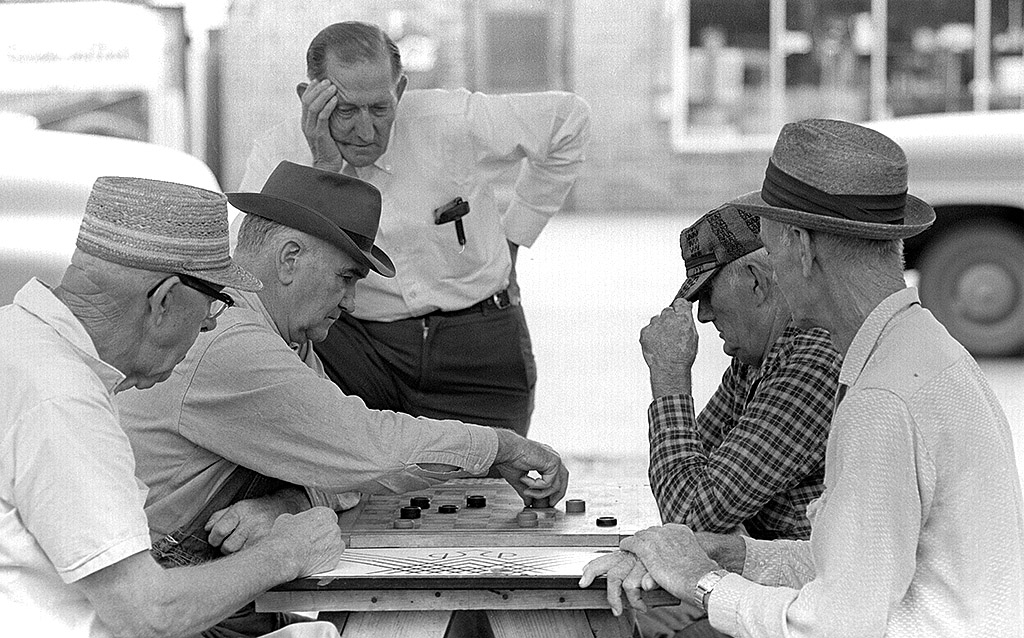 We all know that Mr. Mill is a master of checkers, building, collecting and hum drum observations on the daily vicissitudes of life. I have been playing checkers to improve my humdrum activities in life which requires binary thinking like checkers in so many situations. I frequently use that thinking in @vicniederhoffer on twitter to predict the market. Recently I talked of all the games that have a man down but winning with a good foundation like the last week after Mon.
I would now request a favor which I don't ordinarily do. I used to be a benevolent man who had a uplifting effect on all who came into contact. But now I am just an ordinary man. (See My Fair Lady). The favor is this. Would Mr. Millhone kindly send my recent tweets about his sagacity to the ACF people. And ask them to favor me with a game from time to time even though they are much better than me. This will improve me and keep my stroke from deteriorating at an appreciated rate. Thanks.
7 Occasions of Yield Curve Inversion, from Victor Niederhoffer
 The ridiculous nature of the 7 occasions of yield curve inversion would be clear by reading David Hand's book The Improbability Principle.
Much more relevant is the level of interest rates with the short term rates declining not rising.
Also would Dr. Brett kindly reprieve the gist of his prize winning contest entry about the wild dancing in Ibiza.
.
$1000 Reward, from Victor Niederhoffer
Would someone perform either of these 2 tests:
-
The tendency for devastating moves in one direction to be required by mirror image moves in the opposite direction. I am offering a $1000 reward to this.
-
The tendency for S&P moves to be highly positively correlated with yearly home run totals.
Comments
Barry on August 22, 2019 11:23 am
Can we get some clarity on: “The tendency for devastating moves in one direction to be required by mirror image moves in the opposite direction.”?
Are you referring to testing if moves larger than the normal range in one direction to lead to moves of outside the normal range in the opposite direction? Which markets?
Stefan on September 25, 2019 11:09 am
I did two tests: (a) volatility clustering with a price drift reversal; (b) volatility clustering with a price drift continuation; https://oxfordstrat.com/data/volatility-clustering-1/
China Prospects, from Leo Jia
Watch "Bridgewater's Ray Dalio Discusses the Impact of China's Growth on the World Economy" on YouTube
Watch "Gordon Chang: On Hong Kong Protest, Chinese Economy, Trade War, & Trump's New Tariffs" on YouTube
Very distinct views. What is yours? Btw, any news on Jim Chanos' latest China results? Seems like he backed out his short earlier?
Stefan Jovanovich writes:
When Cantillon shorted "France" - i.e. John Law's system, he went to the Bourse in Amsterdam and bought gold with a promise to deliver assignats. The difficulty with shorting "China" is who are your buyers? Cantillon's counter-parties were not AIG fools; they needed Law's paper to pay their French taxes, which could only be done with Law's paper legal tender. But who outside the jurisdiction of the PRC has a need for the delivery of Yuan?
Mr. Chanos' shorts, to the extent he disclosed them publicly, were derivative bets against exporters to China that did not touch the currency at all. Kyle Bass' hints at his short position, which he has closed, involved the exchange between renminbi and the Hong Kong dollar. A question for the List: where, in fact, can a sizable bet be made right now that shorts Chinese legal tender? A bet against the dollar in BitCoin can be laid on in volume but not Yuan. The price CNBC puts on its screens is no more a market quote than the exchange rate for Venezuela's money. Or, have I answered my question already. A purchase of BitCoins in China with the domestic currency would seem to be, for now, as good as selling assignats for future delivery in Holland in 1719.
Peter Ringel writes:
Hi Leo, I don't see necessarily a contradiction between the two.
Dalio seems to highlight opportunities in the Chinese private sector. Chang points to the many issues and question marks, that arise from the behavior of the Chinese government.
Anecdotally, I only hear of foreigners exiting China's "physical" sector. I don't know what foreigners are doing in the financial sector in China.
Isn't Dalio concerned about the rule of law? Will he get his money out at some point? I believe Dalio talks a bit to his book and to ears in China. His historical analysis of past global powers, which was also posted on his blog a little back, is aimed in this direction. I do see contradictions mid and long term. With all due respect to China's culture and idiosyncrasies, how can an economic power house and a police state coexist? (Mainly corruption will rip any economy apart).
What do you think the prospects are (in case as an analogy)? The ear on the ground is always the best source.
anonymous writes:
Hi Peter,
I have been quite negative since a few years ago, and so started long term traveling outside the country since 2015.
I feel quite the same that Dalio was talking to his book and the top ears in the country, and suspect that might be a precondition for him to take his money out now.
His data presentation looks convincing, but it seems dated without considering the country's abrupt shift to the far left in these few years. One may argue that he is looking at a trend on a century level and a few years time can thus be well neglected. Well, people in the West really lacks the experience of what "far left" means. That alone, not to mention about other big issues in the country, will cause a deep and likely long hiccup in the near term, which might well expire everything imagined for the long term.
Larry Williams writes:
LTTIU
Never forget: the Long Term Trend Is Up…do not fear the future. Fear does not create death. Fear limits life.
Anomalies, from Jim Sogi
 I follow the weather and was reading about climate predictions. They look at anomalies and extreme conditions. We are having record heat temps around the globe this summer, in Alaska, Hawaii, Europe and the East Coast.
Anomalies in the stock market should be indicative as well. An anomaly might be any reading that is 3 or 4 or more sigmas away from normal. I think that is about the 95 percent level. Things like 100 point moves or as Rocky counts it, 3 percent moves, low vol lasting three time usual length, or volume spikes, or maybe order size spikes, or speed of change spikes, a 9% drop in 5 days, or things like that. I read you can get 300 depth levels now, but that's another topic.
Jiu Jitsu, from Jim Sogi
 I've been watching a little UFC fighting by Royce Gracie, of the Brazilian Jiu Jitsu school. It's a grappling form which include strikes. It's used in street fighting as well as in the cage. The main part is defensive. They grapple the opponent to the ground and wrap their legs or arms around the opponent's arms and neck to immobilize them, and prevent the opponent from defeating them, or striking them. When there is an opening due to a mistake by the opponent, then they go for a strangle or arm lock using leverage.
I couldn't help but think of the parallels to trading. In the long run, a defensive strategy is a must, and when there is an opening attack using leverage. Gracie says if you cannot be defeated, then you can win.
Another aspect was time. Rather than engage in exhaustive combat, striking, dancing around, the jiu jitsu guys would get the opponent where they could not hurt them, and not expend a lot of energy. They didn't even have to see where the opponent was. Time would go by in a match where virtually nothing was happening.
Time and and leverage are interrelated. Rather than use leverage, time can compound gains as well as or better than leverage. That's why patience is rewarded. But I can't wait to develop it.
Peter Pinkhasov writes:
What's true in almost all martial arts is that the techniques should be used as a means of last resort in any real combat situation. If you are always fighting exhibition matches in the same weight class, once confronted with a dangerous situation with new variables, vol, aggressors et al one might end up in the care of Rocky.
Mr. Isomorphisms writes:
David Mamet wrote an homage to BJJ (apparently he rolls with Ed O'Neill?!) called Red Belt. The hero is an honourable but poor dojo owner who refuses to fight in the ring under fake rules.
Roice Gracie beat significantly larger opponents in the original Ultimate Fighting league, so I think it's pretty clear that for 1-on-1, no friends helping, no weapons, BJJ is the most effective. A former employee who was in very good shape and knew some BJJ was assaulted in San Francisco and needed to cancel his flight and get hospital time. (He was also robbed.) The assailant had a gun (which he used to pistol-whip, not shoot, thankfully), my employee was walking home from a bar, the assailant attacked first, and he was angry.
The Pervasive Fear, from Steve Ellison
 From Dan Rather:
"I can feel it. The exhaustion. The dread. The disbelief. The existential fear of what might come next, of wrongs that will likely never be righted…."
.
.
.
Once Upon a Time in Hollywood, from Alston Mabry
"Actor Bryan Cranston Reveals His Creepy Encounter with Charles Manson"
Extreme Events, from Zubin Al Genubi
We had extreme ranges and drops this week. A couple thoughts… Chair and Rocky argued about percent vs absolute points. Since each point is always $50, points matter most to the wallet. As the absolute value goes up, absolute ranges rise as well.
Questions arise about extreme events: clustering, duration, time between, distributions of returns. Pareto distributions are a key idea according to the book.
Peter Ringel writes:
From a base of extremely less experience: I think in points. It is more intuitive. The market seems to move in chunks of points. E.g. NQ seems to like 30pts.
Current Learning Science, from Alston Mabry
 I happen to be working in this area the last few years, and I am sold on the insights from current learning science.
Very useful and practical.
This book is an excellent summary by some of the leading researchers:
"Make it Stick: The Science of Successful Learning"
Leo Jia writes:
Spaced repetition of concepts from both directions are the most efficient way to me for learning new things.
I wonder what more he offers with a full book.
Shaun Tomson’s Life Lessons, from Jeff Watson
 Shaun Tomson is a South African surfer who was the 1977 surfing world champion. Tomson absolutely ripped at Pipeline, giving Gerry Lopez and Rory Russell a run for their money. He is a very quiet, humble man who would charge the biggest, gnarliest waves and make it look easy. He helped make professional surfing a reality, whether that's a good thing or a bad thing is an exercise to the reader. Tomson assembled a code of collective wisdom to help surfers make it through the humdrum of life.
I will never turn my back on the ocean
I will paddle around the impact zone
I will take the drop with commitment
I will never fight a rip tide
I will watch out for other surfers
There will always be another wave
I will always ride into shore
I will honor the sport of kings
I will pass along my stroke
I will catch a wave every day
All surfers are connected by one ocean
Every one of Shaun's gems has a corollary that can be applied to speculators, or life in general.
Petroleum vs Renewables, from George DeVaux
“The Threat That Will Send Oil Down to $10″:
“We conclude that the economics of oil for gasoline and diesel vehicles versus wind- and solar-powered EVs are now in relentless and irreversible decline, with far-reaching implications for both policymakers and the oil majors,” Mark Lewis, the global head of sustainability research at BNP Paribas Asset Management.”
Patience and Leverage, from Jim Sogi
I've learned a lot from the DailySpec. Larry's advice that the market rewards patience is good. Ralph's formula for leverage is good. I realize they go hand in hand (their advice). It's hard to have patience when over levered.
Larry Williams writes:
Leverage is pressure. There is enough of that in this business as is. Why compound it?
Ralph Vince writes:
This is life and death, and I have NO interest in comfort.
Steve Ellison writes:
When the game is to shake out the weak, a game plan of being strong, which would preclude excessive leverage, just might work.
I thought the Chair summarized it perfectly in a tweet on Monday:
A typical fri-mon almost identical to the feb 2018 decline with down another 1.5% on Mon nite 1100 pm est and then ready to resume its inevitable bullish climb on tues. anything to force the weak to give their chips to the strong.
Peter Ringel writes:
This is a wonderful tendency. Worked like a charm.
Comments
Andre on August 8, 2019 3:22 pm
I think the main reason I have lost at trading is because of being consumed by doing, not understanding the players in the market, ever changing cycle, and not being strong. Even knowing this isn’t enough to ensure victory as the market like to lull you into doing the wrong thing anyways.
Nobody Asked Me But, from Victor Niederhoffer
 1. The bookstores in major universities are bereft of books. At a recent visit to Duke book store in August I found just 1 test book for sale.
2. The American Tobacco Company has numerous buildings, warehouses, and apartments in Durham. At their entrance is a beautiful garden with the prominent sign: "no smoking". The downtown areas of big cities like Pittsburgh, Durham, and Buffalo featured expansive granite and stone office buildings in the 1920s. Every one of them is being torn down or renovated for startups and condos.
3. The drift in the S&P, i.e its expected rise is significantly better than 10% a year during periods when they are in a declining qualitative rate excursion like they are in early August, 2019.
4. The systems and wise maneuvers for making money in sports betting are much more sophisticated, clever, and better researched than those in markets. And the 5% vig in sports betting is much less than the vig in futures markets now that they are dominated by high frequency trading.
5. The key to success in trading is to not get in over your head and the best way to do this is to have a good credit line to draw on when the top feeders in the markets try to devour the bottom feeders by forcing them out of positions through exacerbated and temporary moves which the bigs are able to withstand.
6. The stock market tends to go up inordinately in times when the home runs in baseball are higher than average for a season and after a down previous year.
7. The main reason that stocks go up more than bonds is the higher return on capital than companies show growth. The differential after a reasonable period of years becomes considerable because of compounding. This is the main reason that the Fed Model shows sensational returns.
8. A trader should always prepare at least 1//2 hour in advance of his first trade of the day and never rush into a trade without preparation.
9. The main reason that NY basketball has been so bad is because of the higher service rates there and the pall left on the team by Ewing.
10. The fallacy of thinking that the odds of a rise or fall change after a long run is no fallacy. The principle of ever changing cycles makes the odds shift in to a reversal.
11. A good book on evolution and ecology is a great way to provide a foundation for market people.
Our Past and Our Future, from George DeVaux
The Cornucopian history of the last two hundred years will continue into the future.
"Impending Defeat for the Four Horseman of the Apocalypse"
Stefan Jovanovich writes:
With friends like Mr. Bailey the odds of a decent future for our species already has enough reasoned enemies. Who else could write this - "(M)an-made climate change arising largely from increasing atmospheric concentrations of carbon dioxide released from the burning of fossil fuels could become a significant problem for humanity during this century." - yet fail, in an article about the to mention either nuclear weapons or pandemics? We should all pray that crowds in their wisdom remain as sceptical as possible. When the future gets so bright you have to wear shades, someone has just delivered a bomb.
Grains, from Jeff Watson
What has given me pause with this China kerfuffle is the behavior of the grain markets. Seriously, I thought all the grains would have locked limit down today, but nothing like that happened. Very odd situation, and I need to get back to the drawing board. Haven't ever seen this one pulled out of Ceres' bag of tricks. I'm seeing a lot of new things these days.
When the Continuum Becomes a Circle, from Kim Zussman
 Putative freedom marketed using socialist demands and blackmail: "Attention YouTube: The Clock is ticking!"
Peter Ringel writes:
Oh god, that is painful!
You are describing it correctly.
I wonder how many in Germany will detect this sneak attack.
If he wouldn't be so imprisoned in his thought models of "job-security" and slave–employee vs greedy employer, he would realize that youtube content creators are little entrepreneurs and not worker-bees, that need rescue by a union.
I give them points for timing. The current wave of biased PC-censorship by youtube, twitter and Co gives them an opening.
Stalinism vs Trotskyism? (sorry getting hyperbolic)
The proposed solution: Lets throw another 1000 regulations on top of it to create "fairness".
The German mainstream media and public debate is full of nonsense of this nature.
I try to ignore it.
Otherwise I will get a heart attack. I simply feel too threatened by this nonsense.
Peter St. Andre writes:
Hallo Peter,
Good idea to ignore the nonsense! I went on a low-information diet 5-6 years ago and I've been much happier ever since:
Peter Ringel replies:
Hi Peter, You are right of course. I read a little in your journal before, especially your etymological analysis of the "-Isms". Great insights! Getting emotional about Germany/Europe is a bit of a tradition, that is hart to shake:
"Denk' ich an Deutschland in der Nacht,
Dann bin ich um den Schlaf gebracht,…"
Heinrich Heine (English Translation)
(Heine escaped to France, I escape to America.)
Funeral Tyre and a Full Moon, from Bo Keely
 The question on Slabber lips after the smoke clears over daily events is, 'What happened to the body?'
In my case, an explanation is possible if you read about 'Prom Night 2019' where a man in a dress marched into my newlywed neighbor's camp, fired two shots, and the next morning there was one less neighbor, down to three. They could not call the cops having cursed and mooned them the previous night.
So, where is the body?
The following mourning the remaining neighbors built an extraordinary barricade across the entrance to my driveway. It was 30' wide, 4' high, and tiered with a layer of tires on rims across the bottom, a thick seam of their belongings including books, clothes and rubbish, and topped by a tucked-in tarp.
I let them build it out of fascination, as the camp bride broke for the Slab Trade Circle to sell the rest of their possessions for gas money, in anticipation…
A gray Ford Explorer drove up, and the silver Elder through the window told the remaining two, 'Get out!' and drove off. The pair tarried to put the finishing touches on the creation.
I arrived an hour later in a Slab Cab that nosed to the blockade. The Kentucky driver rolled down the window to demand, 'This man hired Slab Cab to take him home, and by god, Clear the drive!' The two males lobbed glass bottles into the air above the van breaking and raining hundreds of shards on the roof that wafted in the windows and made the cab smell like whiskey. The neighbor groom dropped his pants, mooned the Kentuckian, who, drunk in the vapor, pulled a pellet gun the size of a .45. The guy saw it between his legs and scampered with his pants around his ankles behind a bush.
We force drove around the barrier to my container and called 911. 'Yes, I recognize your voice,' droned the dispatcher. After an update, she replied, 'The same three deputies who were mooned there last Prom night are on the way.'
We pulled out to the Library and were intercepted on a hypotenuse by the two jogging men, one with a video camera, and the mooner who stepped in front of the van, dropped his pants again, and hissed, 'F___ me, like in Kentucky.' On not getting what he wanted, he rose and smashed the heel of his hand on the passenger mirror breaking it, as the camera rolled.
We shrugged, stepped out, and I stalked the cameraman, as my driver raised a sawed-off shovel handle to the mooner's head. They back-pedaled to an Ironwood and stood their ground. I still couldn't grab the camera as the holder interviewed us with entrapment questions. Instead, I latched the driver's great bicep to prevent the downswing of his old barroom bouncer move of hitting him on the head and stabbing him with the club as he fell. I dragged him foot by foot back to the Slab Cab, explaining to the camera, 'He wants to collect SSI for the rest of his life and moon you in prison.'
We drove a minute to the Library to wait for the police. Suddenly, the Kentuckian sniffed the air, glanced over his shoulder and yelled, 'I declare. The sky over your camp is full of black smoke.'
I redialed 911 but before I could open my mouth the dispatcher burst, 'Yes, it's been called in. the firetrucks are right behind the sheriffs!'
I walked and arrived as the firemen watered the dying embers. The chief told me, 'This was a planned hot fire. The bottom tier of tires ensured a high temperature. Is there anything else you want to tell me?'
'Nope,' I replied, walking twenty yards to my ash and glass coated camp. I had just completed a fire science class: A normal fire reaches about 1300F; a human body reduces to ashes at 1700F; and tire rims raise the temperature to 2400F.
The next morning, I sifted the ashes for two bullet heads and can't report that I found them. The black scar remains across the drive that visitors call a funeral tyre and toss on change. The newlyweds fled to Arizona where they broadcast Youtube live handcuffed in the holding tank of a jail in a fundraiser for bail.
The rest of the story is up in smoke.
Changes in Qualitative Rates, from Victor Niederhoffer
I once did a study of changes in direction, i.e the discount rate. I found that the average duration of such changes in direction was 10 years and 4 changes. It would be nice if someone updated that study. The deceptive call of "once is enough" is good for ageist people of humans but is ridiculous when compared to the record I think. But the Fed model becomes even more bullish as worked on by Doc, Mr. Downing and me and it would be nice to update that. In 2008 the bank earnings brought the actual earnings for the year down but it would be good to work with projections or directions of change in the quarterly earnings to make the study completely scientific.
Anniversary: the French Choose the Wrong Tribe, from Stefan Jovanovich
 Today [July 30th] in 1609 Champlain introduced gun powdered weapons to New England by helping the Hurons attack the Iroquois.
The result was what the folks at StrategyPage rightly describe as the final phase of the largest of the original aboriginal wars in North America. For at least a hundred years before Europeans sailed up the St. Lawrence, the two nations had contested for control of Western New York. The pressure from the Huron in Ontario had helped form the Iroquois Confederacy among the Seneca, Onondaga, Mohawk, Cayuga, and Oneida.
"By 1627, the Huron, with French support and guns, had effectively driven the Iroquois out of the Valley of the St. Lawrence…The Iroquois sought support from the Dutch, then just settling in the Hudson Valley, and later the English, who seized New York from the Dutch in 1664. Termed by one historian "the only people north of the Rio Grande who consistently practiced every principle of war at all times," in 1648 the Iroquois, who could field some 16,000 warriors, began a devastating series of campaigns that in a generation saw them harry their foes relentlessly from New York across the Great Lakes and into Canada, until the Huron and anyone who offered them aid had been effectively exterminated."
George Zachar writes:
Upstate New York has such an interesting history. I'm always saddened when I go up there now, and see its current status as a suppressed backwater.
Stefan Jovanovich writes:
"Suppressed backwater" is, alas, a perfect description.
Peter St. Andre writes:
One wonders how upstate NY would do on its own.
The Mutual Fund Industry by Jack Bogle, from Mr. Theodosis
 "The Mutual Fund Industry in 2003: Back to the Future", remarks by John C. Bogle, founder and former chairman of The Vanguard Group
We are all familiar with the impressive equity returns over the last century but I haven't seen any estimates for historical management fees for index funds. (Obviously not as important the last 50 years with dedicated index funds). I came across this article by Bogle that says the first mutual fund, Massachusetts investment trust 'MIT' back in 1924 had 3.2% management fee per annum. By 1950 the fee had gone down to .3% before going up again and today is sitting at the same spot - 33bps.
Senior Games, from Larry Williams
 Just back from the Montana Big Sky State Games, my events were 60, 100, 200, 400 meters and High jump. Took last place in every event, and also first, as I was the only geezer to show up in the 75-80 year old group.
Usually there are 3-4 of us… over all attendance was way down–as it has been for the Rock n Roll Marathons we started a few years back as well. Dittos for Tri-athlons too. Sportsters these days are looking for something else…maybe Pickle ball?… the events that used to draw 20,000 or so marathoners are way down.
We are perplexed as to why.
Pickleball, from Victor Niederhoffer
 Pickleball. The game is growing. I saw about 1000 players on 40 indoor courts at the Johnson convention center in Pittsburgh. The play is fair with the received rushing the net on all serves and the average duration of a volley is about two hits as the passing shots are very fragile. The game is growing like racketball in its early days and is much easier than tennis or platform tennis.
Looking for Mama Jean in Slab City, from Bo Keelu
 Mama Jean is or was the most popular Elder in the Slabs, depending on your detective work in the following footwork.
Ten days ago, Mama Jean disappeared in the Slab Walmart 500 yards south of my shipping container. I spoke with my neighbor who knows her better than anyone, and he took me on foot to her vehicle in the middle of nowhere. That it, the gifted '97 silver Buick was high-centered, mired to the hubs in sugar sand, and tilted at 20-degrees to the horizon with all four doors flung open. There was a half-pound of weed and her debit card on the front seat, but no keys. Clothes strewn all over and nothing in the trunk. The previous morning, her dog, who never left Mama's side, had turned up at my neighbor's bed licking his feet, and we couldn't trace his paw prints back to the car.
The neighbor took me by the elbow to a poleline track 100 yards from the Buick and, pointing down, instructed, 'These are definitely Mama Jean's waffle shoes. That is definitely the staff she dragged behind her for snakes. I'm not sure if Mama was wearing the shoes and dragging the staff because she couldn't walk 50' without falling over.'
However, seniors are resolute in the face of death, in the 115F desert, and I followed the sign along the poleline northwest for ½-mile to the sandy Walmart wash where it enters and drops due west. The distinct staff and wind-faded prints hugged the north edge of the wash for 1.5 miles to a cut-off track that climbs up to Salvation Mountain and with it the stick drag. Her footstep was firm and bobbing around bushes indicated it was nighttime, about 80F, under a full moon. She walked toward Salvation Mountain for 100 yards, got her bearings, and laid a distinct ten-foot loop as if wishing to be trailed back into the wash and continued west.
In one mile more, the tracks led to the edge of the High Canal about ¼-mile south of Beal Road. There is a cut step in the bank for entry, and no body in the weeds. The preceding is fact, and this is theory – she had arrived exhausted and thirsty, bend on all fours like an animal, drank, bathed to cool off, slept on the bank, and the next morning caught a ride with a good Samaritan.
Where was Mama Jean? The neighbor and I during the next two days contacted everyone she knew, and called all the jails and hospitals. Her floundered car was being tampered with, so we hooked a tow rope and jerked it out like a rubber band. We towed her abandoned trailer on Low Road that people were trying to steal in the wee hours to a safe spot. An ex-military Slabber volunteered to send up his 30-foot drone four days ago, but was pre-empted on asking permission by two police drones already buzzing Slab Walmart. Calls to the cops reporting a missing person were repetitive. A deputy came looking for me but I ducked because 90% of them are incompetent, 50% corrupt, and all green and muck up tracks.
Today, July 28th the case should be solved. Mama's social security deposit is made. Many Slabbers know her password and that she may carry a duplicate card. Within hours, she or her abductor will make a withdrawal. Do you think it will be Mama or an assailant? If the latter, the camera will catch a person in disguise, no doubt, and red flag the police. Or, it will be Mama Jean smiling toothlessly.
Update noon, July 28, one hour ago. The white morgue truck just stopped by with Mama Jean. Coroner Figurero wouldn't let me look at her, said she was too decomposed. However, he updated me. Two slabbers at 8am this morning, who never take walks in Walmart wash and never enter Ella's junkyard 200 yards west of my shipping container, claimed to have smelled Mama Jean's body. They followed the odor past the caretaker's vicious dogs to a VW van on blocks where they found the body. Then one of them ran one mile to the Oasis Café where a dozen patrons were admiring a commemorative photo of Mama Jean on the wall. The runner panted the news, and called 911. Tears spilled. The sheriff sped past my place to the junkyard but could not get past the dogs to the body. Out came animal control. They ran the gauntlet, or shot the dogs, and retrieved Mama's body. They stopped by my place for my version having tracked her, or someone wearing her shoes and dragging her staff three miles to the High Canal. I told the investigator that I believed my version, and suggested it might be an extravagant setup to get the caretaker out the junkyard to pillage the seventy vintage vehicles used in Hollywood movie sets out here. 'It's a theory,' I told him. The Coroner shrugged, and said, 'Please call us sooner next time,' and drove off.
Comments
Pete M on July 30, 2019 4:37 am
Sad story Bo, RIP Mama Jean.
I Have Come to the Conclusion, from Mr. Theodosis
I have come to the conclusion that the only enemy of the wonderful long term equity (and bond) premium is inflation. Triumph trio also mentions it in their book; in fact the countries with the highest inflation shocks had lowest real returns and the ones with hyperinflation had obviously a break in data. Also many of the countries that don't have good historical data and weren't included they suffered higher inflation.
Inflation is not just a number you subtract from nominal returns but summarizes many forces like monetary and fiscal policies, people's trust in currency and policies etc. It contains valuable information. Countries whose currencies are undervalued in real terms have had the best forward returns. Very robust throughout history.
I am working on building a similar dataset for Greece for the last 30-40 yrs and one of the things that strikes out is that the 1970-1980 inflation killed real returns to an extend that they haven't recovered yet. Interestingly, the recent events with fears of country defaulting proved to be nothing both for stocks and bonds and both have made new highs.
Capitalism is Not so Bad, from Peter Ringel
One important thought is that capitalism produces a better citizen (the base for democracy).
In capitalism every entrepreneur is a little king of his house and business.
It creates healthy individual self-confidence. This creates a healthy society.
In contrast, in socialism we find little personal self-confidence.
There self-confidence is replaced by something/a cause to make the little peasant not feel too bad about himself and his fate.
This is the road to Nazism, communism or religious fanaticism.
Bird in Hand, from Victor Niederhoffer
 A fabulous testament to the entrepreneurial spirit was visited by Aubrey and Susan and me during our trip to Pittsburgh. The complex was started by the Smuckers in 1911 as a farm producing swiss cheese where the Smuckers emigrated from Switzerland. It has since grown to a smorgasbord with an average of 500 diners a day, a magic show, a hotel, a bakery and an entertainment complex featuring mini golf and the history of the Amish and the Mennonites. It is worth a visit as all the operations grew out of hard work and ingenious reactions to the changing times. They were hit hard by 9-11 and the recession of 2008 but each time bounced back with new highs in revenues and profits.
Anniversary. Mine, from Stefan Jovanovich
 Mine. 46 years ago. The best, by far, of all my many efforts at being Melville's Confidence Man. "A Mute Goes Aboard a Boat on the Mississippi"
When I arrived in Berkeley in 1972 to go to law school with a duffel bag and nothing else and met the only woman in the world I have ever wanted to marry, she asked me if I was a Polish seaman off one of the break-bulk freighters that still occasionally docked at the Port of Oakland. (All gone now; only containerships.) Thinking about that reminded me of Melville's extraordinary work–which is nearly impossible to read now but remains the best single description of what this country has been and is. It was also the catalyst for the careers of my two favorite Americans - Ulysses Grant and Samuel Clemens.
I have successfully run the happiest of long cons on Susan and then our daughter and now her husband and infant son. With luck and the help of Almighty Providence I may last beyond these 74 years long enough to teach Whumpa how to drive stick.
Acoustic Camouflage Fur, from Jeff Watson
Moths use acoustic camouflage to ward off predation from bats. This article complements some of the ideas the Chair has brought up over the years regarding different types of camouflage: “Moths survive bat predation through acoustic camouflage fur”
Worst Dog Attack in Slab City History, from Bo Keely
 They came out at sunset with no time to prepare. Four dogs circled taking turns taking chunks out of my legs. It was unprovoked in the middle of a road–black, white, yellow, and brindle–in a whirl. The result was six punctures, two fang rakes, and a 6" incision to the bone with a pulsing artery exposed. I tore a tank top to slap on a compression bandage and left a trail of blood for a mile door-to-door for materials. Got duct tape, needle-and-thread, superglue, and ampicillin. An army ex-medic offered Bacardi Rum into the deep wound plus a couple down the hatch before sutures. I don't drink. So, we pound with a spoon ampicillin into powder and sprinkled it into the wound. Three butterfly bandages of duct tape and a few drops of superglue apposed the skin sides.
The next morning I went to Pioneer Hospital where the doc said it was 'the worst dog bite in Slab history.' Surgery took two hours as I watched eight sutures go in and out with curiosity. The nurse yelled at me for 'not crying like a grown man' and it was over before I knew it. It was the seventh attack in five months. People ask why I get bitten so often. I reply that people who drive farther have more accidents. They are probably better drivers. That's me without the tires. Today, three days after the attack, the wounds are healing beautifully. I walked in 115F an hour to the Slab sand golf course and borrowed a 7-iron for protection. A medical problem is a gift to me, and this one was like Christmas.
Comments
Pete M on July 28, 2019 5:15 pm
Sorry to hear about the attack Bo. Get better soon
Robert M on October 9, 2021 11:37 pm
These Speculations are a fascinating read and I love the photos. Well done.
The Constructal Number, from Victor Niederhoffer

 The 3000 level exerts its gravitational constructal pull and like a tree the roots hold it in place and provide for the nutrients and water that the price needs for sustenance until further growth occurs.
Still More Etymology About Money, from Stefan Jovanovich
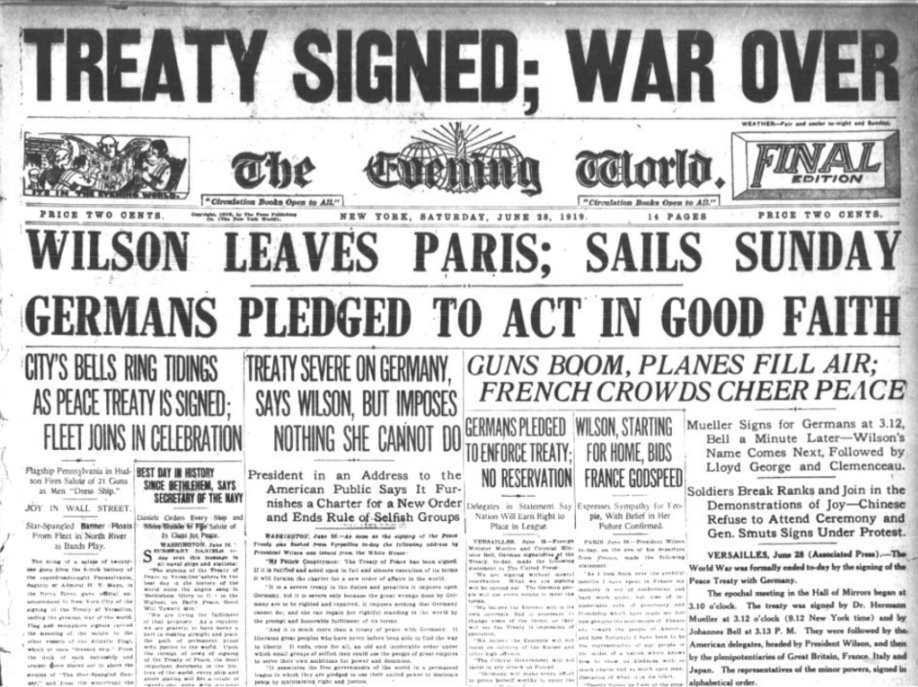 We left off Sunday with a speculation about whether or not the Chinese would find collecting the rewards from their contractor imperialism as frustrating as the European nations did. But, as a long-suffering Mets fan reminded me after his team went down in extra innings against the Giants for the 3rd time in 4 days, shouldn't the question be whether military might can ever be sustained without the profits from foreign lending and direct investment?
It is worth considering.
In spite of the truly awful carnage of the Great War, none of the European imperial powers questioned the profitability of imperialism itself. The Versailles Treaty "failed" not because of German reparations but because half of the winners were excluded from what they considered their fair share of the spoils. Of the 6 Allied nations who fought against the German, Austrian and Ottoman Empires, 3 received no substantial rewards from the redrawing of the world's map in the name of ending all war: Italy, Japan and Russia. Their various responses to having been "badly cheated" are the preconditions without which no Second World War could have occurred. Whether empire was ever, in fact, going to be profitable for Italy, Japan, Russia or Germany is the perfect kind of question for academic debate. It ignores the central fact: no country after 1918 thought its currency could resume being freely exchanged in international trade and finance without having the rewards that came from imperial commerce.
I doubt very much that Donald Trump knows this history; yet he seems to have hit upon the policy that the British Empire used before World War I with great success. Even before his election, Donald Trump was asking why American imperialism had failed to achieve similar success. Since taking office, his one consistent foreign policy has been to have America's "allies" place more defense orders with U.S. manufacturers. In the industries that it chose to support - civilian and military shipbuilding, shipping and the finance that went with it - Britain was #1 for much more than a century. As late as 1914 a third of all world trade was carried on British ships, built in British yards and insured by Lloyds. Britain's naval construction program was an essential component of that system; it was, along with railroad construction, the base for British industry. For Britain the achievements of "free trade" were, in fact, the rewards of military dominance; and the "strength" (sic) of the pound sterling was Britain's ability to collect, by fair means and foul.
Psychological Effects of Currency Exchange Rates, from Leo Jia
 Say something costs you 100 units of your currency in your residence country. Now you travel to the following countries where the cost of the same thing is listed in the local currency.
In country A, it costs 3 unit;
In country B, 20 unit;
In country C, 600 unit;
In country D, 10000 unit
Say that you know the costs are mainly caused by the exchange rates.
In which country would you, perhaps subconsciously, have more tendencies to buy the thing, and in which country would you have more hesitations to buy it?
In my travels in the past years, I sensed that I am in some way affected subconsciously by these numbers. The effect doesn't seem quite linearly related to the cost numbers. For instance, when it's 3 unit, I might want to buy more because it feels so cheap. When it's 20 unit, I may feel that it's too expensive given a good knowledge of the exchange rate in mind. And when it's 600 unit, it feels expensive because the number seems really big. But when it's 10000 unit, it may feel cheap given the knowledge that the currency is very cheap.
Zubin Al Genubi writes:
I'm in New Zealand and the nzd/usd is .67. My thinking is that everything is 1/3 off so I spend like Everything is on sale. Many things are cheaper but most things aren't. So its a delusion. Services, hotels, food is cheaper absolutely but imported products are not. Tipping is limited so restaurants are cheaper.
Contagion, from Zubin Al Genubi
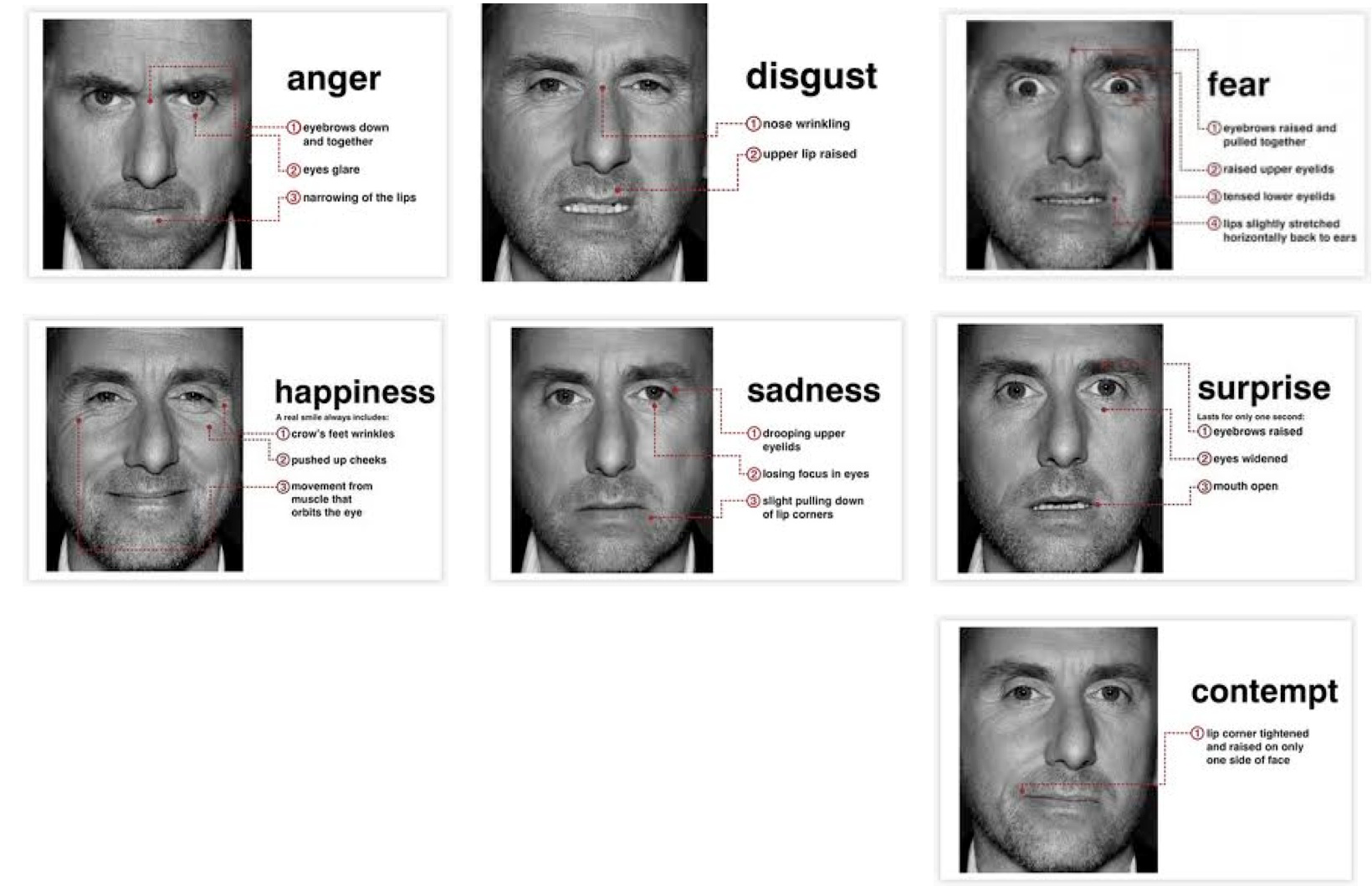 "How Micro Expressions Can Make Moods Contagious"
I wonder what micro tells in the market predict bullishness or bearishness.
Steve Ellison writes:
One-sided order flow, or toxic order flow as market makers call it, causes contagion as market makers widen spreads and take measures to reduce their inventory.
Word on the Street, from Zubin Al Genubi
Word on the street is that the New York buyers come in and buy up all the prime fish for sushi and the restaurants and put it direct on the plane only a few miles away and fly it to NYC. The local restaurants in Honolulu have a tough time out bidding the better financed competition.
What NYC Heat Wave?? shared by Larry Williams

.
.
.
.
.
.
.
.
.
.
.
.
.
.
Video of the Day, from Zubin Al Genubi
"How Micro-expressions Can Make Moods Contagious"
I wonder what micro tells in the market predict bullishness or bearishness.
More Etymology About Money, from Stefan Jovanovich
 But, first, a reminder of why this is the best time of year if your team still has any chance at the wildcard. After beating two of the best starting pitchers in baseball, deGrom and Thor, the Giants go up against a starting pitcher with an E.R.A. of 11.34. He shuts them down without a run for the first 5 innings and they lose 11-4. As Joaquin Andujar, marvelous player and a great wit, once said: "There is only one word for baseball: 'Anything can happen".
Contrary to the Federal Reserve anime fairy tale (thx, Kim), there has never been only "money". The archaeology of artifacts and accounting records always finds at least two different kinds of cash: (1) the currency that the people with edged weapons (now guns), official uniforms and titles collect from people for tribute, taxes and bribes; (2) the currency that other people with edged weapons (now guns) who can't be bullied will accept as payment
I am a Constitutionalist on this question because Washington, Morris and the majority in Philadelphia never let the common sense of experience be defeated by theory, even one as useful as Adam Smith's. Hence, these provisions in Article I Section 8 for enumerating the powers of Congress: To coin Money, regulate the Value thereof, and of foreign Coin, and fix the Standard of Weights and Measures; To provide for the Punishment of counterfeiting the Securities and current Coin of the United States; For the Constitution's authors and the people who voted to ratify its words as Supreme Law, the labels for these two kinds of money were (1) legal tender and (2) free exchange. Coin, both American and foreign, could serve as either or both monies. But, evidence of debt and property ownership in whatever form would be Securities. When Washington warned his countrymen about foreign entanglements, he was talking about money as much as war. Grant said the same thing 3 generations later, when he advised China and Japan, "to avoid foreign debt and the ruin of war that always comes with it". Both men knew, from direct experience, how empire was always and everywhere a corruption. They also knew how it got started. Countries that found a technological advantage - in arms, transport, manufacture and/or agriculture - would quickly accumulate international exchange. Those accumulations would get spent - on wars and on distributions to the politically important, which could include "the people". (Pericles will always survive as a hero of Athens, in spite of his disastrous wars, because the newly-discovered and productive silver mines worked by slaves showered the demos with MMT free money.) The amounts not spent would be "saved". Since "saved" money, whether legal tender or international exchange, could only gain profits beyond arbitrage by being invested, successful empires quickly found themselves lending or directly spending money abroad. That automatically raised the question: what money would be used to reward the investors back home? The easy and obvious answer for imperial investors was to have payments done in a currency that was both legal
Roll, from Zubin Al Genubi
The May trade during the drop showed some interesting anomalies in execution. As the market dropped I decided that I would buy some Sept futures instead of the current June as I didn't know how long I would be stuck in the trade. Normally in a rapidly dropping market you can buy at bid, and that is great until the market drops another 50 or a hundred points through your fill. Some of the drops were some of the biggest. The September contract was still quite thin over a couple weeks before roll, and I was getting filled .5 below last which is pretty unusual now days, but worth noting. Then, I think it was a bit before roll day when the market started really shooting up, so I was letting out some September inventory and was getting filled at or occasionally .5 above last execution. You see that sometimes in fast markets also with crazy air drop fills, but I think that is just the result of delay in the data feed to the computer vs actual fills at the exchange. My impression of this last drop is that it was a fairly orderly drop, just steady drop. Maybe that is the computers doing their controlled selling in their mechanical way.
Roll is an odd period when everyone is forced to roll into the new contract creating an artificial market situation, and added to a rocket up market. I am not exactly sure why conventional roll date is 8 days before expiration, or why that is a convention for trading. It doesn't make sense to me, and my point is that it is a disadvantage to mechanically roll on the same day everyone else does. CME website says to you can roll whenever you want. Seems like waiting till you are forced to make a move when you may not want to make a move limits your options. I'm sure some market makers make money as the salmon come along.
Propagation of Error: Approving Citations to Problematic Research, shared by Alston Mabry
"Propagation of Error: Approving Citations to Problematic Research":
Abstract
Many claims in a scientific article rest on research done by others. But when the claims are based on flawed research, scientific articles potentially spread misinformation. To shed light on how often scientists base their claims on problematic research, we exploit data on cases where problems with research are broadly publicized. Using data from over 3,000 retracted articles and over 74,000 citations to these articles, we find that at least 31.2% of the citations to retracted articles happen a year after they have been retracted. And that 91.4% of the post-retraction citations are approving—note no concern with the cited article. We augment the analysis with data from an article published in Nature Neuroscience highlighting a serious statistical error in articles published in prominent journals. Data suggest that problematic research was approvingly cited more frequently after the problem was publicized. Our results have implications for the design of scholarship discovery systems and scientific practice more generally.
“Cash”, from Stefan Jovanovich
 In the years before electronics, cash meant Federal Reserve notes. The Fed, in deference to the fact that it still needs to order currency to be manufactured by the Treasury, still reports how many of its notes are in the vaults of banks and "issued and outstanding" in the world. But that number no longer has much direct relevance to the question of banking reserves. When the banks report their Liquidity Coverage Ratios, the calculation is "net cash" but that number is composed of the following components:
(1) Unsecured wholesale funding - unsecured debt and institutional deposits
(2) Secured wholesale funding - repurchase agreements and securities lendings
(3) Retail deposits - brokered and transactions deposits, certificates of deposit
(4) Derivatives and commitments
(5) Contingent funding
Currency itself is no part of the "net cash" figure. For those of us in the bleachers enjoying the Giants' return from the dead, the focus on cryptocurrencies is as puzzling as the Dodgers' inability to acquire a bullpen. Why would cash in any form - digital or printed - be the financial problem that requires a brave new technological world for its solution?
anonymous writes:
Strictly speaking, LCR is one of a long list of capital adequacy tests, and not a reflection the optimum amount of physical currency on hand at the branches. In any case, vault cash is now largely comprised of ATM lockboxes spread across a wide geographic area. If an institution needs to depend on vault cash to settle immediate capital calls, pay off depositor withdrawals, to maintain reserves, or to comply with any of the other testing regimes, then they've probably already failed one or more metrics, such as NSFR.
Incidentally, if you're wondering why any institution would purchase negative yielding instruments, the HQLA (high quality liquid assets) component of bank capital adequacy testing is the reason.
another anonymous commenter adds:
Are you evaluating solely the currency utility of cryptocurrencies? The below doesn't seem to touch on a store of value. Also, I'm not clear on where you say e-money if you mean digital dollars or cryptocurrencies.
With regard to interest, you mean other than disintermediation of banks? This seems like a worthy goal in itself. Maybe a bit retro, it is my understanding that some time ago it was common not to trust the banks at all and keep cash at home. As a virile youth, I would not know how much of that is apocryphal. In any event, that option has been largely taken off the table as cash becomes part of a the shame and suspicion culture. Future transactions will stay entirely in bank accounts from deposit to spending.
With that in mind, I'd argue financial privacy is another large driver. As nations move down the path of digitizing their currencies and eliminating physical cash (even though India reversed course for now), the tracking and sharing of every transaction and financial habit becomes more thorough. I've noticed that my Chase Sapphire Preferred card happily shares all of my local transactions with Square and I get emailed offers from local businesses I've never shared information with. In my cryptocurrency fantasies, I would love a future where I could buy a movie ticket online anonymously by just paying with a QR code. Instead I end up logging in or filling out pages of personal information (carefully deselecting all optional email promotions) only to have my information profitably shared behind the scenes.
Additionally there is, of course, the innovation itself. The new concept of distributed digital scarcity hasn't found it's limits. That probably interests only a few of us, but it's enough to keep spurs to the development even in people's spare time.
I'm guessing a bit on your question and the answers and may have missed the mark so I'll stop here. To me there are so many interesting points on the topic, that I don't understand why others aren't equally fascinated.
Article of the Day, from Kim Zussman
"The Rise of the Chinese-American Right"
The Prisoner, from Jeff Watson
All episodes of the excellent TV series The Prisoner are now available on a new site. The show, starring Patrick McGoohan, has many libertarian themes. I recall someone quoting "The Prisoner does to film what Orwell's "1984" did to literature."
Comments
Marion Morrison on August 8, 2019 3:30 pm
I watched the last episode, Episode 17, ‘Fall Out’ last night. I’d seen the entire series years back. ‘Fall Out’ includes the big reveal at the end. I was disappointed — the show felt like ‘James Bond meets Austin Powers.’ I was scratching my head as to why the show is so highly regarded.
Article of the Day, from Victor Niederhoffer
This is a disturbing article: "The Books of College Libraries Are Turning into Wallpaper"
Zubin Al Genubi writes:
I prefer reading Kindle on my phone to a book. I can carry 20 books at a time, and get them on the go. I can read at night, and low light. The print is bigger. I find books hard to read, hard to hold, smelly, heavy, print too small, expensive. I do buy some of Chair's technical book recommendations that are not available in digital format.
There is Something About 1st Week of July Being Up, from Kora Reddy
Since 1980, when fisher effect prone SP 500 index is up in the 1st week of July, the next week returns (fri close to next week fri close)
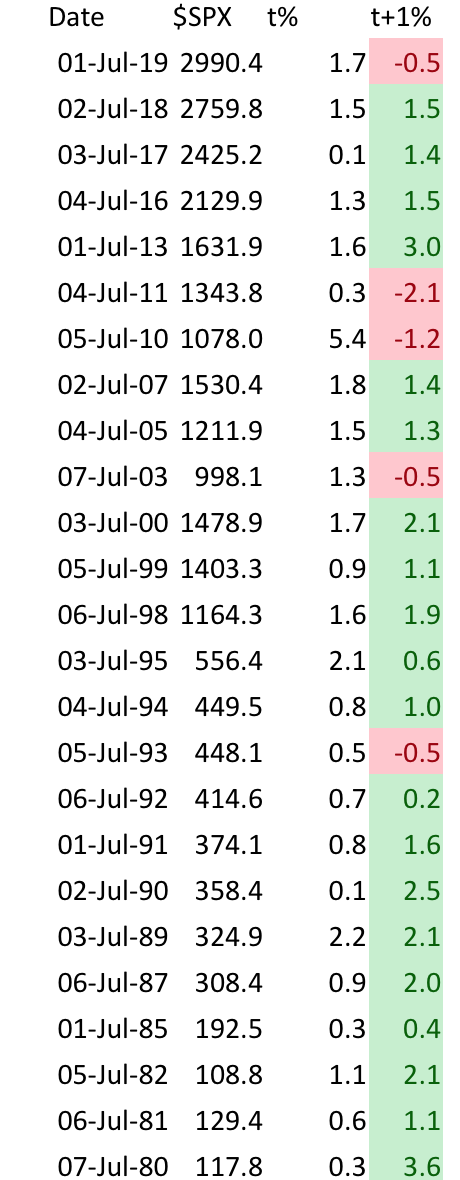 .
.
.
.
.
.
.
.
.
.
.
.
.
.
.
.
.
.
.
.
.
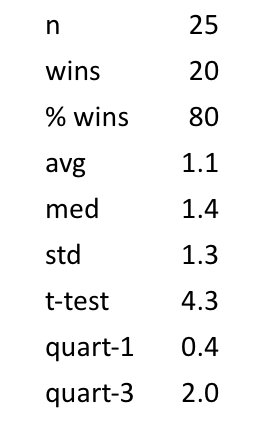 .
.
.
.
.
.
.
.
.
.
.
.
.
.
The Topology of Money and Credit, from Stefan Jovanovich
:max_bytes(150000):strip_icc()/Panic-of-1873-BroadSt-3000-3x2-gty-57253b1e5f9b589e34c30e58.jpg) The NY Fed has produced a marvelous interactive map of U.S. dollar funding.
The NY Fed has produced a marvelous interactive map of U.S. dollar funding.
Zubin Al Genubi writes:
I wondered: Where does credit card money creation fit in M1?
According to an article I read:
"In short, credit cards, debit cards, and smart cards are different ways to move money when a purchase is made. But having more credit cards or debit cards does not change the quantity of money in the economy, any more than having more checks printed increases the amount of money in your checking account"
That doesn't seem right to me. Credit cards are the universal payment method and create much much more liquidity than cash, is easier to spend. Often people buy beyond their ability to pay in one month, so liquidity is being created. And the US economy runs on consumer purchases.
Stefan Jovanovich responds:
ZAG has asked the questions that, in one form or another, American law and banking practice have done their best to avoid answering, ever since the country was founded: where is the boundary between money and credit and what is the definition of the U.S. dollar? The U.S. Code is no help; its only definition of the U.S. dollar is that it is legal tender. "United States coins and currency (including Federal reserve notes and circulating notes of Federal reserve banks and national banks) are legal tender for all debts, public charges, taxes, and dues. Foreign gold or silver coins are not legal tender for debts." 31 U.S.C. 5103. But what "it" is remains wonderfully vague. So, too, do the Treasury's own practices. It does not require payment of legal tender for taxes; you can use your credit card.
There is a good reason for all this seeming confusion. The country needed it in order to get started. When the war veterans met in Philadelphia in 1787, they had to establish a national unit of account that was not a fraud while, at the same time, borrowing enough money to pay the veterans' promised pensions and the government's own expenses. Their solution was an elegant finesse. Money would be defined, by weight and measure, but any Coin, foreign, private or newly-Minted by the U.S. government, would be legal tender currency. The United States would not issue paper money, as the British had; and there would be no national bank. Congress could borrow Money, but there would be no Bank of England that could use its own notes for repayment. Congress would be responsible for defining the unit of account to be used as the yardstick for measuring foreign and domestic currency, but U.S. law would only specie as Money. And, the States of the new United States would be specifically prohibited from doing what they had done during and even before the Revolution - turning their own bills of credit into money. This was so important that the Constitution goes far beyond its usual tact is pronouncing where Federal sovereignty would be supreme. The States would NOT issue bills of credit and would NOT go to war. For the veterans of the Revolutionary War, who had seen what the States had done to the country's money and what Tories had done when they had control of state government, those were the two rights the States would never be allowed to have. It worked. Before Washington left office, the U.S. had a perfect record of borrowing and paying back the money lent by its Dutch bankers.
There was only one problem: people were hot to buy more and more land, and the U.S. and most state governments were insisting on being paid, in money. Clearly, this would not do. The solution was for the States to get into the credit business. By creating banks, they could find their way around the Constitution's prohibition on bills of credit; the banks could issue notes, and those notes could be accepted by the Federal and state Treasuries as payment for Federal and state lands. The arguments over the Second Bank of the United States was not, as Schlesinger says, over "hard" money; it was over whose bank notes would be considered sufficient payment for the land sales. When Jackson decided that only gold coin would be accepted, he was creating the very paradise that Ron Paul wishes for - a country with only 100% gold-backed bank notes and, therefore, very little, if any, private credit.
A correspondent reminds me that the land sales were very much like the Treasury auctions in the good old days of guaranteed spreads. The land was sold to primary dealers at fixed prices per acre; the dealers then resold the property purchased at auction. When and where the auctions would be held became a matter of public record only after they were completed, and the funds paid to members of the House and Senate for what was truly inside information were worthy of the bribes that Vanderbilt and others paid to the New York State legislature. "There is no distinctly native American criminal class except Congress."
Maxims From Ross Perot’s Father, from Kora Reddy
 Maxims from Ross Perot's father who apparently was a cotton trader.
The hit'n'miss ratio was higher than Wiswell's.
.
.
.
.
.
.
.
.
.
.
.
.
.
.
Comments
Murali on July 15, 2019 4:39 am
Hi Kora,
Is there any online link for these axioms? I could not find them.
Thanks for posting,
Murali
Matheus W Cruz on July 17, 2019 9:55 pm
Could you please share more of these? Also tried to find more and couldn’t.
Best,
Matheus
LMS Youtube Channel, from Laurence Glazier
Check out the London Mathematical Society's youtube channel. It has many fascinating lectures.
Pluribus, from Kim Zussman
"Facebook AI Pluribus defeats top poker professionals in 6-player Texas Hold 'em": Pluribus beat five other human players with an unconventional bet-sizing strategy
Ms. Shelton and Mr. Powell Will Get Along Just Fine, from Stefan Jovanovich
 They can take turns looking through the large end of the financial telescope. In his comments yesterday Powell said that the Fed could "stabilize the dollar price of gold" but it might not want to do so. Shelton may disagree about what the Fed should do, but she shares the same delusion that the purpose of the gold standard is have a fixed dollar price for a piece of the metal.
They may have always been a native criminal class, but Congress really did no better. The Currency Acts stated the currency value of a full fine ounce of gold because even in 1791 a dollar's weight and measure would be so small a piece of metal that its coinage would be impractical. But the elected near criminals did not think they were "pricing" gold. They were defining what exactly the weight and measure of the nation's monetary unit of account would be, and they had every confidence that its "price" in wheat, horses and coal would be whatever the markets for those things would be. Bankers could no more set the price of gold than they could choose the length of a mile; bills of credit, bank notes, and U.S. notes were all to be priced by how far their nominal amounts had to be discounted against coin.
The "Gold Room" in the Civil War did not price gold. It stayed at par. The quotations were the prices for how many Greenbacks and other forms of paper were required to own an ounce of money.
As to why this mattered and MMT was not a sufficient answer…
With 16 Months to go, Negative Partisanship Predicts the 2020 Presidential Election, from Alston Mabry
"With 16 Months to go, Negative Partisanship Predicts the 2020 Presidential Election"
On whether the D side can find a candidate that will actually stimulate the turnout required:
The potential advantage they have is a long primary process, during which they hope a clearly strong candidate will emerge. And they will figure out what messages to focus on to get that turnout.
What 45 will do is try to time a great trade breakthrough with China so that it gives him max boost going into the election. That timing should be a tradeable opp.
Big Moves, from Victor Niederhoffer
In checking the old saw that a big rise through the first 6 or 9 months of the year is bull for the remainder of the year, I find an inverse relation i.e. the bigger the rise in the first 6 months the more bear it is. Conversely when big declines the first 6 or 9 months it's very bull for the remainder of the year. Of course there have been only 1 or 2 declines in the first 6 months during the last 20 years… would someone check the relation going back 75 or so years. Of course for once, you will probably see % changes rather than algebraic changes.
Jeffrey Hirsch writes:
I ran the numbers on this for the blog.
Here's the copy. Check the tables on the link.
The market just put on its best first half performance for the Dow since 1999, the S&P 500 since 1997 and NASDAQ since 2003 – and that's a pretty decent omen that market will tack on additional gains. Performance below following first-half Dow and S&P 500 gains greater than 7% and NASDAQ Composite gains greater than 10% shows a solid history of gains for the second half – after a tepid market action in Q3.
Modest gains of about 1% continue into July, but gains little ground during the rest of Q3, which should come as no surprise given the infamous negative history of August and September. On average the market was unable to match first half gains during the second, though the across-the-board 7+% gains over from July to December is still solid. The Dow's second half win ratio following jumbo gains like 2019 is a rather impressive 85.3% – S&P's win ration is 80.0%, NAS 73.9%. Full-year gains are virtual lock.
But The Chair has a point the biggest gains – the handful or so larger than this year had rough second halves.
Help for Fed Heretics, from Stefan Jovanovich
 I think Ms. Shelton's odds for surviving the attacks by CNBC et. al. will improve significantly if she adjusts her Lafferite theology. In a old C-SPAN interview I watched this morning I saw her making the same claim that Boris Johnson made this week on his hustings tour: "lowering taxes raises more revenue".
Clearly, it doesn't; taxes are the government's revenue, and lowering them means that the government has less to spend. This confusion has been a chronic problem for "conservatives" ever since Professor Laffer first scribbled on his napkin. It seems to have created a fog even for Laffer. How else can one explain his support for a single tax rate across all income levels? As a policy and political platform "lowering taxes" is a pure folly equal only to the defense of "capitalism". (Ms. Shelton commits that sin as well; she is an advocate of "democratic capitalism" which is itself an oxymoron.)
Where the progressives are instinctively right is in their belief that the rates should increase as income brackets go up. Where the progressives are and always will be disastrously wrong is to believe that the fundamental purpose of a tax system is to inflict punishment on the rich, to be a collective act of revenge against those who make the most.
A flat tax rate ignores the common sense truth we all see around us: the successful are much better than the poor at making money and the rich are much better at making money on their money. All the babble about the American dream ignores the obvious fact that the power law applies to enterprise just as it applies to the ability to hit baseballs 400 ft. All of us who love the sport can play the game, but only a very few can make the All-Star Game roster. What produces more wealth for both the government and the people who pay taxes is the lowering of TAX RATES if you get the proper shape for the stair-step of brackets and rates. The current tax code has gone a long way towards achieving that result; that may explain the seemingly inexplicable–how both net wages and tax collections can continue to grow in the United States even as they flatten out elsewhere.
Rudolf Hauser writes:
The Laffer curve idea that lowering marginal tax rates increases revenues only works to the extend that it makes it cheaper to pay the tax than the costs and losses incurred in trying to avoid the high tax rates. In regard to the incentive impact on growth, it is best not to focus on how much the tax rate is reduced than on how much after tax income is increased. The incentive impact of reducing the tax rate five percentage points is a lot more important when the initial marginal rate is 90%, thereby increasing after tax income by 50%, than it is when the initial rate is 50 and the increase in after tax income is only 10%. When the cut applies to the capital gains tax rate, there might initially be a larger increase in tax revenues, as many long term investors might tax advantage to sell their stocks that they only held for so long because of the tax consequences of selling and/or to repurchase the shares to establish a higher cost base should the tax rate be increased again in the future.
But beyond that, there is a conflict of interest between the wealth of the nation and the wealth of the government. Lowering rates does increase the incentive for greater growth. But if the average tax rate is only 20%, the growth in the economy has to increase five-fold for the tax cut to result in more revenues. That is unlikely in most cases. It also has to be remembered that many people are by nature game players, that is they are very competitive and like to win. Why would a billionaire have any incentive to work hard? After all, he has more money than he could ever need to satisfy his consumption needs? It's because gaining the most money is like winning the most points in the game. So even when the government takes a large share of the gain, there is still the competition to have the most points, that is after tax profits and wealth, even with the reduced incentives. Naturally, that only applies to some people. Many will behave like the British aristocracy of old and become a leisure class. But it does explain why we were still able to have economic growth when marginal tax rates were so high in the 1950's, along with the fact that the various loopholes, etc. reduced the actual tax rates that were paid.
Stefan Jovanovich replies:
I hate to disagree with RH, especially this week when I am enjoying a biography of Gresham that I owe to his recommendation. My view may be distorted by my experiences as a low-rent criminal, both with and without a law license. My direct observation of both clients and customers is that they all followed the Gompers rule where taxes and penalties were concerned. ("What does labor want? We want more schoolhouses and less jails; more books and less arsenals; more learning and less vice; more leisure and less greed; more justice and less revenge; in fact, more of the opportunities to cultivate our better natures, to make manhood more noble, womanhood more beautiful, and childhood more happy and bright.") Taxpayers want to pay LESS at every possible rate. When rates are confiscatory - at the rates that Democrats have traditionally favored - taxpayers literally stop being taxpayers. They find ways to categorize their wealth and income so that it is not subject to any rate at all. They don't look for marginal reductions; they look for escape.
The ability to escape explains the seeming paradox of the 1950s when private incomes and wealth grew even though the legacy tax rates of WW II remained in place. Thanks to the magic of non-recourse debt financing, the effective tax rates paid in the 1950s were no higher than they were in the 1980s after Reagan's tax cut. The 1954 Tax Act became the bible of the 1950s whiz kids in Beverly Hills whom I was lucky enough to go to work for in the 1970s and it made their fortunes. (The reference is deliberate: Tex Thornton's Litton Industries offices were just down the block on Little Santa Monica.)
When Jerry Ford, the economic moron who succeeded those other economic morons Johnson and Nixon, signed the 1976 tax reform act, he not only did me out of a job (no more 8-1 write-offs on real estate, oil & gas and movie deals); he also raised the effective tax rates on the wealthy to where they had been in the late 1940s. It produced exactly the same kind of inflation that Truman's vetoes and price freezes had done. The Federal government collects roughly 21% of the national income. The individual income and employment tax share is about 17%. It is rumored that Kevin Hassett's magic calculator at CEA produced a Laffer ziggurat (it is never a curve) that begins at 5% and ends at 30% for all personal incomes; its output was 20% of the national income - 3% more than the current collections. The result was never published because it would be the ruin of the Republican Party.
Integrating Social Security and income taxes would be even worse than Bush's "privatization"; and they would never be able to get it through the Rich's brains that their loss of exemptions and carve-outs would be more than offset by a simple 30% top rate. But, to be fair to the Rich, they know - from long experience that a simple stair-step is a Congressional impossibility. What would Representatives do is they could not offer special rules for wool growers and weavers? Still, as a thought experiment, it is intriguing.
Alex Forshaw writes:
Getting back to Stefan's original post, I don't understand how anybody can take seriously someone who for tight money in 2011-13 who's simultaneously in favor of loose monetary policy today. (Stephen Moore, Shelton, others) You can be for one or the other but not both, unless you 'evolved' to a completely different philosophy… which rarely happens honestly in my observation.
Stefan Jovanovich writes:
Let's go back to RH's point as well. If monetarists think that "money supply" is both the fulcrum and the lever for Archimedesian economics, we taxistas tend to have the same certainty that tax rates move everything. They don't.
For me Ms. Shelton's heresy is the belief that legal tender in any form can be a "store of value". I also find her giving Jefferson and Madison credit for putting the U.S. dollar on "the gold standard" the worst kind of Ron Paul historical fiction. If credit is to be given to Virginia Presidents for fixing the dollar by weight and measure, it has to go to the first and last of the Founders - Washington and Monroe.
Rudolf Hauser writes:
The monetarist point is simply that an excess of money ( the accepted means of exchange and those liquid assets held that are considered reasonable means of quickly obtaining the means of exchange at minimal cost) results in an attempt to dispose of the excess, which initially results in more nominal purchases of other assets and goods and services and subsequently inflation as the sellers of those goods and services realize that the increased production was not really economical. When there is a deficit of such liquidity, the opposite happens. If income and nominal wealth gains go to those who have a low propensity to consume, the increase may mainly be reflected in higher prices of existing asset, both physical and those financial claims behind such assets. If monetary policy is erratic and causing erratic inflation, the increased uncertainty as to the future might deter future real economic growth potential. Aside from that, monetary policy has negligible impact, if any, on real growth potential. Another mechanism is the increase in money driving up prices of financial assets, thereby lowering interest rates. That in turn can shift some purchases of durable goods financed on credit and investments likewise financed on credit to be shifted forward, whereas a deficiency of money can work in the opposite direction. Stefan believes that the central bank can control interest rates. But a central bank can only keep interest rates low when it has created an inflationary situation by continuing to accelerate the rate of monetary growth. When that stops or the public expectations catch up with what is really happening, those interest rate will rise. As the central bank is not the only creator of near forms of money, the demand for money created by the banking system can change for numerous reasons such as opportunity costs, the speed of transaction settlements, inflation expectations, and financial uncertainty. One impact of financial uncertainty is reduced access to quick credit and less confidence in the ability to convert such assets as commercial paper into money that can be used to settle transactions quickly and at minimal cost is diminished. Shifts in the demand for money depend on public desires for the amount of money they wish to hold and are not well understood or necessarily constant.
In contrast the main impact of tax policy is on economic growth potential. There are both temporary shifts as changes and expectation of changes in tax policy can drive income recognition forward or backward and the far more important permanent effects. To the extend producers try to pass on tax increases to consumers, it might have some inflationary impact as industry shifts the tax burden on to consumers, but since the income of consumers is not increased, eventually it should mainly have a real impact on the purchases of goods and services.
A Constructal Wedding, from Victor Niederhoffer

Two Duke to be students in med school and law school celebrate their wedding two days before the constructal 3000 is hit.
Appropriately, the constructal theory was invented at Duke by our friend Adrian Bejan: "Dr Adrian Bejan: How Cooling Laptops Led to the Constructal Theory"
Doubtless there is constructal confirmation in this as Dr. Bejan introduced this to us two years ago when the S&P was 2000 and the youngest progeny going to Duke at S&P 3000.
There is also a branching constructal in progeny ending at Duke and never even considered.
.
Comments
steve on July 4, 2019 5:22 pm
blue crocs?
Pete M on July 5, 2019 4:58 am
Congratulations, you must be very proud, lovely photo.
Alex on July 9, 2019 3:02 pm
@steve: blue socks with white polka dots
150th Anniversary of the Declaration of Independence, from Stefan Jovanovich
Calvin Coolidge Speech on the 150th Anniversary of the Declaration of Independence
The Failure of the Crusade to Tax All Fortunes Out of Existence, from Stefan Jovanovich
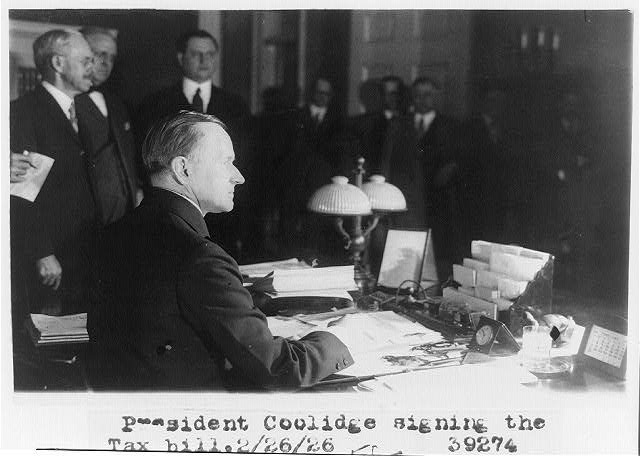 The Revenue Act of 1926 never appears in any historical discussions about what the U.S. did right after the Great War. When Andrew Mellon and Calvin Coolidge succeeded in getting the conventionally-minded Republicans in Congress to adopt this truly "radical" legislation, they established the most successful tax regime in American history. To this day the surcharge rates of the 26 Act remain the most effective soaking of the rich; had the wealthy actually handing over enormous amounts of money to the Treasury while at the same time persuading them to go out and make even more money and pay even more taxes. That is, of course, the reason why it has disappeared from history. To remember it would call into question the central assumptions of almost all modern economic doctrine - that neither money standards nor tax rates and structures matter.
America's entry into the Great War depended on the notion that great nations were built by collective sacrifice. Without that religious assumption - which also drove the push for Prohibition, the Zimmerman Telegram might not have been enough to persuade Congress to vote for mass conscription and nationalization of the railroads. For Americans to take a side among the European powers in their struggle for territory, they had to believe that the Great War was really a sacred Crusade to establish fairness in the world. To an extraordinary extent, that belief carried forward through the 1920 election. Harding was able to secure a modest reduction in tax rates, but his 1921 Revenue Act only removed the excess profits tax and lowered the top rate by 1/5th. But a lowering of the top rate from 73% to 58% did very little to defeat the presumption that the rich should hand over most of their income to the government for the sake of the public good.
1926 changed all that.
Sporting Gentleman by E. Digby Baltzell, from Victor Niederhoffer
 Along comes a history of tennis from its beginnings in 1870 when Major Walter Wingfield invented and patented it until 1996 shortly before the author's death. The author believes that the upper class is necessary for a good civilization and good tennis. He deplores the growth of pro tennis and modern stadiums especially Flushing Meadow and believes that the quality of the game has declined form the glory days of the 19th century when the twins Renshaw, Doherty and Battersly won 80% of the Wimbledon singles and doubles titles during the first 30 years. Particular mention should be noted of Arthur Wentworth Gore who entered Wimbledon 35 times and won the singles title 3 times and again in 1908 at the age of 40 and won his last singles match there at 55 years.
The author was a sociology professor at Penn who deployed quantitative analysis and his analysis and predictions of the declining level of the game and the declining sportsmanship has proved completely wrong as have most of his analysis. Yet he should have known better because he was number 1 man on the Penn team in 1937 when Tukdeb was at his height.
The book was fascinating to me as many of the tennis players moved over to squash after their tennis career had waned and I knew many of them, and there are more interesting anecdotes and record in this tennis book than any other. Some examples: shortly after tennis's founding Oxford had 66 grass courts and they were all occupied by students. The Doherty brothers won Wimbledon singles and doubles 10 times in the 1900s and probably are the third and fourth best tennis players ever. The Sears family won the US national championships 12 times and Eleonora Sears, their daughter, won the national doubles 6 times. Tilden won a 6 and under championship at the age of 8 (with future national champions entered into it). The Titanic had two two survivors who played Davis Cup for the US Narsi Williams and Karl Behr who played the one and only squash match on the boat before the water reached the tin.
*Baltzwell considers Tilden the best player ever and there are some beautiful anecdotes of how the French 4 horsemen studied his game in the 1920s and then beat him soundly by hitting the ball on the half volley. They were helped in the Davis cup when Coceh was a referee of the Tilden Lacoste game and refused to call a Lacoste shot out in the win for France. The Dwights and Davis and Fred Taylor (the founder of scientific management were the best American players in the 1900s and ruled the game Perezs of the USLTA for 30 years. They lived across the street from each other on Beacon Hill and always wore bachelors button.) The Newport tennis casino was founded by William Bennet after he was thrown out and fought a duel with his would be bride's brother for drunkenness on the wedding day. (to be continued)
Comments
Thomas Gleeson on July 7, 2019 5:49 pm
Mr. Niederhoffer. I am from Bermuda and had the honor of meeting you at The Raquet & Tennis Club on Park Avenue for tea in the 90s. I worked in Reinsurance. I thought of you recently and that led me to this article. You may be aware that Bermuda introduced lawn tennis to America. This accomplished by a Bermudian named Mary Ewing Outerbridge in 1874 as I read it. This by way of soldiers in the British Army reporting to Major Wingfield who brought the rules and equipment to the Island whilst stationed there.
I trust all is well with you and wishing you the best.
Thomas Gleeson
Passes the Kaepernick Test, from Stefan Jovanovich
 Massachusetts abolished slavery during the Revolutionary War.
The Pine Tree was it's naval ensign.
Comments
marion ds dreyfus on July 3, 2019 12:33 pm
‘’Whenever I’m … between two evils, I always choose the
one I never tried before.'’
~ Mae West
A Collector’s Collection, from admin
The Chair is selling a few things from his private collection. Please check it out and please feel free to share.
Comments
Ned Downing on July 1, 2019 4:28 pm
Interested in items for sale -Collector’s Collection” especially if they are Wall Street, Rev War, Alexander Hamilton related.
If it’s online I couldn’t find it
My BOOK: SPY High Probability Trading Strategies, from Kora Reddy
I have published a book.
I would say about 44% of it I learned from spec-list readings, even before I joined the list.
Apply the code speclist to get the e version here: $SPY High Probability Trading Strategies
And if you insist for a paper back here it is on amazon and make me rich!
Comments
Murali on June 17, 2019 6:12 am
Kora,
Thanks for your generous offer.I have downloaded the book.
Regards,
Murali
Pete M on June 18, 2019 5:08 pm
Congratulations, looks like a great read.
Andre on June 29, 2019 9:25 am
So much insider information ie g20 meeting out come to use as an example. I dont care what statistically derived strategy you use my hat is off to you if you can beat the tricks and the vig. It seems, feels, is an insurmountable challenge and until I see real hard evidence with a man in flesh and blood trading before my eyes on a long enough time horizon- a profitable trader is a dinosaur extinct since circa 2009.
Liz Merrill on July 1, 2019 10:06 am
how do i get the e version of the book? and what is the code again? Thanks
Hiro Narita on July 1, 2019 9:13 pm
Kora,
I just heard that Pan Rolling in Tokyo bought the right to translate your book into Japanese to sell. I am looking forward to work on your great book.
Hiro
Ayush on July 13, 2019 2:36 am
Good
ela on January 9, 2020 4:44 pm
the code speclist is invalid, is there any working code?
Interest Rates, from Stefan Jovanovich
In Belgium right now. BNP Paribas Fortis will pay you 0.11% - 0.01% for interest and 0.10% for loyalty –on a savings account in Euros. For a U.S. dollar savings account Bank of America offers 0.03%. From the point of view of "the middle class" (sic) with money, thrift has been quantitatively loosened out of existence.
Comments
crit on June 24, 2019 12:12 pm
Point taken but worth noting that the spread between online banks and brick and mortar institutions is substantial.
Ally Bank (online institution) pays 2.20% right now on savings accounts, presumably that will not last terribly long once fed cutting cycle gets underway but their rates were competitive throughout the hiking cycle.
Ally is still FDIC as well.
Finished the Mueller Report, from Stefan Jovanovich
These days I find I will do almost anything to avoid getting down to the necessary paperwork of selling our last operating business or the much promised scribbling of fiction.
The Report can be summarized as follows (Caution: I have already seen abbreviated versions of this kind of remark actually attributed to ranchers living in Wyoming and Montana):
"Mr. Trump did not steal any cattle, and there is no evidence that he conspired with anyone else to steal cattle. In fact, there is no evidence of any cattle having actually been stolen. Nevertheless, under the new Federal presumption rules for guilt and innocence, we Special Prosecutors are convinced that the President is obviously guilty of trying to resist being hanged for it; and we only wish we had jurisdiction to provide the rope."
The Markets Take Money, from Larry Williams
The markets take money from the impatient and give to the patient.
Ralph Vince writes:
There are plenty of mega-institutions whose horizon is longer than the human life expectancy.
They are plenty patient.
They're just slow, and adding into market drops must be done by committee. An individual, with adequate grit and nerve, can take advantage of that.
We live in an era of incredible fear. The multiples on stocks are further evidence of that - the world staggering around as though recovering from a good bonk in the head, the periods, roughly, 2001Q3 - 2016Q3, by many metrics worse than the Great Depression.
There's SO MUCH FUEL out there.
Russ Sears adds:
While I will agree that there are many institutions that should have an infinite time horizon they are run by humans that have a finite political power over them. And generally the more politically charged the leaders must be, the shorter the patience shown.
Ralph Vince writes:
Russ, yes, in the West.
But some Middle Eastern SWFs have no such pressure–one's "position" determined at birth, the possibility of screwing up diminished via indexing.
Stefan Jovanovich writes:
NASRA says their members collect 2,850 billion dollars annually in state employer and employee contributions. That averages out to 7.8 billion daily, not 750.
Quote of the Day, from Stefan Jovanovich
 "The worst thing you could do is judge the world by what you believe. Everyone will act only on their own reasoning and belief system." -Martin Armstrong
Craig Feldspar writes:
A belief system provides an operating metric, which, we all need, and which if adequate enough (it damn-well better be) can help you navigate. Absent knowledge of the specifics of a data point, a man is restricted to generalizations from the distribution of which the data point is drawn.
The problem with operating metrics is that they do not capture the complexity of reality. "In which direction does the Dardanelles flow?" The question itself, a reduction of reality to the point of uselessness.
Mary Meeker’s Annual Slide Deck, from Kora Reddy
Mary Meeker's annual slide deck here!
I Flew Over, from Larry Williams
 Flew from San Francisco to Charlotte last week —at SFO there was a Yoga area, meditation room and a Penelope of signs offering wide variety of gluten free, organic, plant based, vegan dining choices.
In Charlotte I was greeted with signs for the NASCAR Bar, Ribs and Southern Fried Chicken, nobody there looked "cool", they did look much less self-absorbed.
Happy flying to all.
Admin writes:
Much less self absorbed to think of animals that are slaughtered for a throwaway meal and be vegan or plant based in order to reduce the amount of totally unnecessary violence to innocent beings–simply by choosing a great tasting plant based meal. Picture is the most non graphic slaughterhouse image I could find.
Comments
Waqar Ahmed on June 13, 2019 4:42 am
Thank you, Admin. For once somebody here has considered other beings.
Waqar Ahmed on June 14, 2019 11:55 am
Who are you, Admin? Thank you.
Andre Wallin on June 14, 2019 1:32 pm
I believe processing makes food inherently bad. Whether it’s meat or otherwise the further away from the source you are the worse it is for you. Meat from a slaughter house is worse for you than meat from a freshly killed animal from a forest. Sugar from high fructose corn syrup vs sugar from a freshly picked fruit. Cereal bars vs a bag of nuts. It’s expensive to eat fresh while having the time to pursue other activities higher on the value chain (San Francisco). Of course you could eat fresh as a nomad, but you’d spend all your time on it.
marion ds dreyfus on June 19, 2019 11:13 am
Speaking of alternatives, found a rather tastyvegetarian surprise in a new food from Lightlife [”Since 1979″]. It’s round slices of pressed white bean and kale, presented like salami slices in a slim peel-and-reseal plastic pack. It tastes vaguely like liver, is quite delicious, is a wee 90 calories per serving–three slices, though I’m happy with one at a time, so only 30 calories, presumably.
It’s a nice option instead of salami, and cheaper, too.
Adventure Book Recommendations, from Alston Mabry
 The Best Books by Adventurers recommended by Alastair Humphreys
Alastair Humphreys is a British adventurer, author and blogger. He spent over 4 years cycling round the world, a journey of 46,000 miles through 60 countries and 5 continents. More recently Alastair has walked across southern India, rowed across the Atlantic Ocean, run six marathons through the Sahara desert, completed a crossing of Iceland, busked through Spain and participated in an expedition in the Arctic, close to the magnetic North Pole. He has trekked 1000 miles across the Empty Quarter desert and 120 miles round the M25—one of his pioneering microadventures. He was named as one of National Geographic's Adventurers of the Year for 2012.
The best books on Victorian Adventures (though the selections may seem to stray) recommended by Stephen Evans
The Best Travel Books recommended by Paul Theroux
The best books on India, Ancient and Modern recommended by William Dalrymple
The award-winning writer selects five books on India and says that the Mahabharata, eight times the length of the Bible, is one of the great works of literature of mankind - and every bit as good as it's made out to be.
Comments
marion ds dreyfus on June 28, 2019 8:14 pm
It’s not a walking adventure, quite, but it is a seeing adventure.
For parents of young kids, or couples, or solo visitors, there is a wealth of adventure in the American Museum of Natural History, now showcasing a brilliant (in light and color as well as narrative excellence) documentary.
My new tweet says it:
Twitter @dreyfus_marion
Breathtaking and spectacular #photography+narration [Kate Winslet], definitively a joyous zoology doc good for old or young (how many docs or movies can say THAT?), the film showing @the #AmerMuseum of #NatlHistory is OCEANS: OUR BLUE PLANET Swims you around the seas.Go see it to sigh, smile, grin.
Take any kidlets to share the delights.
The show on T.rex is also magnificent, especially if you can hook up with tour person Perry, who enlivens all the dioramas, movie clips, facsimiles and real specimens, on floor 4. Amazing riches to be had in studying these fantastical sadly extinct mega-faunae.
Children are always particularly partial to these big, amazing, powerful creatures, likely because they stimulate a sense of possibility and power; and because they are no longer around to actually put the fear of Hades into any of the little ones.
The MVP Machine, from Pitt T. Maner III
 There is a popular new baseball book.
It is making the internet rounds.
It mentions updated and enhanced data analysis techniques.
Excerpts discussing weighted baseballs looked interesting.
Perhaps there are applications to other sports and skilled endeavors.
Leg weights were brought to mind.
Comments
Pitt T Maner III on June 11, 2019 10:53 am
Weighted baseball training reference–the use of which one thinks would require individual evaluation,experienced coaching and due care to avoid any possibility of injury. https://nypost.com/2019/06/08/how-two-men-turned-average-baseball-players-into-superstars/
The Development of Anaesthesia, from Victor Niederhoffer
Dr. Morton, a Hartford dentist, developed the first practical use of anaesthesis and went to Dr. Warren who is generally classified as the first man of Harvard Medical schools having founded Mass General and Brigham…but he was quick to lead a chorus of "Bah Humbugs" for Dr. Morton when he presented the discovery at a round at Harvard medical. But 5 years later he amputated a leg and Dr. Warren cried knowing that he had been all wrong in opposing this life saving technique: "this isn't humbug" he said and cried.
Comments
Joyce Ilson MD on July 31, 2019 4:34 am
Dr Morton was a Boston dentist also enrolled as a medical student at Harvard. On 9/30/1846 when Morton was 27 years old he successfully used inhalation ether to painlessly extract a tooth.This extraordinary event was witnessed by his colleagues and a glowing account was published the next day in the Boston daily newspaper along with an advertisement promoting his painless dental services. With this and a few other similar painless dental extractions Morton now had the necessary leverage to convince Harvard’s esteemed surgeon Dr Warren to operate Oct. 16 on a young man with a neck tumor with Morton as the anesthetist. The anesthetic went so well that Warren was alleged to have said ‘This is no humbug” at the conclusion of the procedure. Whether this was his actual utterance is controversial as that turn of phrase was not popular at the time but from eyewitness accounts Warren was clearly impressed and scheduled a more extensive surgical procedure for 3 weeks hence on Nov 7. Warren delayed only because he was ethically troubled that Morton was secretive and reluctant to release the ingredients in the anasthetic preparation. Morton’s secrecy was partially related to his joint pending patent on the ether inhalation anesthesia process along with the physician and chemist Jackson.They called
their preparation “Lethium” but in reality it was just plain old ether,otherwise known as diethyl ether or sulphuric ether, without any fancy additives or new twists and known to pneumatic medicine.Ironically its anesthetic properties were discovered at recreational frolic parties when ether altered participants(academic society including doctors) would seemingly be oblivious to pain when bumping themselves or falling down. Warren would only proceed with the next procedure, a scheduled low thigh amputation on a 26 year old woman painfully disabled by a probable tubercular knee if Morton divulged the composition of the mysterious and magical anasthetic. Morton,already in the surgical ring of the Massachusetts General Hospital amphitheater (subsequently crowned the Ether Dome) and surrounded by anxiously expectant colleagues,finally agreed and revealed that the anesthetic was familar unaldulterated ether,reassuring Warren to surgically proceed.The amputation with ether anesthetic was a great success and was widely publicized both in the Boston press, medical journals, and letters by physicians and dentists to their colleagues across the land and to Europe. Inhaltion anesthetics caught on like wildfire both here and abroad, with rapid and wide acceptance by surgeons and patients. Within a year a textbook was published and both civilian and military surgeons were using ether anesthesia. Over time anesthetic agents evolved to be better tolerated and less toxic. Even Queen Victoria had her 8th child delivered with the assistance of anesthetic (chloroform) which promoted anesthesia for obstetric use. Of note is that Morton was not the first to successfully demonstrate ether anesthetic in an operation before colleagues.That honor belongs to Crawford Long MD of rural Jefferson, Georgia. He operated on 6 patients all witnessed in the 4 years prior to Morton but refrained fronm publishing his elegant and impressive results until 1849. In addition Dr.Wells of Hartford, also a dentist and senior colleague and teacher of Morton, had success with nitrous oxide as an anesthetic but his public demonstration off site before Harvard medical students in January,1846 was accidentally bungled and he failed to get recognition for his achievements. As an aside, Morton died addicted and penniless, Jackson was committed to a mental asylum and Wells died by suicide. There is an Ether Monument in Boston but it was not dedicated to an individual because of the controversy between claims as discoverer( Morton, Jackson, Wells and Crawford) at the time. Inhalation anesthesia has both relieved human suffering and made complicated and extensive surgery possible as well as safe. The article published in the New England Journal of Medicine( The former Boston Journal of Medicine and Surgery) was voted the most significant contribution to medicine in its 200 year history of publication. What I fail to understand is that ether was used hundreds of years earlier to both sedate animals and later by Davies as treatment for human respiratory disease that it took so long for it’s first trial as an inhalation anesthetic agent.
Stupid Physicists, from Stefan Jovanovich
There is in my opinion a great similarity between the problems provided by the mysterious behavior of the atom and those provided by the present economic paradoxes confronting the world. In both cases one is given a great many facts which are expressible with numbers, and one has to find the underlying principles. The methods of theoretical physics should be applicable to all those branches of thought in which the essential features are expressible with numbers.
I should like to suggest to you that the cause of all the economic troubles is that we have an economic system which tries to maintain an equality of value between two things, which it would be better to recognise from the beginning as of unequal value. These two things are the receipt of a certain single payment (say 100 crowns) and the receipt of a regular income (say 3 crowns a year) through all eternity. The course of events is continually showing that the second of these is more highly valued than the first. The shortage of buyers, which the world is suffering from, is readily understood, not as due to people not wishing to obtain possession of goods, but as people being unwilling to part with something which might earn a regular income in exchange for those goods. May I ask you to trace out for yourselves how all the obscurities become clear, if one assumes from the beginning that a regular income is worth incomparably more, in fact infinitely more, in the mathematical sense, than any single payment? In doing so I think you would then get a better insight into the way in which a physical theory is fitted in with the facts than you could get from studying popular books on physics.
Paul Dirac said this at the banquet for the Nobel prize winners in 1933. If you bother to search the net on this topic, you will find the usual harrumphing of the Economics degree holders (Tyler Cowen offers his usual Berkeley snot rockets) about how Dirac was a genius but not as smart as they are about their subject.
Dirac never again discussed economics in public or private. He had thought about what the fundamental principles could be and offered his quiet suggestion about where so far they had failed to pass the test that physicists were required to apply to their work. The theory of discounting did not compute successfully as a prediction of future events. In pointing out the infinitely greater value (in a numerical sense of that tricky word) of a time series (which is how the math works out even for us village idiots) versus a single payment, Dirac was telling his audience what physicists were struggling with - those bothersome infinities that keep destroying the mathematical truths and beauties of our thoughts about nature.
Article of the Day, from Stefan Jovanovich
"VERDICT: Jury awards Gibson’s Bakery $11 million against Oberlin College"
How to Teach Kids Checkers and Chess, from Duncan Coker
 Does anyone have some tips for teaching a 9 to 11 year old checkers and chess from a beginner/intermediate level? Thanks.
Victor Niederhoffer writes:
I would suggest checkers as much better relevance to logical thinking and binary decision making the crux of all electrical circuits as a foundation for decision making in life. Chess is a contrived world relating to warfare in the old days. As to how to learn checkers, I would load checkerboard program onto their computers and play against the engine. Tom Wiswell wrote 22 books that are good and some of them are for beginners. You might read Edspec the chapter on Tom's proverbs of life: "Checkers and Markets". Playing with one's father or mother is very resonant in life. Good luck.
JayJay Hales writes:
Go is a nice boardgame as well. Although in general not as popular in the west, it has a bit of a foothold among mathematicians.
Comments
Marion Morrison on June 13, 2019 5:08 pm
You can pick up Kasparov’s “Checkmate!: My First Chess Book” used online for $1. Hard to beat the author’s bona fides!
Nigel Davies on July 29, 2019 6:17 am
When choosing a board game it’s worth bearing in mind the popularity of the different options in order for kids to be able to play and compete with others. As far as I’m aware chess is far and away the most popular board game in the US with the USCF currently having 94,000 members 2,000 affiliated clubs. This in turn creates a market for coaches and other learning resources.
The breadth and complexity of chess may seem daunting at first but this allows for a wider expression of the mind and emotions than many other games. In particular the interplay between concrete tactical operations and long term considerations involving pawn structure is rather unique to chess.
Ending Special Tax Treatment for the Very Wealthy, from Kevin Eilian
Center for American Progress: "Ending Special Tax Treatment for the Very Wealthy"
Kim Zussman writes:
(Cue Sonny and Cher "The Beat Goes On")
In the US the top 10pc pay most of the taxes, and a large portion of low income pay no income tax. Maybe we need leveraged taxes, like SPU: the top must pay 300pc and the bottom pays -200pc. This will not only be fair to the poor, but will also importantly maintain governing apparatchik's vig and fiefdoms.
Stefan Jovanovich writes:
The analysis has the usual academic corruption; it only examines the facts that support its conclusions. There is no mention of the other direct and indirect taxes that are levied in the U.S. against people, property, spending and incomes. The people with "low" incomes pay almost all the employment taxes collected. If the authors were serious about taxing the rich, they would have spared us the elaborate discussion and simply advocated removing the income ceiling on Social Security and other employment taxes. That alone would make Social Security's pay-go financing secure for this century. Those of us who have fond memories of our anarchist grandfather would be happy to add a further adjustment in the name of having one big tax. (The Wobblies platform was "one big union"). Abolish all confiscations of income from savings (interest, dividends, pass-through distributions, capital gains, "excess" Social Security) and tax those incomes as further employment income. That alone solves the inequality of the Federal tax system and the unfunded liabilities for Medicare as well as Social Security.
So, why don't Lefties offer this alternative - which would be simple and avoid all further adjustment of the income tax? Because "fairness" is about assuring that the rich use the Buffett Dodge to subsidize the non-profitistas. Keeping high marginal rates at the top guarantees a continuing flow to foundations.
That motivation explains the authors' other glaring omission. They do not discuss the Federal estate tax. All the subsidies for income on securities (the special rates for interest, dividends, long-term capital gains) are more than successfully recaptured by the estate tax. If, instead of the current system, estates had a single flat rate equal to the employee share for Social Security, net collections from the estate tax would go up ten-fold. But, that would crush the rake-off by recipients of the deductible bequests. Can't have that either.
Comments
Gregory Rehmke on June 8, 2019 5:59 pm
It’s worth noting too that few with very high incomes ever paid the high income tax rates. Just as they wouldn’t pay them if tax rates were raised to 70% or above again. This post explains: “The Rich Never Actually Paid 70 Percent” https://www.aier.org/article/rich-never-actually-paid-70-percent
And the Hollywood connection: “The Golden Age of Hollywood Tax Avoidance
Do you really think Bing Crosby and Bob Hope paid 90 percent of their income to the taxman?” https://www.bloomberg.com/opinion/articles/2019-01-29/hollywood-stars-didn-t-pay-90-percent-tax-they-created-loopholes
Statistical Analysis of Extreme Values, from Zubin Al Genubi
 Statistical Analysis of Extreme Values cited by Chair is useful for risk analysis. I've used survival stats on when to expect the next hi vol event and Vince's binomial analysis for leverage analysis.
Reiss and Thomas use a number of methods and begin analyzing the probability of exceeding a certain value in a given time. For example a daily range of over fifty SP or 100 in a year. They use Pareto distributions as a parametric model among other methods. They state Poisson distributions fit binomial distributions in smaller data sets. The book includes software. I'd be interested to do an analysis of expected high vol events in a year or number of days in a month in an event. I think adding weekly or monthly occurrences of extreme highs would be useful as in the last and current hi vol events.
“Range” by David Epstein, from Alston Mabry
 David Epstein is a writer who had a NYT bestseller in 2014 called The Sports Gene.
His new book is called Range.
In this podcast interview, Epstein discusses the book.
Lots of interesting topics, including some nice statistical points, and also a few lagniappes for Gladwell h8rs:
Epstein mentions this online discussion between him and Gladwell.
Political Predictions by Markets, from Stefan Jovanovich
 PredictIt offers its predictions for 2020.
The posted prices compute as these odds:
Trump - 7/5, Biden - 19/5
Trump to win - 42 cents; Democrat Party to win - 56 cents.
Net gain: 2 cents on a bet of 98 cents (2%) that will pay off in 17 months if Trump is the nominee.
Biden to win - 21 cents, Republican Party to win - 47 cents.
Net gain: 32 cents on a bet of 68 cents (47%) …
Mexico Tariffs, from Stefan Jovanovich
 Automobile Production in US vs. Mexico, by brand:
Toyota - 1.4M, .089M
Volkswagen - .3M, .825M
Charles Sorkin writes:
I believe that the supply chains are far more complicated than a simple production tally would lead one to believe. There is an enormous volume of intermediate goods and finished auto parts which are assembled and transported across the border in a multitude of ways (some more than once) before delivery of finished vehicles in the US.
Stefan Jovanovich writes:
This may help.
"Toyota Production in North America Nearly 2 Million in 2017"
Lines of Battle, from Stefan Jovanovich
The paradox of "modern" land warfare is that it is now settling into a convention that is more than a century old. Artillery and aircraft are the only two means of killing and breaking things that do not require engagements by line of sight. The political tolerance for casualties is now so low that having men and women stand within rifle range of each other and exchange fire is no longer acceptable as a tactic, except, of course, in fictional dramas. Armies will continue to train for such fighting because it preserves the necessity of large headcounts (officers need subordinates); but the Second U.S.-Iraq War and the subsequent "surge" will be the last times infantry divisions take the field for the U.S. in foreign wars. There will still be the need for blowing things up and terrorizing the enemy, but that can now be done more safely and efficiently using bombs rather than bullets. Since the physics of taking bombs and carrying them into the air is so much more expensive than shooting them out of breach-loaded barrels, cannons are much, much cheaper as a solution. Thanks to GPS-guided shells, artillery is now flawlessly accurate. Give a battery a coordinate and within less than a minute it will be gone.
Interesting Graphic, from Alston Mabry
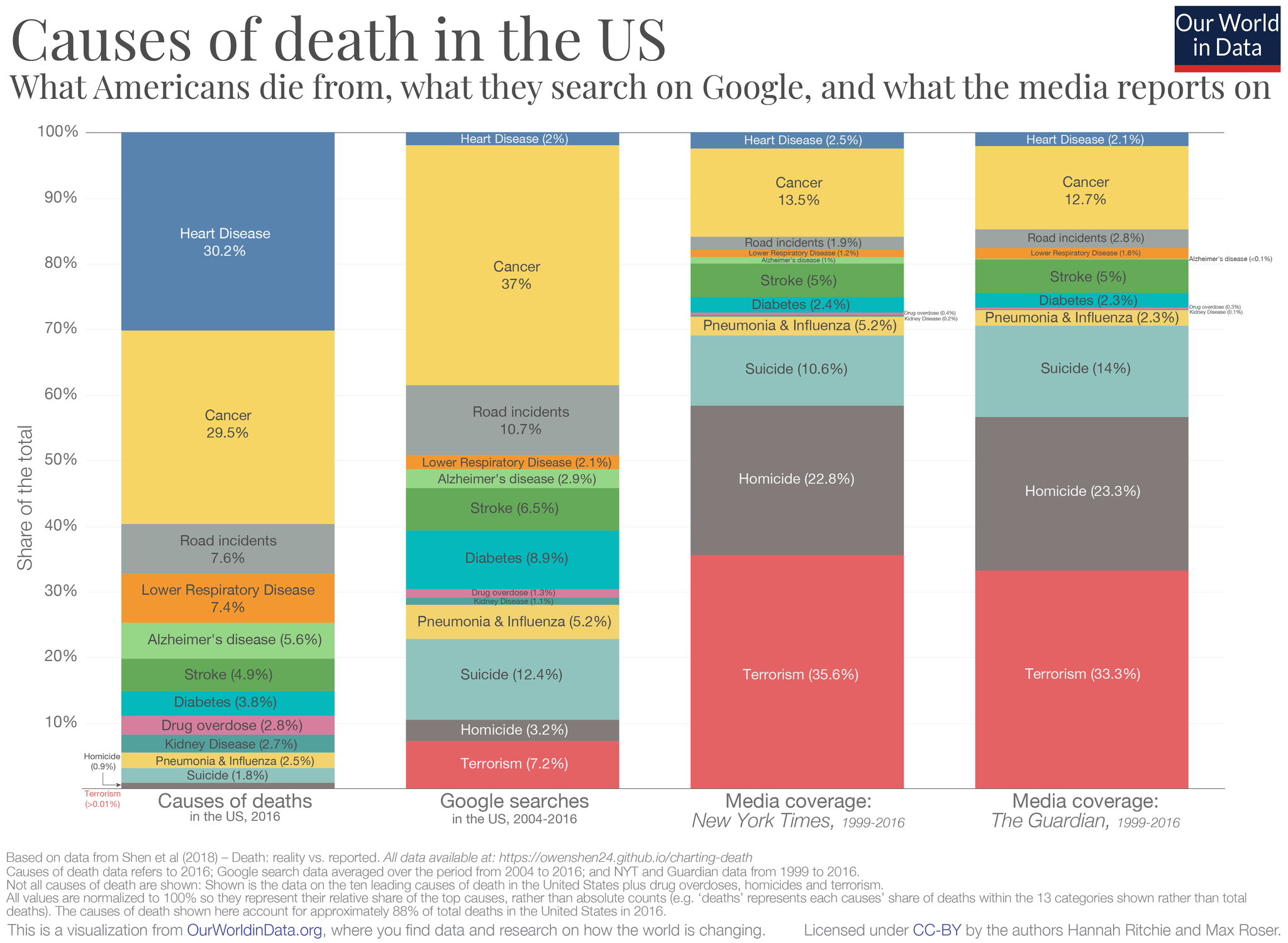 Causes of death versus media coverage of the same.
Presumably they're trying to show that media over-emphasizes terrorism and murder, and that we worry about the wrong things.
But the vast majority of medical mortality is not caused by others, and to a large extent is, at least eventually, unavoidable.
You have to die from something, and the two most common things are cardiovascular disease and cancer.
Actually, that would have been an excellent title for it:
"You have to die from something"
Memorial Day, from Stefan Jovanovich
 The accidents of time and circumstance make this a day when John Finn's comment about heroes always comes to mind.
And that, in turn, brings up the name of Hank Greenberg, who was one.
.
.
.
Correlations for the S&P Quarterly, from Alston Mabry
 Just to scratch a quantitative itch, here are correlations for the S&P quarterly.
One hopes it's clear as presented.
Slightly larger magnitudes in bottom 2 rows one assumes is mostly from smaller sample sizes.
And btw, the Q on Q R, or autocorrelation, is +0.07.
Comments
George on May 28, 2019 8:31 am
Question for Vic and everyone:
Why are Treasuries rates at 20 month lows with tariffs going up 25% or more?
Won’t the supply chain disruptions cause shortages? Won’t the cold tech war setback productivity? How can the Fed cut in these conditions?
What do ‘they’ know?
Trumps Trump Card, from Larry Williams
 Here's an interesting — and for Democrats, ominous — statistic: since the election of 1896, a political party has been denied control of the White House after four years only once. That was in 1980 when incumbent Democrat Jimmy Carter lost his re-election bid to Ronald Reagan. And since 1953, only one party has stayed in office more than eight consecutive years. The Republican administrations of Ronald Reagan and George H.W. Bush lasted from 1981 to 1993. A lot of voters may be reflexively throwing out the bums after eight years, with rare exceptions.
Stefan Jovanovich writes:
The 19th century was even more fickle. After the first broad expansion of the franchise in the 1820s, only Jackson, Lincoln and Grant were 8 year Presidents in 2 consecutive terms.
“There are no miracles. There is only discipline”, from Alston Mabry
A sign hangs in prolific romance novelist Danielle Steel's office:
"There are no miracles. There is only discipline."
Interestingly, Steel has 9 children.
Nelson Lichtenstein, from Mr. Isomorphisms
 Nelson Lichtenstein wrote interesting books about $WMT, noting that Sears was excluded from the initial 1955 Fortune 500 list "simply because it was a retailer".
His "retail revolution" is the transfer of power from manufacturers down the line and closer to the consumer. WMT now significantly controls the supply chain "up" the line.
(Nike and Starbucks have been noted in this regard, but not so far in this book.)
There is a second reason why Burger King management has put the federal Equal Employment Opportunity Commission (EEOC) statement at the very top of the application. Americans consider workplace discrimination on the basis of race and religion and creed un-American. For nearly a third of a century we have had a national debate over the definition of such discrimination and the remedies that are useful and legal to eliminate it. But there is practically no debate about the need to stop it and compensate individuals for it, when discovered.
The overwhelming majority of workers, employers, and politicians believe that the government has a right to insist that active discrimination not take place against anyone covered by Title VII of the 1964 Civil Rights Act or those many statutes that followed in its train. This seems so commonplace and common sensible, that we forget the radical character of this law. If you own a restaurant or a factory or a motel or run a college, you can't make use of your property as you wish. The state mandates you to hire, fire, promote, and otherwise deal with your employees or clients according to a set of rules laid down in Washington and refined by the EEOC and the courts. If litigated, the courts will force an employer to pay real money in compensation and rehire or promote a worker if management is found to have transgressed this new kind of labor law.
Peter Ringel writes:
Yes, the "point of sale" has the dominant power position.
Like the US has it towards China: US is the point of sale.
Mr. Isomorphisms writes:
I think this was a point made by Michael Pettis (shows up on twitter.com/jaredwoodard feed) as well.
Stefan Jovanovich writes:
Some of us are happiest as counter uppunchers. But for I's and PR's wonderful (as always) comments, I would not have spent the first part of the morning rummaging through my books and pestering the wife about her encyclopedic knowledge of employment law. So, I pray these remarks will be taken as merry grumbling, not smart-ass smugness.
-
The EEOC placard is like putting In God We Trust on the Money. It does no harm but it is not proof of anything real. Companies put it up for the same reason water fountains in my birthplace and the nation's capitol once had labels that said colored only; the law made them do it.
-
Labor Union's flourished in the 1930s for the same reason the water fountains had the signs; the Federal law made companies do it. What it did not do, of course, was make the labor unions allow memberships to be open to people regardless of gender and race. On the contrary, those awful capitalist employers had shown a shocking willingness to allow women and Negroes and Mexicans to come to the same workplace. They had, of course, shown the same terrible openness to letting rich black and Creole people in Louisiana ride in the same passenger carriages as white people. In both cases the law put a stop to the dreadful egalitarian idea that anyone could be a source of profit.
-
One should be careful about drawing any inferences from the Fortune List. When Henry Luce ran Time-Life editorial selection had a simple rule: our advertisers are the news. Sears was not a major advertiser in expensive magazines in the 1940s and 1950s. They did not need to be any more than Google (forgive me: Alphabet) needed to buy ads on television in the 1990s and 2000s.
Mueller Report, from Mr. Isomorphisms
 Here are the official links to part I and part II of the Mueller report.
Not strictly to do with markets, but what on the site is these days?
Stefan Jovanovich writes:
If telling people with badges and law degrees that you do not want to talk to them is "obstruction of Justice", then Trump is guilty. That is clearly Mueller and his minions' reading of "the law". They found it impossible to state that conclusion in their report because they could not get Trump to say anything at all while being directly interrogated. Obstruction is the new catch-all crime, even better than conspiracy. With conspiracy you have to make positive statements; with obstruction you can answer "I do not recall" and be found guilty because someone else has a recollection that proves you could have recalled or in the first, fifth or sixteenth answer to the same question you said something that was a recollection. There is no reason to volunteer to say anything, ever, to the people who can put you away if they want to.
Comments
marion ds dreyfus on June 17, 2019 10:54 am
This is refreshing to read, and all too true.
The term “process crime” has been added to the lexicon of everyday people because many persons of undoubted integrity have been ensnared and sometimes jailed for the “recollection” trap, where one is not lying, but overzealous prosecutors (read: Mueller types and henchfolk of similar stripe) choose to leap upon tiny variances in answers to same questions asked umpteen times or with incremental variations. Memn of great probity are now broke from defending themselves from absurdities of this ilk, lawyers and courts, which seems a criminal abuse of the undisciplined, untrammeled, largely unvetted prowess of deranged prosecutorial types bent on damaging, in these years, anything Trumpian by squeezing aides, appointees or cabinet members, current or former, of the current Administration, which these zealots seem unable to accept as part of the normal political landscape.
A sad condition, indeed. Mr. Isomorphisms correctly calls out the regrettable syndrome.
marion ds dreyfus on June 19, 2019 9:35 am
This is refreshing to read, and all too true.
The term “process crime” has been added to the lexicon of everyday people because many persons of undoubted integrity have been ensnared and sometimes jailed for the “recollection” trap, where one is not lying, but overzealous prosecutors (read: Mueller types and henchfolk of similar stripe) choose to leap upon tiny variances in answers to same questions asked umpteen times or with incremental variations. Men of great probity are now broke from defending themselves from absurdities of this ilk, lawyers and courts, which seems a criminal abuse of the undisciplined, untrammeled, largely unvetted prowess of deranged prosecutorial types bent on damaging, in these years, anything Trumpian by squeezing aides, appointees or cabinet members, current or former, of the current Administration, which these zealots seem unable to accept as part of the normal political landscape.
A sad condition, indeed. Mr. Isomorphisms correctly calls out the regrettable syndrome.
Marion d s dreyfus