Earlier posts · Page 25
Show Recommendation, from Scott Brooks
I recommend to the group the TV show on Netflix Turn: Washington's Spies. It's based on the book Washington's Spies: the Story of America's First Spy Ring I believe. I enjoyed the series very much!
Ralph Vince writes:
Turn is excellent. I second Scott's motion.
Do the Rich Capture All the Gains from Economic Growth? from anonymous
A friend said to me: "I was in Chicago for a quant conference (with Bitcoin PhD's, unbelievable. for $3000/head.) and saw large numbers of desperate urban homeless. In one case a young man was bypassed by people in expensive clothing on their way to expensive drinks, who then looked at their phones while he was staggering, helpless. (I think the drinks signs were like $30/drink.) That kind of stuff is more pervasive than I remember in the US."
No one is claiming this ubiquitous phenomenon is not tragic. The argument is about who, if anyone, should pay. Let's say you are 5 stdev smarter than him, and perhaps we agree you should pay for him. I am not so smart, but my simple father taught me to fight. If you want me to pay we will fight over it.
That is the argument. Against nature.
anonymous replies:
I would disagree with the question "who should pay". It's not a lack of people paying or amount paid. Lack of money is not causing these problems to grow. It is where the money is going before it gets to those needing a hand. The government has ever incentive to keep those receiving money dependent on them and without any tough love for those that refuse to meet them the best they are capable of to receive aid.
We are so afraid of someone falling in the cracks that we make it ok to make terrible choices without any real consequences for so long until many are hopeless. We have made the cracks huge by building these costly safety nets on the edges.
The last mile problem of charity can only be solved by those nearest the situation not those pandering to voters.
A Good Disguise Book, from Bo Keely
A good disguise book:
The Master of Disguise: My Secret Life in the CIA
A 4 Hour Mini Series: The Circus, from Alston Mabry
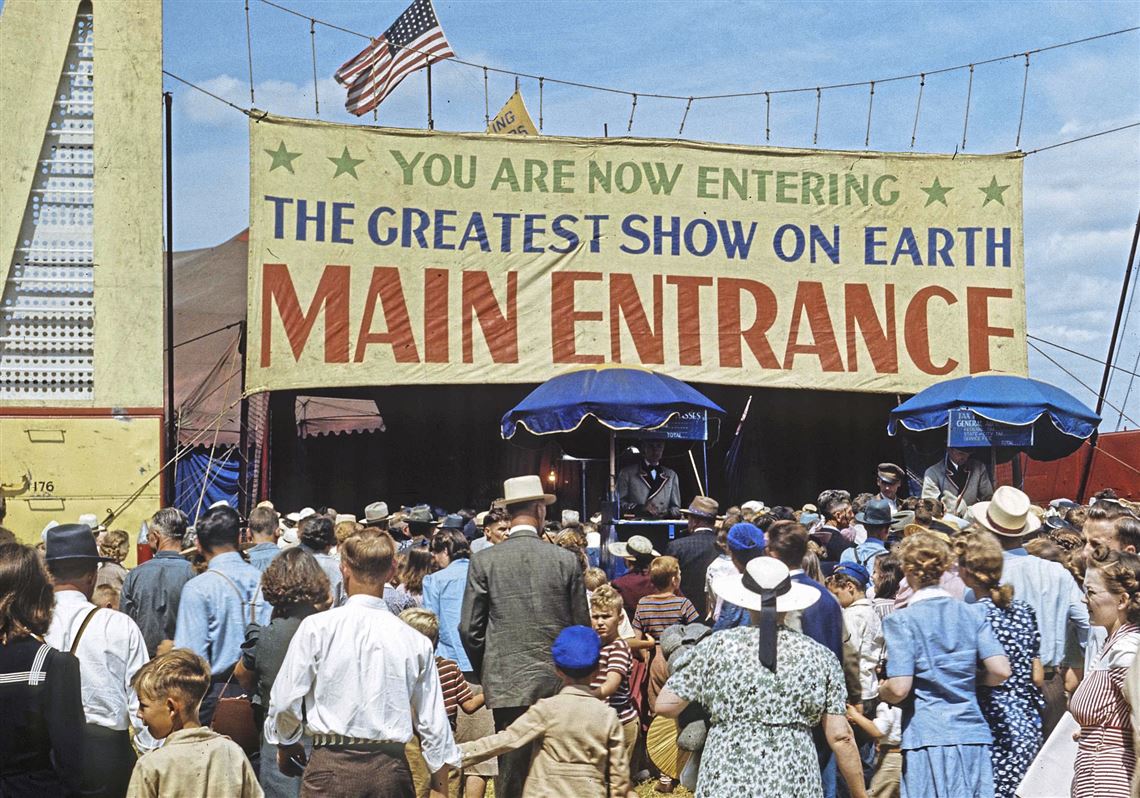 This is very nicely done and I wish it were even longer, like a Ken-Burns-style series:
This four-hour mini-series tells the story of one of the most popular and influential forms of entertainment in American history. Through the intertwined stories of several of the most innovative and influential impresarios of the late nineteenth century, this series reveals the circus was a uniquely American entertainment created by a rapidly expanding and industrializing nation; that it embraced and was made possible by Western imperialism; that its history was shaped by a tension between its unconventional entertainments and prevailing standards of respectability; and that its promise for ordinary people was the possibility for personal reinvention. For many Americans, the circus embodied the improbable and the impossible, the exotic and the spectacular. Drawing upon a vast and richly visual archive and featuring a host of performers, historians and aficionados, The Circus follows the rise and fall of the gigantic, traveling tented railroad circus and brings to life an era when Circus Day would shut down a town and its stars were among the most famous people in the country.
Impeachment Trades, from Alexander Good
 This article predicts the impeachment odds near 50% for next 2 years
What are the obvious stocks/commodities/currencies that would directly benefit from an impeachment, if any? Which would decline?
The private prison stocks used to trade somewhat as an impeachment proxy but with the ousting of sessions and change in tone re: reform, no longer intuitive.
My thought would be putting on an appealing spread trade to hedge the odds market which feels very aggressive
Ralph Vince writes:
First things first.
I don't see Trump and Xi bypassing an opportunity to goose their markets. Expect a statement from both of them, jointly, to the effect of "we're working on a deal, we're getting close, it's complicated, there are lots of issues, but it's coming."
Commodity ETFs, from Jim Sogi
/cdn.vox-cdn.com/uploads/chorus_image/image/57642853/Roadster_Front_58.0.jpg "tesla roadster") I've been sucking wind on these commodity etfs for it seems like years.
I've been sucking wind on these commodity etfs for it seems like years.
I'm starting to wonder if they are like an outdated unchanging index. When a commodity gets expensive, technology just figures a way to use something else and bypasses a hard to get resource. That's why we haven't run out of stuff and Malthus was plain wrong. Peak oil was wrong. I think I'm wrong.
My friends and family are getting teslas. Oil is headed to zero. Better to invest in tech not commodities.
Comments
Marc on December 4, 2018 5:47 pm
Electric planes are not that common yet, oil is easy and portable.
Birds, Bats and Balls, from Bo Keely
 Pheasant season just opened in Slab City and right on the tick of 5:51 AM of the shooter's time table a salute of fifty shotgun blasts startled me from sleep in the weeds. The shooting continued for the next thirty minutes until I decided to risk rising, and on peeking out the bushes discovered hunters stationed every quarter mile for as far as the eye can see. Every few minutes a hawk sound screamed through the air and dozens of bats flicked off the branches. The hunters were using hawk callers to uproost the pheasants, but hawks also hunt bats. It was a wonder the hunters didn't shoot each other, but as they didn't I felt safe in rising and walking out the battlefield. The scene put me in mind of the sheriffs chasing fugitives through Slab City. There are so many citizens on the run, that the sheriffs 'shake the bushes' out their loudspeakers, 'We know you're in there, come out with your hands up!.' The sheriffs are nearly as successful as the bat hawks who capture prey on 40% of their attempts. They don't necessarily catch the fugitive their looking for, but they get one.
Disguises, from Bo Keely
Slab City is crawling with spies for the military, feds, police, and for Slabbers. The local town dick may be identified by her large breasts. All the undercover people look, dress, and party harder than the true citizens, and are hard to pick out. The only real cues are their hard pistol callous on the heel of hand, and they cannot hide an extremely high innate intelligence, which unfortunately is also prevalent among the residents.
Most of the spies are inserted long term here, but have arrived in the past two years in conjunction with thefts from the military base and macabre murders in the Slabs. You'll see tattoos appear and disappear overnight as part of their disguises. In regard to the recent decapitation of the knife sharpener, someone else found a head with a mop of curls on the ground not far from my camp. A neighbor approached it, was freaked out, and went for a stick to probe it. His companion kicked it and screamed in pain, for it was a stone with a wig on top. They called me to investigate and the wig looked exactly like my hair that had been cut two days earlier down the road. I didn't want to touch it either, but returned the next day, and on examining the wig it was not my hair but the ugliest piece I've ever seen. I took it to camp and washed it, and bought a balloon to stick it on in a window when I'm absent. I wear a different wig when I leave town so I won't be recognized and my place robbed.
Update From Slab, from Victor Niederhoffer
Victor Niederhoffer writes to Bo Keely:
Can we have your reaction to the Smithsonian article on Slab City.
Bo Keely responds:
Slab City is an anarchist psych ward in a sand box that used to be General Patton's desert headquarters. Hence we citizens have immunity from pretty much everything. I held my neighbor's skull (minus the body) in my hands a couple weeks ago, a knife sharpener who made the mistake of robbing the wrong person. Yet, the population has doubled since last year, and shows signs of continued growth. People read about it online and arrive for the freedom, free land, and independence, but find it's also an outlaw town. I've been doing a study of the peculiar, and cannot point to one citizen who is not. Therefore there is a lot to be learned about human nature and consciousness.
My motorcycle broke down two months ago, stranding me here, walking, hitching, and tracking bad guys. Because of that, I've met most of the newcomers. The population is high IQ and stoned across the board. My new neighbors, two lesbian ex-military, are the only two besides me who don't indulge in drugs. Our introduction was a couple days ago as they chased me across my own property with four snapping dogs, horn honking, and gun under the seat. The other arrivals are young roadies, freight hoppers, anarchists, divorcees, retirees, many musicians and artists, and a few unemployed professors and executives.
All hail Slab City as the last free place, but most succumb to meth to make it a hotbed of any abnormal activity you can think of. It's paradise to a behaviorist like me.
Comments
Pete M on November 28, 2018 5:11 am
Thanks for the update Bo, these always make my day.
The Prz, from Victor Niederhoffer
The Prez was right with all his comments about Powell being hawkish and "not a little bit satisfied with Powell" and the markets all over the world gave everyone wealth. But now we shall have to hear about "succumbing" and "interference" and the inviolable "independence of the Fed being violated".
Pete Earle writes:
Here is something I wrote a month or two back regarding the media assertion that the current President is conducting himself in manners vastly outside historical norms.
Thanksgiving to Xmas, from Zubin Al Genubi
"The stock market usually bounces from Thanksgiving to Christmas":
The Dow has averaged a gain of 1.93 percent in that time period since 1990, while the S&P 500 and Nasdaq gain 1.77 and 1.66 percent, respectively.
The S&P 500 was positive between Thanksgiving and Christmas 78 percent of the time since 1990, according to Kensho.
Kora Reddy writes:
This is very easy… from the engine we created, from the close of mon after thx giving till close of the last trading before x-max, since Y2K :

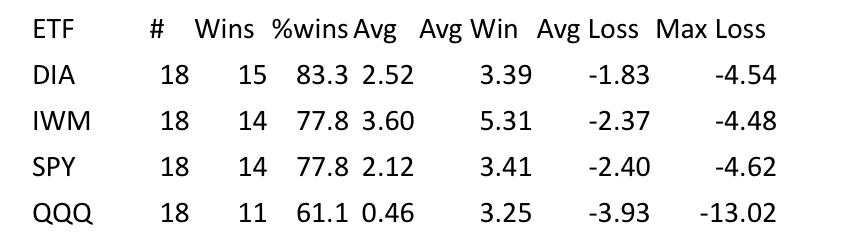
Let me do this for all SP500 tickers and send it across.
Second Best Western Ever, from Victor Niederhoffer
A movie of the second best western ever: The Good Old Boys (1995)
Comments
Jeff Watson on November 28, 2018 2:18 pm
That begs the question, what is the best western ever?
Optimum F Help, from Zubin Al Genubi
Ralph or anyone else. I need help with Ralph Vince's optimal f.
Take any one of Kora's excellent sample trade systems in SP with for example N0 Classical expectation is 60% winners, T=2.2, max historical drawdown 50pts, avg gain 4 pts avg loss 4 pts, with a million dollar stake; max acceptable drawdown 2%, a one year horizon rather than normal asymptotal assumption. R=risk free rate. Time horizon is close to close one day.
Traditionally one would use 8 contracts to limit loss to 2% on the max loss, or a fraction of .4 of stake.
What is the Optimum f use to achieve max TWR? Also what is appropriate n to compute optimal f: the 3 expected trades in the year, or the 30 over the history of the trade? Assume the current historical volatility in SP of 18. How does f change if vol is 9? Also how does the Vince bounded expectation differs from the classical unbounded expectation over a one year with 3 one day event horizon?
The solution in Vince, Risk Opportunity Analysis, p 171 is a 3 dimensional copula. (Escaping Flatland!). Is there a simple R routine or spreadsheet to compute this? The late Seattle Phil uses max drawdown as the main factor In his allocation formula. I think risk management is the most important aspect of investing.
Ralph Vince replies:
Zubin,
So your criteria, from what you describe, is to maximize your gain over this period of time, all else be damned, withing a given (but unidentified) risk constraint. So you are talking about being at the peak of the curve (there are other points, or paths through the space, for different criteria), and you;re talking about a portfolio of one item.
But you do not know what this one-year future time window has in store for you, and I've found the best approximation for where the peak is to divide the percent of profitable compounding periods (in this case, since you have only one component, a compounding period we can say is the same as a trade) by 2. I won;t go into the math for why this is hte best guess aside from saying it will minimize the price you pay, worst-case, between this best-guess point and where, after the year, the actual point turns out to be. So in this example, it starts out at 60% winners, so
.6 / 2 = .3 ad therefore, the best guess point to use as the peak is .3, asymptotically. But you;re talking about only 3 trades over the course of the year, and since the expectation, if you make one play, is to be positive, then if you were to quit at 1 trade, your f would be 1.0, at two trades, the best guess is (f one play less-the asymptotic f) / 2 + the asymptotic or (1-.3)/2 + .3= .7/2+.3=.35+.3 = .65 and for three trades (.65 - .3 ) /2 + .3 = .175 + .3 = .475
So that;s an approximation, that .475, and that;s how I would arrive at it, absent knowledge of the future. It is a good, robust approximation and mathematically sound. I prefer robust approximations as opposed to the exact mathematical answers based solely on past data
Software for this can be found at Josh Ulrich's R implementation for it. I do not have the link offhand. The paper you cit gives the exact formula for determining the landscape and optimal fractions therein, but that is on past data. In the foxhole looking at tomorrow, or next year, I prefer robust approximations that will mimic what the actual formula might provide.
Next, you need to determine a worst-case loss situation. Perhaps you are going long, and you could use the value of 0 for your worst case. or maybe you have a stop in there, and you can use that plus some ridiculous amount of slippage for worst case or perhaps you are using options, etc. But you really need a worst case situation. Dividing the worst-case dollar amount by .475 will tell you how many units (the same quantity you determined the worst case dollar amount on, say, 1 contract 100 shares, whatever) to have on.
Understand, however, that when this worst-case is hit, you will be hit for 47.5% of your stake! So my point is, I think you need to rethink your criteria as it is unlikely what I paraphrase it to be in my first paragraph here. Perhaps you want to allocate a smaller percentage of your capital to this endeavor such that 47.5% is akin to 2% or your total capital. Maybe your criteria actually has you traversing a path in the landscape this curve in 2D space.
Orson Terrill writes:
Is Ulrich, or anyone, still maintaining quantmod? I still have some code that runs on parts of it, that I'll refactor to save time, but hadn't seen much activity around it.
Ralph Vince writes:
I'm certain there is a robust community around it.
One Thing About Buying Art, from Victor Niederhoffer
 One thing to remember about buying art is that the vig is very high. It costs 15% buyers fee and 10% sellers fee. Plus the markets are generally wholesale markets so that what you pay for retail is likely twice the wholesale price. So you start out about with a 50% to 70% loss, it's greater for items that are 8 or less. You should think of waiting at least 10 years to get even.
Jeff Rollert writes:
I find art (along with vintage cars) is best acquired from someone's near bankruptcy, as time pressures reduce shopping/selling opportunities. BK goes through the courts which permit other games. Of course, documentation must be present.
Also, if they are still alive, buy directly from the artist.
Growing GDP, from anonymous
 Exploring the data:
Rolling 10-yr % increase in GDP (in nominal dollars, hence the peak value occurs in Q2 1981)
A Person on Twitter, from Victor Niederhoffer
A person on twitter said it best: "the agrarians hate prosperity".
Kim Zussman writes:
A note from a notable reform school:
By Martin Feldstein Nov. 26, 2018 7:00 p.m. ET
It’s Not My Fault, It’s Paul Ryan’s, from Stefan Jovanovich

 In the great tradition of all failed prognosticators, I hereby declare that it is not my model that was in error but reality. A week before the election Paul Ryan declared that President Trump was hurting the Republican's chances by talking about immigration. Gallup has just released a poll that strongly confirms the election results. The candidates who wrapped themselves in the America First flag outperformed the average for Presidential mid-term for the party in the White House; those who waffled lost the Independents and failed to win enough votes to survive the last minute ballot discoveries that are the Democrats' most enduring tradition.
Comments
Richard Berger on November 24, 2018 2:13 pm
Also, the Republicans failed to answer the Democrats’ charge that they were hurting those with pre-existing conditions. IIRC, Obamacare had a provision for a pool for those with PECs and it was hardly used. If anything, the efforts to repeal Obamacare, which were thwarted by the late, unlamented John McCain, have helped. Obamacare increases have moderated, and the availability of temporary plans (along with the repeal of the mandate) has made plans more affordable.
Whatever happened to the old Paul Ryan?
I Am Thankful For, from Scott Brooks
 I am thankful for the blessing of healthy children who are driven, intelligent and ambitious.
The ability to make money and create the world I want for myself, my family, my clients and my employees.
Good parents who raised me well, even in bad circumstances. Parents who gave me a work ethic and a drive to succeed and build on their legacy of hard work.
The lessons, friendships and business relationships I've made being a part of this group!
These are a few that come to mind.
How about the rest of you?
Russ Sears writes:
Health.
A family that loves me and is healthy.
Friends and family that are motivated and cheer me on when I succeed and pull me back together when I fail.
Love is miraculous when you're healthy and see the miracle of life in your children.
Life and the energy to enjoy it. Almost every morning I run 7 miles at 56 years old. Each morning I am grateful and amazed what the human body can do.
The wealth of the time and place I am living. The technology, knowledge and wisdom that has come before me, and I have had the chance to see marvels upon marvels developed during my life.
I propose a thankfulness hypothesis and leave it as an exercise to the reader to prove or disprove on an individual basis. Billy Graham believed that worry was usually due to a lack of gratitude. Or failure to see the reality of how blessed we are, only seeing the problems at hand. Hence I suspect that the Santa rally comes from the thankful spirit of these holiday season. The individual test for a trader therefore is when you're most worried, take a few moments like this to be thankful and see if that will clear your head and help you trade better.
I am thankful I'm a part of this site!
Article of the Day, from Tyler Mcclellan
It's amazing to me how many people who think all of life—or at least the mainstream media's presentation thereof—is a con job are actually just being conned, but then of course they know that I only think that because in fact the mainstream mind alteration is so successful.
"Anatomy of a Conspiracy Theory" (about the Las Vegas shooting)
Give Thanks for Pilgrims — and McDonalds, by Victor Niederhoffer and Laurel Kenner
November 22, 2018 (our annual article about Thanksgiving)
Thanksgiving is about sharing prosperity, and it's a good time to think about where
prosperity comes from. The Pilgrims figured it out in 1623. We'll retell
that story as we celebrate the way it lives on in countless U.S.
families and companies today. And in particular at one company,
McDonald's, that in its humdrum way beautifully
demonstrates the source of prosperity and the American way of life.
The Pilgrims started with so little. They had to hide in England
because the authorities considered them dangerous. They fled to Holland
but found themselves compelled to take menial jobs. On the way to
America, many of the company died. They lost their way to Virginia and
landed in Massachusetts just as winter set in. The Virginia Co., their
backers in London, went bankrupt and couldn't send relief supplies.
To cope with want, the Pilgrims made the same mistake that so many
countries do even today: They divided all their land, efforts, supplies
and produce in common, to each according to his need.
As always in such systems, need surpassed supply.
The Pilgrims spent their first three years in America suffering from
hunger, illness, cold and infighting. People stole from the common
stores "despite being well whipped," according to William Bradford's "Of
Plymouth Plantation."
Bradford, governor of Plymouth Colony, records what happened next:
"They began to think how they might raise as much corn as they could,
that they might not continue to languish in misery. After much debate,
the Governor decided that each settler should plant corn for
themselves."
Under the Land Division of 1623, each family received one acre per
family member to farm. That year, three times as many acres were planted
as the year before. Prosperity was not long in coming.
The Pilgrims turned from their Old World system of common ownership
to incentives. They didn't go that way out of ideological conviction,
but because they didn't have the luxury of waiting for support to come
to them.
How many families in America tell the same tale? "When we came here, we worked hard and our lives were better."
But that wasn't the end of the story. Before the switch to
incentives, the hungry settlers were at each other's throats. Hard
workers resented receiving the same portions of food as those who were
not able to do even a quarter of the work they did. Young men resented
having to work without compensation to feed other men's wives and
children. Mature men resented receiving the same allotments as did the
younger and meaner sort. Women resented being forced to do laundry and
other chores for men other than their husbands. Many people felt too
sick to work.
But when they were allowed to farm their own plots, the most amazing
thing happened. Everybody — the sick, the women and even the children —
went out willingly into the fields to work. People started to respect
and like one another again. It wasn't that they were bad people,
Bradford explained; it's just human nature. Adam Smith came to the same
conclusion later, and Friedrich Hayek updated Smith's ideas for the 20th
century. But we don't need to go back to New England for understanding.
Similar outcomes can be seen at McDonald's every day.
For centuries, people on the lower rungs of the social ladder weren't
able to eat meat. They ate grains and beans. But people like beef. And
chicken.
When McDonald's started popping up in every neighborhood, all of a
sudden there was an affordable place for families to eat. Previously,
one of the main differences between the upper and lower classes was that
the rich could eat out. Even if the poor could afford the tab, they
couldn't hire baby sitters, and they couldn't bring their kids to the
elegant establishments designed for the rich because they would have
disturbed the other diners.
Most kids don't like fancy restaurants anyway. They want fries, not
polenta with wild mushrooms. They want fried codfish, not turbot. They
want burgers, not lamb chops.
How many people has McDonald's made happy? How many families has it
brought together? How many Happy Meals have been eaten there? How many
kids have enjoyed the playgrounds? How many tired workers have been able
to catch a quick meal? How many women are able to pursue careers and
other productive activities and dreams because McDonald's has freed them
from the task of having to cook every night?
The Pilgrims might have served 200 or 300 American Indians at their
Thanksgiving feast. McDonald's serves 26 million customers a day at
13,700 U.S. restaurants.
For the traveler, McDonald's is a home away from home, offering so
much for so little. The restrooms are clean. And McDonald's serves hot
strong organic coffee in smooth cups of some wonderful material that
keeps liquids hot without burning the hand, shaped to fit into the cup
holders that just happen to be in your car, with carefully designed tops
that permit just the right amount to be sipped.
No regulator, no fascist dictator, no socialist planner decreed sip
tops or cup holders. But how many late-night drivers have died for the
lack of a good cup of coffee? What could be more munificent than saving
lives?
And the story doesn't end there. Consider the employees of
McDonald's. How many people have worked there and learned the most
important lesson in America: The customer is always right?
The anti-this-and-that people who demonstrate against profit
incentives and free markets like to single out McDonald's as a symbol of
modern capitalism. (They don't mean that in a nice way.) As the McLibel
Support Campaign puts it: "(McDonald's) has pioneered many business
practices that have been taken up by others, and have come to represent a
symbol of the way that society is going –'McDonaldization.'" But when
have you ever seen an unhappy customer at McDonald's? There couldn't be
too many of them, because about 10% of America eats there each day.
Given the choice of cooking at home or going to other restaurants — and
competition ensures that there are other restaurants — people go to
McDonald's because they trust they'll find good food, quick service and
value for money. What could be more munificent, more representative of
sharing the fruits of hard work than McDonald's?
McDonald's and the Pilgrims are the essence of America. The people
work hard, motivated by the chance for profits. They provide a welcome
to others, whether to Indians joining in harvest celebrations, or to
customers looking to satisfy their hunger. Their work results in high
quality, low costs and family togetherness.
Those humdrum, everyday attributes are what makes America great.
That's what we should be celebrating. It's the source of all our
munificence, from the first Thanksgiving to today.
Comments
Andre Wallin on November 24, 2018 9:30 am
Mcdonalds hasnt kept up with consumer tastes. Ironically french mcdonalds is much better although might be because better brand value and consumer less price sensitive in france. Out dated example in my opinion. I dont think mcdonalds will survive much longer
Bill Posters on November 25, 2018 3:20 pm
Give thanks for Squanto last of the Patuxet.
"Fat" Mike Sirvinskas on November 26, 2018 3:41 pm
McDonald’s is a wonderful company and success attracts critics. The company JUST raised their dividend 14.9% so investors continue to be rewarded. Dividends are paid from cash and cash does not lie. I do not believe a disappearing middle class (in America) is a death knell for the Golden Arches - quite the opposite.
Kyle Murphy on December 11, 2018 10:16 pm
Chris Arnade (https://en.wikipedia.org/wiki/Chris_Arnade) also documents the importance of Mcdonalds to american class mobility.
Year of the Super Cyclone? from Jeff Watson
 "Will This Be the Season of the Super Cyclone?"
A big typhoon on the other side of the Pacific would make it worth a trip for this Florida boy to go to California to catch some epic South swell. The most rideable waves from those gigantic typhoon swells come right after the peak, when the wave form is changing.
The ocean gives the experienced waterman many clues as to when the form is changing, be it a swell, a hurricane, tuna run, whatever. The markets do the same. There's more than a few market lessons in hurricanes and waves. A difference between surfing and the market is that the very biggest waves on the planet will max out under 1000', nobody knows how high a market can go.
Yield Curve Inflection Points, from anonymous
 I'm starting to see multiple points popping up along the constant mat treasury curve. When this has happened, historically, the existing trend exacerbates.
Given that the curve is entirely of bull-market shape (i.e. a positive-but-slowly-flattening curve) I have to take this to be a very bullish omen for the next few weeks to months.
Jim Sogi writes:
Read some of Ralph's books for some "secret sauce". They are quite mind boggling.
I've gotten a glimmer of the concepts. For example, his idea of using discrete math and decision trees rather than the normal continuous calculus curves for making decisions. The market is discrete prices with discrete beginnings and ending points giving the decision tree methodology a good practical basis for making decisions in real time.
The yield "curve" also has discrete points and beginning and endings for the bonds each with a discrete term and rates.
I've only heard brief mention of this idea elsewhere.
Video on Philosophy and Success, from Peter St. Andre
Some folks here might enjoy this video of a talk I gave last month to philosophy undergraduates at the University of Colorado Boulder:
Ugly Monday, from anonymous
Despite Tel Aviv being up today (this has been a very strong market this year) the spread between the broad Market ETFs and in particular svxy and their net asset values is just too wide in favor of the ETFs, but usually signals a pullback of one to three days, indicative of just a little too much short-term optimism at the moment.
Rules, from Stefan Jovanovich
After the Thousand Oaks bar shooting, the rules for successful massacres continue to apply:
- The people being attacked have been forcibly unarmed; even licensed Concealed Carry permit holders are excluded
- The "security" plan focuses on organizing and controlling the crowd, not spotting the troublemakers
- The shooter(s) are already well known by schools, military and the legal system to be certifiably nuts
Comments
Anonymous on November 22, 2018 7:28 pm
This is correct. Security, both operational and general are architectural not strategic. Unfortunately the actions of the few end up restricting the rights of the many.
francis burton on November 25, 2018 6:05 pm
Newtown
New York City Books, from Victor Niederhoffer
 Gotham and New York: the Novel make a fine pair of telling the history of a great metropolis with many financial insights contained within. Both books are very informative and tell you everything you should know about the hi-ways and byways that led to current times. However, both books spend an inordinate amount of time on the plight of the 1% who did not prosper with the rising tide.
Henry Gifford writes:
To the list of New York City books I recommend The Island at the Center of the World by Russell Shorto.
Basically, in the 1970s, some government employees were throwing out boxes of junk from the basement of the NY State capital building in Albany, NY, and someone looked to see what was in the boxes and found old documents written in a language nobody could understand. Turns out the documents were written in old Dutch, which very few people can understand, but someone found a translator and a non-government-employee wrote some checks to get the translation done.
The documents were basically the history of NY City when it was a Dutch trading post.
As a trading post it wasn't a country or a colony, but something that perhaps doesn't have a well-matching modern equivalent. New Amsterdam, as it was called then, was run by a governor, but many people from all over passed through or lived there. One description from the time said something like:
"Mine eyes hath never seen such a place so full of people from all over - Africans, Europeans, Natives, Christians, Jews, Mohammedans, etc., each of which has a place where they worship and at least one place where they eat (and I think drink) - all living in harmony. Such happiness and prosperity I have never seen anywhere else."
Maybe still a decently fitting description.
Not many people liked the governor, who was a bit of a jerk, and who broke the law requiring doing what can be done to avoid war with the natives - the law required fair trade, whatever that meant. But, he was appointed by the powers that be in Holland, so there wasn't much anyone could do.
But a Dutch lawyer by the name of Adrien van der Donk, who was living in New Amsterdam, formed an advisory council, elected I think, who advised the governor. They had no official power, and the governor had no obligation to listen to them, but he didn't get to be governor by not being an astute politician.
I won't spoil the rest of the story for anyone, but the book makes a good case that democracy started in New York City, while the pilgrims who landed in Massachusetts were interested in anything but freedom.
anonymous adds:
The Plymouth Pilgrims were very much interested in liberty. They were superceded by the Massachusetts Bay Colony that had the Royal Charter and, therefore, the sole legal authority; but they never surrendered fully to the Puritans belief in witch hunting and one almighty pulpit. The Mayflower Compact is the foundation of the American notion that the People, as individuals and not merely as a class or estate, are Sovereign. The Pilgrims and the Hugeunots and the Jews - refugees all - brought their ideas of freedom to Holland. They and the native Dutch created the amalgam of open outcry trade and commercial credit by contract whose rewards we all live by and exported it to the New and Old Worlds.
As Shorto's book and others demonstrate, New York became the center of Amercan commerce rather than Boston because, as Harvard daily reminds us, the Bay Colony was more interested in theocracy than free enterprise. The Anglicans in the Duke of York's Crown charter wanted the same monopoly for New York that the Congregationalists had established in Boston, but they always had to struggle against the melting pot that the adventurers from Holland had already set to a rolling boil. To the extent that the Royal authority did take hold in NY, the city lost out to Philadelphia (Franklin, with his eye for the main chance, chose Philly, not NY, when he left Boston). How Gotham became #1 again is the story of how the Dutch and others took hold once again after the British Crown was evicted.
Enlightenment Now, from anonymous
 Enlightenment Now by Steven Pinker, I reckon, may become one of Chair's favorite books.
Pinker describes the fantastic improvements in health, life spans, and happiness since the Enlightenment of the 1800s.
Despite widespread denial by many the world has seen an explosive increase in health, lifespan, wealth, productivity, reduction in crime, poverty, disease and he cites the statistics.
Truly a record to inspire optimism.
It's a quirk of human nature not to be able to recognize the improvements.
A must read!
Argentina Tidbits, from anonymous
 A few follow up tidbits after returning from Antarctica via Argentina. I hear interest on Bak accounts is 50%! And interest on credit cards is 100%.
However commerce seems to running along ok. People seem to be okay and happy, and there is no strife.
As elsewhere around the world it's a cashless society and a credit card worked everywhere except taxis. Paypal didn't work in Uber but a credit card did.
Hat Tip to a Pundit, from Stefan Jovanovich
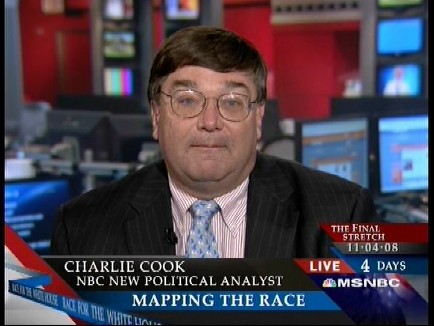 Charlie Cook got it right. Here is his firm's analysis of what the election says about the future:
"Democrats wanted this election to be about more than just winning the House or the Senate. They wanted 2018 to be a total rebuke of Trump. A wipe out of epic proportions all across the country. That didn't happen. What we saw instead was more of a retrenchment. Red areas stayed red; blue areas stayed blue. The only real movement was in districts that were purple — districts that had voted for Hillary Clinton, Barack Obama or had narrowly supported Trump- tipped overwhelmingly to Democrats. As my colleague David Wasserman pointed out, Democrats didn't flip any district that Trump had carried by 55 percent or more."
anonymous writes:
It would appear it is going to be a long, hard slog for the D's in that regard. The economy, though hotter than a hotel Coke, and acknowledged by the media is not yet being felt and celebrated on Main St to the extent it seems it should have been.
Half of America, and the other 96% of humanity outside of America, still believes we are in the darkest of times. Of the un-retired, everyone in the private sector, is still shuffling about in a glossy-eyed PTSD-like state from the protracted period of essentially no economic growth, despite substantial population growth in that period. Women in their late 40s to early 60s and older probably in the worst shape from it if they are single.
Millennials, in the main, still hunkered by the tens of millions in their parents basements with their incredible dildo collections.
We have not emerged culturally from the past depression. This is going to take a while, this will not be like the 1980s or it's brother, the 90s, and the reason I believe that not only do the D's have an uphill battle, needing to find a new voice, a new platform–a new direction, but the distance between where we are in terms of economic optimism and where we have been in times past (where the backdrop, sans anything going on policy-wise, has been nowhere near as rosy as now) in terms of euphoria, is a gaping chasm still. More reason why I believe this thing will run longer and go farther than any of us think it will.
Comments
Gregory Rehmke on November 12, 2018 11:37 pm
“For now we see through a glass darkly” But new lights are shining across the U.S. economy and the world. A Vox post reports the decline of extreme poverty. Child mortality is down. Every measure of human flourishing is up, but on average and not for everyone, everywhere. A billion less people in absolute poverty now than just 8 years ago. That’s progress.
https://www.vox.com/future-perfect/2018/11/8/18052076/human-history-in-one-chart-industrial-revolution
The Industrial Revolution that lifted Western Europe and the U.S., then Japan, has lifted the people of China and around southeast Asia. The intense debate from the 1930s to 1980s over capitalism vs. communism vs. socialism has shifted to debates of income inequality, immigration, climate change, and more or less socialism at the margins. These are debates worth engaging.
More debates about the Industrial Revolution, Great Depression and New Deal, and Great Recession would be good for students, teachers and parents. I suggest various videos and posts here: http://economicthinking.org/brookings-benefits-debate/
The Industry, from anonymous
Peter Schiff was the first one where I realized there is an actual gloom-and-doom industry full of people who consistently predict disaster, and then every X years there is a big market downturn, and they can claim to have been right all along, and the cycle starts again.
Comments
nik on November 12, 2018 4:44 pm
… as is jim rogers, the biggest crook Armstrong, to name a few
Spy Books, from Peter Ringel
 The chair wrote about Macintyre's new book about A. Gordievsky. That book references the autobiography of Victor Cherkashin, the KGB Spy master on the other side (co-written by Gregory Feifer Spy Handler, 2005).
I can recommend that book–at a minimum for it's epilogue, "Lessons of Cold War Espionage":
"With Russian and American intelligence agencies again gearing up after the brief if partial truce following the Soviet collapse, what lessons can be learned from the Cold War espionage game?
Anyone who has read this far knows my conviction that intelligence work is less politically important than it may seem. During the Year of the Spy, CIA and KGB operations represented little more than intelligence games. Their connection to real issues of national security, such as stealing military/technological secrets—let alone to the larger national interest as a whole—was often peripheral. Mostly they tried to ferret out moles and recruit enemy intelligence officers."
The Gordievsky episode seems to confirm this.
The other thing about Macintyre's book is I noticed that Gordievsky accused his 1985 KGB interrogators of Stalinist Terror tactics, while interviewing him, under drugs. That angered and confused his ex-comrades and finally helped saving Gordievsky's life.
Maybe there is a trading lesson here. Make your opponent emotional.
Anniversary: Asia Takes the First Step Towards killing 100 Billion People in War, from Stefan Jovanovich
 The choice for Japan was whether they would follow a European or American model of Empire. Would their Korean colony have the promise of Independence, like the Philippines, or would it be like French Indo-China and the Dutch East Indies and British Malaya? For Hara Kei the American model made sense; European colonies rewarded permanent bureaucracy–the very political economic disease that Japan itself had suffered under.
On this day in 1921 the first commoner prime minister was stabbed to death in the name of Imperial glory.
The Spy and the Traitor, from Victor Niederhoffer
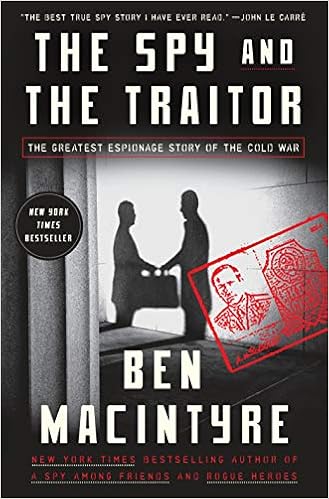 How many of the activities of spying with their misinformation, dangles, floaters and honeytraps, emphasis on the false, and hiding of the true, in general, have counterparts in markets?
I was led to consider this by a reading of the excellent book The Spy and the Traitor. Perhaps most resonant to me was the warning against seeking confirmation from a third party of something you already believe. The false confirmation that the D-Day bombing would be at Calais and the false belief that there were weapons of mass destruction in Iraq and the belief that an imminent nuclear attack on Russia were 3 examples cited by Macintyre in the book. The idea of searching for regularities among market moves that you know will confirm the regularity is horse from same garage.
Jim Sogi adds:
Spycraft, a meticulous attention to details of deception, is important to spies and traders.
Never brag of success. Don't trust those who do.
Place orders in hidden unexpected places and disguise them and the size.
Use the element of surprise when entering a market.
Test the waters or market before committing all the way like the Commodore in Lefevre.
Never listen to the disinformation laid like traps.
Be prepared for pain under torture.
Understand the triple cross and the double cross always at play and how to use it against your counterparty.
Yeah, I read lots of spy books.
Peter Ringel writes:
Great one-liners. The double/triple cross reminds me of myself searching for a bottom.
Comments
TC on November 1, 2018 6:25 am
I always smile at the unbridled narcissism of bankers, traders, lawyers who envision themselves in epic battles, describe losses as a catastrophe, or tell each other they’re heroes or see themselves as some sort of 007 swinging from market to market.. Why? A battle is where people die, get maimed and see horrible things, a catastrophe is when a river overflows in Indonesia and 50 people die, a hero is someone who acts selflessly for others and if a spy gets caught, he ends up in jail or worse.. Folks in financial services simply move money around and hope to get a slice of it to pay for the house in Greenwich and a mistress on the UES. At worst you lose money, and its not even yours usually and get sent home.
Book Recommendation: Factory Girls, from Mr. Isomorphisms
I missed this book Factory Girls: From Village to City in a Changing City back in 2008, but can now recommend it to dailyspec readers. There were 130 million Chinese migrant workers at that time, and this is the story of two. Sex differences, family trade-offs, freedom, outsourcing–all the meat of life and capitalism is there. Cheers.
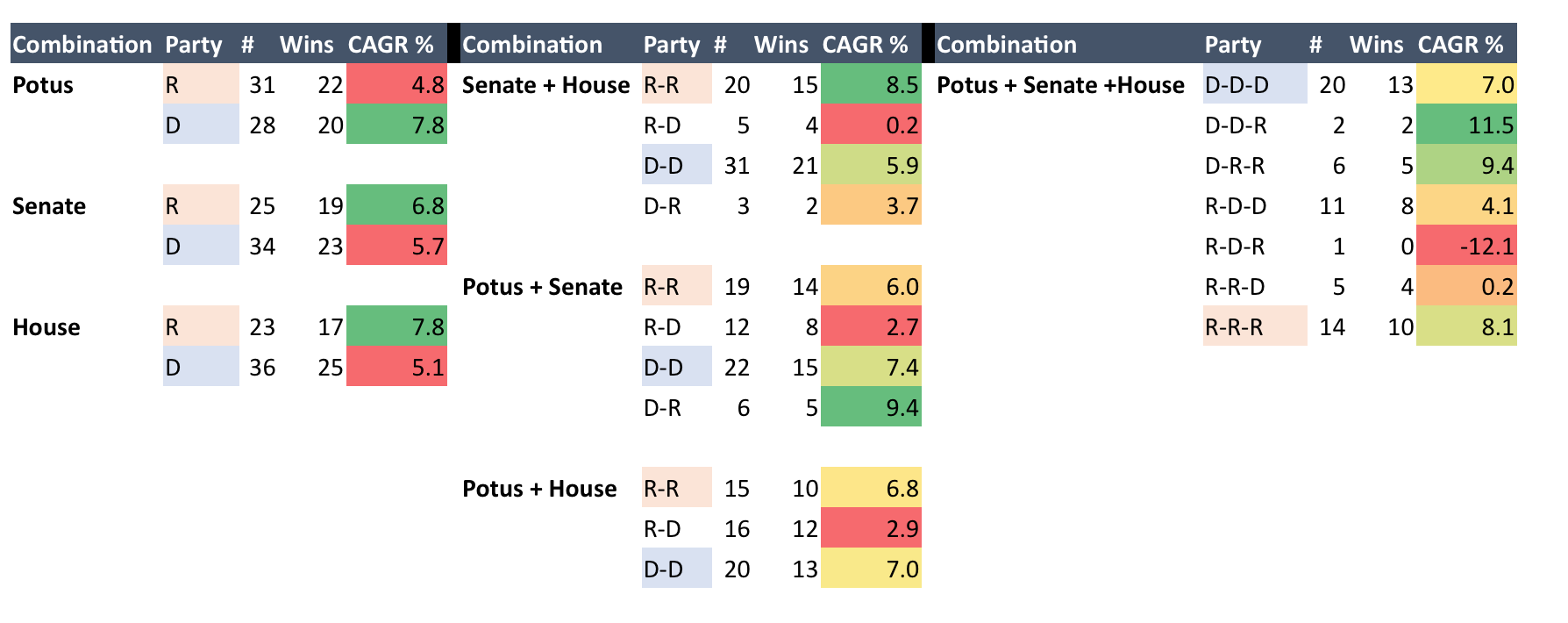
Average DJIA Returns Over 2 year Period Since 1900, from Kora Reddy
Under various combinations, for your mid term election campaigning purposes!
Shoe Shortage? from Bill Rafter
 I am always impressed with how speculation is crowd oriented. This is particularly true when one company in an industry is targeted for acquisition and its industry mates rise in sympathy.
OK, that's a given. However at this particular time there are a number of companies in the "footcare retailing" business giving similar signals. What happened? Did Americans wake up and realize that they were shoeless?
Roughing It, from Victor Niederhoffer
Mark Twain's Roughing It has a 200 page description of a silver boom in 1867 that contains all the hopes and agonies and easy money of many booms and busts since then and is a better description of great rises like Nasdaq in 1999 and bitcoin in 2017 than any other work. It is strongly recommended.
Comments
Daniel Dabek on November 7, 2018 11:35 pm
Looking at Nasdaq rise with a 3.7T marketcap; bitcoin has not yet touched on 1T marketcap; Bitcoin has yet to do its thing.
More Tariffs? I Hope Not, from Jeff Watson
There is a good chance of more tariffs in the near future.
Currency AR Pesos, from Zubin Al Genubi
I'm in Argentina on the way back to Antarctica on a ski expedition. The dollar is 36 pesos which is a 450% increase from the official rate two years ago and 250% increase from the black market rate. Things are quite cheap in dollars: a cappuccino is $1.50 and a beer is $2!
I wonder what the effect is. Cash has depreciated. Imported goods inflated. What about real estate? Goods and assets held and debt is better than cash. Prices for food don't seem to have increased much so the core inflation doesn't seem to have jumped. Hotel was very cheap.
There are a lot of tourists, including the ubiquitous Chinese in buses. Formerly stalled building projects are completed. The government floated the peso which got rid of the black market and presumably enabled building loans to go forward.
I've never experienced an exchange rate change this extreme. It's an interesting study for a student of currencies. Our site has a currency martial arts expert and am curious on his take.
anonymous writes:
Scott Grannis posted an optimistic & compact article on Argentina last month: "If Macri and his new central bank leadership team can stay the course, the upside potential of this struggling emerging market economy is HUGE."
Not in the article:
- I think Argentina has the most usable shale oil of all South American states- Argentina was once the leading country in South America
- (if they can shake the socialism)
Scary Headlines, from Ralph Vince
And at this very minute, the ten day correlation between VIX and he S&P 500 is -.97. VIX is running a positive carry both to cash and futures months more distant for any given futures month.
It is a condition which, if persists, allows a portfolio manager to in effect get a completely free lunch via Markowitz. Either stocks go up in the not-too-distant future, or the carry on VIX goes negative again (which occurs….when stocks go up).
Speculators: Then and Now, from Pete Earle
 From Hamon's New York Stock Exchange Manual, 1865:
"Great gains usually alternate with great losses in this kind of business. One would think that jobbers would soon die of worry and anxiety, and often enough they are seen to be very 'down in the mouth'. But nature is kind, and fits the back to the burden, or rather most of these men have been born with the peculiar temperament of the speculator.
They have an extra amount of hopefulness, and get through life with more excitement, indeed, but hardly with less equanimity on the whole than other men engaged in trade."
Marie Curie, from Jeff Watson
 An interesting article on how Marie Curie spent WW1 learning radiology and setting up portable x-ray machines to attend to the wounded soldiers.
Pitt T. Maner III writes:
Ironic that one of Madame Curie's daughters, Irene, developed leukemia from probable exposure to x-rays too and likely radioactive material (lab explosion) and died even younger than her mother at the age of 58.
Madame Curie's other daughter Eve, the non-scientist/pianist, however lived to be 102.
1) From Eve Curie wiki–'She sometimes joked that she brought shame on her family. "There were five Nobel Prizes in my family," she joked, "two for my mother, one for my father, one for [my] sister and brother-in-law and one for my husband. Only I was not successful…".
Apparently all of M. Curie's descendants have been at the genius level–even the living great, grand children.
Polling Report, from Stefan Jovanovich
RCP's current list of "Swing Districts" totals 49. This includes the following districts held by Republicans: 3 that are "Likely Dem", 11 "Lean Dem" and 31 "Toss Up". It also includes 4 districts held by Democrats: 1, "Toss UP", 2 "Leans GOP" and 1 rated "Likely GOP". So far, I have analyzed 31 districts, including the 5 reviewed today.
The total pick up for the Democrats so far is 6 seats. Adding that to the seats the Democrats now hold (193) gets them to 199 and reduces the Republican majority to 229. If the Democrats win all 15 of seats held by Republicans in the races I have not yet reviewed, the two parties would be EVEN, each with 214. Control would then be determined by the 7 remaining "surprise" districts. Those would be among the 56 districts I had not planned to review: the 18 Democrat seats that are "Likely" or "Lean" Democrat and the 38 Republican seats that are only (sic) "Likely" or "Lean" Republican.
My dedication to sloth leads me to pray that the Democrats will only pick up another half dozen seats from the 18 remaining to be reviewed. That would leave the Republicans with 223 seats - a loss of 18 seats from the results in 2016 - and not require any further labor on my part. The odds are in my favor. There has been only 2 elections since 1952 in which a Republican President had a majority in the House of Representatives during the mid-term elections of his first 4 years in office: (1) Eisenhower in 1954 and (2) Bush II in 2002. In 1954 the Republicans, who had an 8-seat majority, lost 18 seats. In 2002 the Republicans held a 9-seat advantage and gained 8 seats, increasing their majority to 24 seats. For the Democrats, since Eisenhower, their President's first mid-terms with them in charge of the House, have been these: Kennedy in 1962, Johnson in 1966, Clinton in 1994 and Obama in 2010. In 1962 the Democrats lost only 4 seats from their 87 seat majority; in 1966 they lost 47 but that was from a 155 seat majority. Clinton's first mid-term was a complete disaster. For the first time since the 1952 election, the Republicans won the House of Representatives - winning 54 seats and turning an 82-seat minority into a 26 seat majority. Obama's first mid-term was even worse; the Republicans gained 63 seats and a 49 seat-majority, destroying Speaker Pelosi's 2008 moment of glory when the Democrats had won an 87-seat majority. In that election the Republicans outpolled the Democrats by 6 million votes.
It may be that the Democrats' belief in a "wave" this year is a projection of what has recently happened to them. It is certainly not a dispassionate assessment of what happened to Ike and Shrub in their first mid-terms.
The List of Real Clear Politics "Swing" Districts: The 18 districts that remain to be reviewed are identified by *.
PA-1,PA-5, PA-6, PA-7, PA-14, PA-17 D+2
NJ-2 D+1
CA-49 D+1
IA-1
MN-3
AZ-2 D+1
CO-6
KS-3,KS-2
NJ-11
MN-2
VA-10 D+1
CA-10
CA-45
FL-26
IL-6
MI-8
MI-11
NC-13*
NM-2*
NY-22*
TX-32*
VA-7*
CA-25*
CA-48*
FL-27
IL-12
KY-6
MI-11*
NJ-3
IL-6
NV-3*
UT-4*
WA-8*
CA-39*
FL-15*
IA-3*
IL-14*
ME-2*
NC-9
NJ-7
NY-19
TX-7
VA-5
MN-8*
MN-1*
KS-3,KS-2: KS-3 has Kevin Yoder as the Republican 3-term incumbent; it is Cook R+4. Ms. Clinton carried it by 1 point; but Yoder beat his Democrat opponent by 11. That was a decline from Yoder's successes in 2012 (37 points) and 2014 (20 points); but hardly seems to justify the NY Times calculation that the Democrat challenger Davids is now ahead by 9 points. What does affect Yoder's chances is the 3rd party factor. The Libertarian candidate polled 8% of the total ballot in 2016; and 2018 will be the first of Yoder's races in which there will be both a Democrat and a Libertarian on the ballot. Still, it is hard to see how Emerson comes up with having the Democrat up by 6. It is equally mystifying trying to understand how Emerson manages to put the Democrat up by 4 points in KS-2, a district that is Cook R-10 and also has a Republican incumbent, Lynn Jenkins. Jenkins first won the seat in 2008 defeating the incumbent Democrat Boyda by 4.4 points in a race in which the 3rd party candidates won over 3% of the vote. Since then Jenkins has won 63,57,57 and 61 per cent of the total vote. Yet these two incumbent Republicans are a Toss Up at best in a state where the President is still popular and Trump won by 21 points. That conclusion becomes even weirder when you find that Emerson's affiliation data for its Statewide sample has party registration at R-52, I/O-20, D-28. (For individual Congressional districts they have only done "e-Polls"; and those do not offer sample data or any estimates for 3rd party candidates' likely vote total.) I am afraid that the Emerson poll falls into the PAGI-BWO category (Progressive Academic Garbage In=Blue Wave Out.). Whatever is wrong with Kansas continues to be wrong; Republicans win both races.
FL-26 is a district that, by all 538-style model calculations, should be a lock for the Democrats. It is Cook D+6, Obama carried it by 11 1/2 points and Clinton by 16. Yet, the incumbent Republican Carlos Curbelo managed to win 53% of the total vote against both a Democrat and Independent challenger. The Mason-Dixon poll has Curbelo up 1 point on his Democrat challenger; their sample shows Party Registration as R-33, I/O-30, D-37. Curbelo's incumbency is likely to prevail, especially since his challenger's surname is Mucarsel-Powell is unforgivably diverse in a district where 4 out of 10 likely voters self-identify as Cuban.
IL-6 is Peter Roskam's suburban Chicago district. Roskam matters. He is the Republican Chairman of the House Ways and Means Subcommittee on Tax Policy. He began in the House in 2006, when he beat Tammy Duckworth by 2 points. Since then, he has never been seriously challenged. His margins of victory have been 18 (2008), 26 (2010), 18 (2012), 26 (2014) and 18 (2016). Even the Times is gracious enough to concede that he is ahead by 1 point in their September poll. Republican wins.
MI-8 has a 2-term Republican incumbent Mike Bishop. The district is Cook R+4. Bishop won in 2014 by 12 1/2 points; in 2016 he won by 17 and Trump won by nearly 7. There is no sample data available for any of the polls; but they all (including the NYT) have Bishop defeating Elissa Slotkin the Democrat challenger. I agree.
China GDP vs. Market Performance, from anonymous
 So I was looking at statistics around China and noticed a couple things.
Chinese GDP has reportedly over tripled since 2006 while Chinese markets in dollar terms are only up 40%. In the meanwhile the US markets have doubled while GDP is up only 40%.
Has all the growth been in the private sector? Have earnings been secretly paid out to the party? Or are the GDP numbers likely false? Or something else entirely?
Books/articles on the subject would be appreciated!
anonymous writes:
Chinese GDP is tricky. There are 2 Chinese economies–the state economy and the private economy. The private economy follows short boom/bust cycles like the US economy in the 70’s/80’s, overall grows healthily but with high volatility and high frequency. The state economy is where the zombies are.
The PBOC believes that Chinese NPLs are effectively in the 15% range. They calculate this by counting all debt >180 days past due as delinquent, but crediting back about 20 cents on the dollar, because delinquent bank debt can be auctioned off to private investors at around 25c on the dollar.
Chinese gross debt is 250% of GDP. 15% of all debt as bad debt equals 37.5% of GDP. This was also true of other countries like Japan where for cultural reasons bad debt is not called bad debt.
Additionally, the bad 37.5% debt has grown at faster than the economy rate, as the private economy’s growth rate has slowed down and the government has effectively leaned harder on the bloated state sector to hit headline GDP growth numbers.
Michael Pettis has blogged a lot about this if you want to read the much longer academic version of this thesis.
The Most Sensible Thing, from Victor Niederhoffer
The most sensible thing out of the Fed in years.
"There's a New Bullard Rule That Finds No Need to Raise Rates"
By Steve Matthews (Bloomberg) –
Federal Reserve Bank of St. Louis President James Bullard is proposing a new monetary policy rule — effectively the Bullard rule — that updates popular policy guidelines such as the Taylor Rule and concludes there's no reason to raise interest rates further.
Bullard's benchmark adjusted the Taylor rule for developments in the past two decades, such as the weak link between the unemployment rate and inflation, the aging of the U.S. population and low inflation expectations.
"Incorporating these developments yields a modernized policy rule that suggests the current level of the policy rate is about right over the forecast horizon,'' or the next several years, Bullard said Thursday in a speech in Memphis, Tennessee. The Federal Open Market Committee discussed raising rates to a "restrictive'' level, or a rate that would slow growth, at its meeting last month, according to a record of that debate released Wednesday. Fed officials projected that rates would rise to 3.4 percent by 2020, their latest forecasts show. The Fed has raised rates three times this year and has penciled in a fourth hike, which is expected in December.
Bullard has been the most dovish Fed official the past two years. He's argued that the U.S. economy has been saddled with persistently low growth, so there is little need to raise interest rates much. His development of a rule is an effort to provide some academic justification to his viewpoint. "The modernized version of the Taylor (1999) rule recommends a relatively subdued policy rate path over the forecast horizon — similar to the St. Louis Fed's recommended path,'' Bullard said.
The Taylor Rule was developed by Stanford University professor John Taylor, who has preferred his original rule as a guideline for policy, which suggests further rate hikes are necessary.
Cagdas Tuna writes:
He can always find an excuse for not raising rates!
Polling Report, from Kim Zussman
They say the market is upset about the jump in bond yields but maybe she's anticipating a premature return to socialism
Stefan Jovanovich writes:
If I thought there was any reliable direct connection between elections and speculations, I would be tempted to join LW and you other clever traders and bet my "system" - which does better than average at guessing political horse races. I don't because, if there were any such link, I would not be able to pretend to be an expert in such company. You guys would already know the odds down to the precinct levels if that mattered.
I think, in fact, you all do know what matters regarding politics and money. Now that I am 60% of the way through the House "swing" districts, I are learning what the markets have already predicted: Jim Jordan is going to be the new Speaker of the House of Representatives. When that happens, the Federal budget and the Treasury's operations are going to be subject to the approval of the 21st century successor to John Sherman; and the shock is going to be that the national debt will be brought home. The taxpayers are going to become the Federal bond holders just as they did during and after the Civil War; and they are going to want tariffs and "sound" money to protect their investments, even as Confederate paper (aka Chicago municipal bonds) is allowed to evaporate.
Larry Williams writes:
If the new speaker shrinks debt stocks will get hit hard. Deficits are very bullish for equities.
Alex Forshaw asks:
Larry, why do you say that/how do you strip out correlation vs causation in this? The blowoff 1998-2000 top occurred among budget surplus and deficits are inherently counter cyclical i.e. generally low in late cycle/high in early cycle (deficit as % of GDP biggest in 1981-83, during/after 2 recessions or 1 severe recession; 1991-93 after a fairly deep recession; 2002-03 after a recession; 2009-10 after a severe recession.) To the extent that the deficit is high adjusted for its place in the economic cycle (2012, 2018 ytd) it doesn't seem bullish. To the extent that deficits are unusually low cyclically adjusted (late 90s, 2007 arguably, 2015 arguably) it definitely does not seem bearish.
Larry Williams replies:
I don't think it is correlation but causation. Large deficits means lots of money floating around the hood. That translates to expansion, building–which translates to jobs, and that to consumer spending, and that to corporate profits. I'm traveling so lack data. The "one and only" Mr Vince may wade into this with data.
Ralph Vince responds:
25+ years ago I bought the Commerce Dept Database of 900 data items, and set u p a program (that would take two months to run, with a math coprocessor no less!) to examine each pairwise data set, and for each pairwise data set, to skew them +12/9/6/3/0…/-12 months, and record only those dataskew pairs with absolute value of correlation > some value (I forget which, but it was quite high).
One of the (many) dataskew pairs that filtered through very highly was that of federal deficits and economic growth (and broadly, we can stipulate that ROC of economic growth correlates to equity returns). The greater the deficits, the greater the market gains.
There were periods that did not fit this pattern, of course, it was not absolute (one out-of-sample period being the Robt Rubin era which was yet to transpire).
My guess is like the Senator's here; greater money floating around menas greater economic activity. I think it;s even a deeper causation than that. I would define it by saying that debt needs be repayed only once (if ever, it can also be perpetually rolled — the "problematic" nature of this is solely a function of rates. If manageable due to rates, it is virtually nothing. Further, even if rates become problematic, the yield curve itself provides an avenue of release — cue Rubin again), whereas the borrowed dollar can circulate multiple times.
So there is the multiplier effect of borrowed money vs the borrower's asset which is a one-time shot
If it weren't for borrowing, in particular the fractional banking system, we'd be in the year 1,000.
Book Recommendation: On Desperate Ground, from Victor Niederhoffer
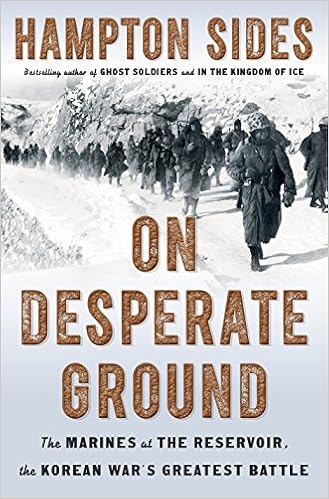 The history and events of the battle of Chosin during the Korean War has been described as the best depiction of a battle ever.
Michael J. Edelman
TOP 500 REVIEWER VINE VOICE
5.0 out of 5 stars
A superb, literate, popular history that illuminates the greatest battle of the Korean War
August 17, 2018
It's not often that you come across popular history that reads like good literature. On Desperate Ground follows the First Marine Division from their landing at Inchon to their legendary route at the Chosin Reservoir, and manages to be both detailed history and gripping narrative. Author Hampton sides provides a detailed look at the men, the commanders, the strategies, the terrain, and the politics for not just the Marines and allied Korean and UN troops, but also their North Korean and Chinese opponents.
If there's a hero in this book it is Marine General Oliver Smith, commander of the First Marine Division and architect of the Inchon landing. It was Smith who turned MacArthur's plan- "We will land at Inchon"- into reality, and it was Smith who led the breakout and retreat from Chosin, managing to extract the 100,000 soldiers of the American X Corps and Republic of Korea I Corps along with nearly 98,000 citizens, surrounded by 120,000 soldiers of the Chinese PLA. Smith's nemesis was his direct commander, Major General Ned Almond. Almond was one of MacArthur's inner circle of trusted aids, or as others often characterized them, toadies. Almond had an undistinguished career in WWII, and blamed his poor performance leading the 92nd Infantry in Italy- which he blamed entirely on his African American soldiers. His racism extended not only to his troops, but to Filipino troops who were part of the UN forces, and to the Republic of Korea troops, who had shown themselves to be fierce fighters in the battles to retake the South. Alexander Haig, who was an aide to Almond in Korea, wrote that "[Almond] was not a believer in the racial integration of the Army, and thought those of us who were, such as myself, were in the need of education, or perhaps something stronger, to wake us up to reality."
Having secured Inchon and driven the North Korean soldiers from South of the 82nd Parallel, MacArthur decided to push North to the Yalu, and chose Almond to lead that campaign, much to the dismay of Smith and others. Almond had his forces advance along narrow roads, making resupply or reinforcement difficult or impossible. Smith and others warned that Almonds plan was a dangerous division of forces, to which Almond maintained that North Korean forces would not put up a fight. Almond also echoed MacArthur's opinion that, contrary to intelligence assessments, China would not intervene, and even if they did, they were not a significant fighting force. Meanwhile, hundreds of thousands of PLA soldiers were preparing a trap for invasion forces.
The results of MacArthur's grand strategy and Almond's ground tactics are well known. UN forces encountered a massive PLA force, and despite superior tactics, weapons, and experience, found themselves outnumbered and encircled. Author Hampton Sides follows the progress of the battle and retreat through the eyes of commanders and individual Marines, soldiers, and airmen. It's a powerful, realistic, narrative and a book I recommend highly to anyone with an interest in the Korean war.
It depicts the arrogance of General Douglas MacArthur very well and provides a nice example of how arrogance and self promotion can lead to terrible consequences.
One anecdote is priceless. The US Marines called for ammunition which they nicknamed tootsie rolls. The headquarters in Japan thought they wanted the candy rather than ammunition. Tens of thousands of tootsie rolls were delivered and the tootsie rolls were used by the engineers to plug holes and as an adhesive and became the most desirable currency of the engagement.
Comments
Paul Wankmueller on November 6, 2018 12:27 am
Hampton’s other book “Hellhound on his Trail” is an excellent book about James Earl Ray. One of my favorites.
Generic Ballot Polling, from Stefan Jovanovich
The generic ballot poll for the House of Representatives, which was, until this week, the best evidence for the predicted "Blue Wave", asks a sample of adults, registered voters and/or likely voters which major party they favor for "Congress" (the word of both the House and the Senate has, in modern parlance, come to mean only the House).
The logical flaw in using such a poll is that no office in the Federal government is determined by a national vote–not the President, not the Senate, not the House. But, the poll does have the great advantage of being easy. The only alternative is to go by individual House district; I am not even 30% of the way through the "battleground" House districts, and I am - for the first time in my sedentary life–beginning to have a sense of what long-distance runners mean when they discuss "hitting the wall". I promise to finish; but getting the data for each House race is a long slog.
That is why I am following 538 and taking the easy road for an hour this morning.
But, I can't be a complete cheat. No political poll, of any kind, avoids GIGO if it does not disclose its sample's partisan allocation. It will not surprise any of you to learn that the New York Times and the other most frequently cited generic ballot polls are scrupulous about not providing any such useful data. I did find one polling organization that has gone against the GIGO trend. The YouGov people have been remarkably forthcoming about how they get their numbers. In their CBS/You Gov Tracker poll, their sample data for party ID is R-42, I/O-15, D-43; for political affiliation it is Conservative-38, Moderate-32, Liberal-30. What they do not disclose is their methodology for converting these sample numbers into their overall prediction: R-48 and D-52.
I can explain how they get there, but I was not able to find any explanation of the why. The recipe for How works by taking the middle third of voters - the Moderates - and asking the Lean question in such a way that more than 3 to 1 favor of the Democrats. The result of their party ID inquiries is to assign 13 points to the Democrats and 4 points to the Republicans. That reduces the "middle of the road" share of the electorate to 1/7th. To get to their final D +4 result, their algorithm assigns 60% of the Independent/Other vote to the Democrats and 40% to the Republicans.
When YouGov did a second generic ballot poll for the Economist, they queried 1500 adults. Their bottom line result was similar to the one from their CBS tracking poll: D +6. But, here, too the How and the Why seem very much at odds. Their political affiliation numbers show a slight leftward variation on the common 1/3rd, 1/3rd, 1/3rd distribution pattern. Their sample has Conservative - 31, Moderate - 34 and Liberal - 35. But, that somehow shifts to a Party ID landslide for the Democrats: Republican - 23, Independent - 42, Democrat - 35. Where the numbers get really strange is in the data for 2016 voting. The 931 respondents who voted in the last Presidential election produce a sample that is divided Republican - 45.8 and Democrat 54.2.
But we know that the actual vote count was Republican - 62.98M and Democrat - 65.84M. That was Republican - 48.9 and Democrat - 51.1. Somehow a sample that should, to be representative of known ballot numbers, have a D +2.2 margin ends up with a D +8.4 spread.
No wonder the statistical affiliates of the party of Native American heritage prefer national algorithms above all else. They are not only easier but they always give the right answer.
Canes, from Zubin Al Genubi
 The hardest part is resting on your oars, but 58pts is a good time to ease off leverage. I think Ralph is right and there is more to go. Unlike RG I can't wait to learn patience.
Peter Pinkhasov writes:
Most of the close to close stats I'm seeing for such a decline are coming with the narrative that "but it has a potential to go lower" which I think takes away from being data and analytically driven to make decisions. I think with the large move in short term rates, it's better to use that as an independent variable for forecasting future returns given we have seen a new interplay in the last two weeks between stocks and bonds.
Ralph Vince writes:
The upmove in st rates is and has been exceedingly bullish here.
Poling Report, from Stefan Jovanovich
Maine - The Suffolk poll is wonderfully detailed. They break down their registered votere sample into R, D, I and then add Green and Libertarian. They also distinguish between Unenrolled (which they include with Independent) and Undecided. R-28.6,I/U-33,R-28.6,G-1.2,L-.6,U-2.8. Eric Brakey, the Republican, has no chance, given the bias of the Democrats in favor of King, the "Independent" (sic).
Vermont - No one has bothered to take a poll. Socialism rules! Sanders is anointed again.
Rhode Island - The "conservative" news had a recent flurry of articles about how this might be a competitive race. It is not. The most recent UNH poll sample has the electorate R-28, I-24, D-48. Whitehouse in the usual landslide.
Connecticut - Quinnipiac has given up on telling us what its samples contain; but their estimate for the race is not going to be so far off as to give the Republicans an upset. When Gravis did a sample earlier this year, it was R-26, I/O-34, D-40. Murphy is re-elected easily.
New Jersey - The news may say that this race is close; but it is not. Fairleigh Dickinson's poll sample has the state: R-36,I-8,D-56 among Likely Voters; yet it has the race as a statistical "dead heat" between the incumbent Democrat Robert Menendez and the Republican Hugin. More than 1 in 5 Democrats (22%) and nearly half the Independents (42%) declare themselves undecided. The problem for the Republicans is that it is still New Jersey. The statistical "dead heat" is Menendez-43, Hugin-37; and the odds are beyond hope that Hugin can somehow win 2 out of every 3 of the votes from the 20% of the electorate that has not made up its mind. Menendez will win because New Jerkers, especially women, seem to loath the Donald. Prediction: Menendez +4/5.
Pennsylvania - Franklin & Marshall's sample is R-40, I/O-8, D-52. Casey will be re-elected easily.
Maryland - This state makes California look purple. The Goucher Likely Voter poll sample is R-27, I/O-12, D-61. Cardin will win, even if he is in a coma on election day.
Delaware - Gravis sample: Conservative-32, Moderate-45, Liberal-23. On its face that might offer the Republicans a chance; but the term "Moderate" is now code for Democrat-leaning Independent. The sample shows the party affiliation as R-32,I/O-21,D-47. Their Likely Voter poll was taken in July and had Carper +8. The most recent poll - from the University of Delaware - offers no sample and has Carper +37. Carper should win easily.
Virginia - The University of Mary Washington poll has R-29,I/O-35,D-31 and C-37,M-31,L-32. Kaine, the Democrat, is not an attractive candidate; but he has the advantage of running in a 3-way race. The Libertarian candidate is likely to get 5% of the vote. Prediction: Kaine +8.
West Virginia - This race is really a Republican primary in drag. Manchin, the Democrat, was clever enough to not commit political suicide by voting against Kavanaugh; and his personal popularity is distinctly higher than Morrisey's, his Republican opponent. Gravis's likely voter sample has the state R-35,I/O-22,D-43. Trump has been to West Virginia for several rallies, but he has been careful not to criticize Manchin harshly, except at the one held before the Senate vote on Kavanaugh. The Republican party in WV is very much as the Republican party in Alabama was in 2017 - fractured by internal scandals. Prediction: Manchin +6. Commentary: Manchin will become the White House favorite for "bi-partisanship". He is likely to campaign for Trump in 2020.
Ohio - Suffolk's poll sample: R-34.8,I/U/O-23.8,D-38.4. Sherrod Brown, the Democrat incumbent, polls consistently with a double-digit lead. That will be the final election result.
Indiana - None of the polls - Ipsos/Reuters, Fox News, NBC News/Marist - deigns to disclose their sample. The RCP Average has the Democrat incumbent Donnelly +2.5 over the Republican challenger Braun. They show the Libertarian candidate Brenton getting 7% of the final vote. In the absence of any usable data, I am relying on the judgment of the brains of the outfit - Susan, who was born and raised in Evansville and whose mother still lives there. (Margaret Mead: "Everyone knows somebody from Evansville, Indiana"). She thinks Donnelly's vote against Kavanaugh was fatal. I agree. I also think the Libertarian vote will be half the RCP prediction; and Braun will be get those votes. Prediction: Braun +2/3.
Florida - Mason-Dixon poll sample: R-37,I/O-25,D-38. RCP's current average is Nelson, the incumbent Democrat, +2.4. The governor's race is equally tight. Prediction: Genuine Toss-Up.
Tennessee - Gravis poll sample: R-40,I/O-29,D-31 and C-39,M-42,L-19. Gravis had Blackburn, the Republican candidate, at +4 in August; CNN, with their usual bias, had Bredesen, the Democrat, at +5 a month later. The NY Times/Sienna poll from this week (as always, no sample data) had Blackburn +14. That is likely an exaggeration. TN is a Republican state; but Republican states never reward their candidates with landslides. Prediction: Blackburn +7/8.
Wisconsin - Marquette University's Law School poll sample data is wonderfully precise. They not only include the historical data of their previous samples. The sample for the current poll: R-47,I/O-8,D-44; when the pollsters exclude "leaners" it is R-33,I/O-36,D-30. Wisconsin's electorate is true to its good government heritage; and I do not offer that as a snarky comment. Their voters are genuinely independent-minded and have no difficulty in splitting their tickets - i.e. voting for candidates from both parties for the offices on the ballot in a single election. That is not good news for the Republican Senate candidate - Vukmir. The voters are likely to reward the Republicans by re-electing Scott Walker as governor and Brad Schimel as Attorney General and then by "fair" by re-electing Democrat Senator Tammy Baldwin. Prediction: Baldwin +7/8.
Mississippi - At least the GOP has one state where RCP and 538 concede that their incumbent hold a "safe" seat. Roger Wicker will be re-elected. Cindy Hyde-Smith will also win and take the seat Thad Cochran held before his retirement. There have been polls taken in MS but only for the "jungle" primary. No one is bothering to talk to the voters for the general election. The Democrats have Vermont; the Republicans have Mississippi.
Minnesota - Klobuchar is an absolute lock; but the race to fill the comedian's seat could be interesting. The Star Tribune/MPR poll sample is R-31,I/O-32,D-37; and they have Smith, the DFL (Democrat Farm Labor) candidate at 44, Housley, the Republican at 37, Other - 4 and Undecided - 15. That is less than half the margin of the latest poll from NBC/Marist, which offers no sample data at all. What makes this interesting to me is that Smith's lead is almost entirely from "Da Yute". There has been a flurry of new registrations among voters 18-30; and they hate Housley - perhaps because the old people like her. Housley is definitely a longshot; but the Michael Moore effect could easily take hold, especially if Minnesota has one of its lovely blizzards. And, MN is very much like its Southern neighbor, WI - a good government, ticket-splitting state. If I did trade, the Housley win would be the black swan option I would buy. Prediction: Smith +3
Montana - Remington Research offers its sample data: R-42,Non-Partisan-30,D-28 and C-47,M-38,L-15. RCP has the incumbent Democrat Tester at +3. It is the contest of Marine haircuts; both Tester and his opponent Matt Rosendale sport buzzcuts. Trump's popularity is likely to be enough to defeat Tester, especially since he was foolish enough to vote against Kavanaugh. Prediction: Rosendale +2/3
Washington, California, New Mexico, Utah, Wyoming, Nebraska. These states will all return the incumbents who are evenly split 3-3.
Overall Forecast: Republicans gain 3 to 5 seats. They are nearly certain to win Indiana, Missouri and Montana without losing Arizona or Nevada. They have a good chances to win Florida and a longshot to win the open seat in Minnesota. If you include Manchin's conversion to being the President's new and permanent bi-partisan best friend, the election could be enough of a gain for McConnell to decide that the 60-vote filibuster rule has to go so that Tax Cut - 2 and Build the Wall funding can be passed, either during the lame duck session or in the next Congress (if the Republicans keep their majority).
That will be the question for the next 2 weeks when I plan to review each of the 41 House races that RCP lists as either a Toss-Up or a Republican incumbent in a Lean Democrat seat.
One last snark for the weekend: Using the Generic Ballot for the country as a means of predicting the results in the House is the polling equivalent of the Hillary Clinton campaign thinking that total votes is the way you keep score in a Presidential campaign. It is truly Garbage Data In = Nonsense Out.
Premature Canes, from anonymous
 Canes need to be walked out when blood in the streets is almost dried. I think cane talk now is a wee bit early.
The market has been up for 9 plus years on monetary steroids–and we go down half-hard one day and folks are extolling and faux strolling out with their bullish canes???
Now that is perma bull–shiess.
Comments
Igor on October 13, 2018 4:22 pm
50 more percent, young bull
Opinions Wanted, from Ralph Vince
 I'm very bullish. I can take the pain of that (and in truth this "pain" is something of a joke compared to what we went through in the 80s and 90s). I won't even attempt to trade the short side and such a strong bullish Market this move notwithstanding. That makes the current situation all the more juicy for getting or building long position–even if Kora's research manifests here and it goes on to seeing lower prices. Higher highs in the coming weeks and months are inevitable. This thing is nowhere near a high in price, in valuation or sentiment.
Russ Sears writes:
Perhaps I am too conspiracy and paranoid minded, but I see a parallel to Kavanaugh seated and Trumps election where market participants on the left saw a tragedy, and quickly exited only to miss out on a nice bull market. Not that I think Kavanaugh seat matter much to the economy or markets direction. But when people work themselves up into turmoil the markets reflect more volatility as it's made up of people's emotions
Comments
Petter Dahl on October 12, 2018 8:51 am
Most likely the global credit cycle is peaking or has already peaked. If so, the smart money have been distributing stocks for months reducing their equity risk exposure. On the other side eager buyers has driven the equilibrium prices in stocks ever higher. Major stock indices has been lifted by fewer and fewer stocks ignoring the increasing numbers of 52w lows. Their eagerness to buy are based on higher prices in them self and positiv readings of coincident and lagging economic indicators. The sell side in the financial industry having an easy time, they just have to point out the window and tell the costumer that everything is fine. Also Warren Buffet thinks the only place to be is in the stock market, thats hard to ignore if you are a hard pressed investor afraid of missing out. Warren may have an 30-50 years investment horizon in mind? An important detail easy to overlook facing constantly rising stock prices. Some of the excesses have now been washed out in recent days. There are probably more to come as the credit cycle abates. Even if the GOP holds the control of the Congress after the elections the fiscal expansion will be limited, the US treasury market will make sure of that. The executive branch may try to influence the FED but have no power over the bond market. All thats left to look forward to is an average 2% growth in real US GDP the next decade and slow growth in earnings. During that time the equilibrium between buyers and sellers of stocks will probably find it self at much lower prices than we can imagine today.
Igor on October 13, 2018 4:12 pm
Partridge, RV Partridge
Publius on November 22, 2018 12:24 pm
6 weeks in, is it even juicier yet?
Halloween Trick? from anonymous
Perhaps it's a bit of a Halloween Trick by the Fed and the Treasury. Much like February this current selloff was triggered by the Jobs Report, all-time market highs and perhaps the Fed's need to unload a bunch of bonds. So if they talk down equities, and the market cracks, folks will run and gobble up all the bonds. What's the difference between 3.21% yield and 3.25% yield on the 10-year Treasury? Four beeps. Bupkes. A rounding error… What magically happened when the 10-year traded above 3.25% in early trading Tuesday? 3.25 is arbitrary. Why not 3.27 or 3.30?
Bonds China, from Jim Sogi
I've been pondering the big drop in bonds and the China moves and if they signal something was up.
Looking at bonds, I wondered why they dropped, who had the means and the motivation to cause such as drop. Looking at the move it appears concerted and done with virtually unlimited selling power. Game theory looks at means and motivation. Trump's recent lambast of the Fed gave me the clue. The Fed has the means and the motive to raise yields and they have expressly said they would use interest rates. They have a large inventory to sell, and rather than move the short end, moved the long end, maintained stimulus with the positive curve, but raised yields and thus put a bit of a damper on the works as we saw yesterday in the equities. The bond market is much bigger than equities so such a tectonic shift was bound to have repercussions. I was surprised how little comment resulted.
The other player who has the means and motivation is China. By raising yields, they strengthen the dollar by enough to offset any tariff, and encourage trade with China.
If I Was a Gambling Man, from Ralph Vince
If I was a gambling man, I'd be getting very long here.
6-week weekly coefficient of variation in SPX calling for a major move.
Volume Thurs and Fri say to be a buyer on weakness.
A certain alliteration in the way prive & volume work on the short term is occurring here. OooOooOO this is hard!
Thurs SPY volumes on and Friday SVXY volumes - indicating to be a buyer on weakness in the coming day or two, followed by a little weakness this morning, and I'll double down on the gambling man proposition. (I have other signals too confirming this, but not going into the long-winded diatribe here at this time).
It;s hard because that 6 week weekly coefficient of variance, calling for a good, prolonged market run in one direction or the other, could be signalling a drop much further from here. But the odds favor the upside, so does the nose.
Comments
Daniele on October 10, 2018 6:03 pm
how about now?
Today’s Date is a Palindrome, from Sushil Kedia
8/10/2018!
What inspiring ideas do speculators derive from palindromes and the Palindrome?
Thoughts, from Peter Ringel
The NAFTA/USMCA success is significant for the US economy.
Note how Canada was played against Mexico and negotiated between the two. A success for the Trump camp (& staff).
Next on the calendar are trade negotiations with Japan and China. They will be seemingly independent events, but there is an interrelation, since both compete for the US market and both will watch the deal of the other side.
After that, I think, comes Europe.
Trump and others hint at India FTA.
Real Return, from Greg Van Kipnis
I attached the latest calculation for the yield on TIPS. The prices across the board have dropped rapidly in the last few days to the point were greater than 1% real yields can be realized above the CPI on Treasuries for maturities as short as 2022. I find this quite surprising. Any thoughts about the pros and cons of this opportunity which hasn't been seen in years.
Treasury Inflation-Protected Securities
Friday, October 05, 2018
Treasury Inflation-Protected Securities, or TIPS, are securities whose principal is tied to the Consumer Price Index (CPI) . The principal increases with inflation and decreases with deflation. When the security matures, the U.S. Treasury pays the original or adjusted principal, whichever is greater. TIPS pay interest every six months. Figures after periods in bid and ask quotes represent 32nds; 101.26 means 101 26/32, or 101.8125% of 100% face value; 99.01 means 99 1/32, or 99.03125% of face value.
| Maturity | Coupon | Bid | Asked | Chg | Yield* | Accrued principal |
| 2019 Jan 15 | 2.125 | 100.10 | 100.12 | + 1 | 0.770 | 1173 |
| 2019 Apr 15 | 0.125 | 99.15 | 99.17 | + 2 | 1.022 | 1075 |
| 2019 Jul 15 | 1.875 | 101.08 | 101.10 | unch. | 0.160 | 1180 |
| 2020 Jan 15 | 1.375 | 100.22 | 100.24 | + 1 | 0.791 | 1165 |
| 2020 Apr 15 | 0.125 | 98.20 | 98.22 | + 1 | 0.989 | 1076 |
| 2020 Jul 15 | 1.250 | 101.01 | 101.03 | unch. | 0.622 | 1155 |
| 2021 Jan 15 | 1.125 | 100.14 | 100.16 | unch. | 0.898 | 1152 |
| 2021 Apr 15 | 0.125 | 97.25 | 97.27 | unch. | 0.998 | 1063 |
| 2021 Jul 15 | 0.625 | 99.17 | 99.19 | - 1 | 0.771 | 1118 |
| 2022 Jan 15 | 0.125 | 97.09 | 97.11 | - 1 | 0.950 | 1113 |
| 2022 Apr 15 | 0.125 | 96.28 | 96.30 | - 2 | 1.014 | 1036 |
| 2022 Jul 15 | 0.125 | 97.09 | 97.11 | - 1 | 0.845 | 1095 |
| 2023 Jan 15 | 0.125 | 96.14 | 96.16 | - 2 | 0.966 | 1091 |
| 2023 Apr 15 | 0.625 | 98.09 | 98.11 | - 2 | 0.999 | 1014 |
| 2023 Jul 15 | 0.375 | 97.18 | 97.21 | - 3 | 0.880 | 1082 |
| 2024 Jan 15 | 0.625 | 98.03 | 98.06 | - 3 | 0.981 | 1080 |
| 2024 Jul 15 | 0.125 | 95.13 | 95.16 | - 4 | 0.927 | 1061 |
| 2025 Jan 15 | 0.250 | 95.06 | 95.09 | - 4 | 1.031 | 1064 |
| 2025 Jan 15 | 2.375 | 108.03 | 108.06 | - 6 | 1.024 | 1337 |
| 2025 Jul 15 | 0.375 | 95.30 | 96.01 | - 6 | 0.982 | 1062 |
| 2026 Jan 15 | 0.625 | 96.27 | 96.30 | - 7 | 1.065 | 1060 |
| 2026 Jan 15 | 2.000 | 106.15 | 106.18 | - 7 | 1.060 | 1269 |
| 2026 Jul 15 | 0.125 | 93.08 | 93.11 | - 6 | 1.019 | 1051 |
| 2027 Jan 15 | 0.375 | 94.11 | 94.14 | - 7 | 1.080 | 1043 |
| 2027 Jan 15 | 2.375 | 110.04 | 110.07 | - 8 | 1.080 | 1249 |
| 2027 Jul 15 | 0.375 | 94.11 | 94.14 | - 7 | 1.041 | 1030 |
| 2028 Jan 15 | 0.500 | 94.21 | 94.24 | - 9 | 1.098 | 1021 |
| 2028 Jan 15 | 1.750 | 105.21 | 105.24 | - 9 | 1.097 | 1203 |
| 2028 Apr 15 | 3.625 | 122.18 | 122.23 | - 12 | 1.104 | 1558 |
| 2028 Jul 15 | 0.750 | 97.00 | 97.06 | - 9 | 1.056 | 1004 |
| 2029 Jan 15 | 2.500 | 113.11 | 113.16 | - 12 | 1.106 | 1173 |
| 2029 Apr 15 | 3.875 | 126.31 | 127.04 | - 14 | 1.131 | 1533 |
| 2032 Apr 15 | 3.375 | 127.21 | 127.26 | - 17 | 1.147 | 1419 |
| 2040 Feb 15 | 2.125 | 116.28 | 117.02 | - 34 | 1.216 | 1166 |
| 2041 Feb 15 | 2.125 | 117.16 | 117.22 | - 37 | 1.219 | 1150 |
| 2042 Feb 15 | 0.750 | 90.04 | 90.09 | - 34 | 1.231 | 1115 |
| 2043 Feb 15 | 0.625 | 87.03 | 87.08 | - 35 | 1.233 | 1096 |
| 2044 Feb 15 | 1.375 | 102.29 | 103.02 | - 38 | 1.234 | 1081 |
| 2045 Feb 15 | 0.750 | 88.29 | 89.02 | - 38 | 1.238 | 1070 |
| 2046 Feb 15 | 1.000 | 94.10 | 94.16 | - 41 | 1.238 | 1063 |
| 2047 Feb 15 | 0.875 | 91.06 | 91.12 | - 40 | 1.238 | 1044 |
| 2048 Feb 15 | 1.000 | 94.03 | 94.08 | - 46 | 1.234 | 1022 |
*-Yld. to maturity on accrued principal.
The Moves, from Victor Niederhoffer
The moves from the open to key afternoon hours can be thought of as a lever. The fulcrum would be say, the 1:00 pm price. We can either be above the fulc or below the fulc.
Effort is the move from the open to key afternoon price.
Comments
Pete M on October 3, 2018 4:06 am
Should the location of the fulcrum factor into the amount of effort?
Chez Galton, from Steve Stigler
Took a pilgrimage to a hallowed place.
Best,
Steve
[The plaque reads: Sir Francis Galton, 1822-1911, explorer statistician, founder of eugenics, lived here for fifty years].
Comments
Andre Wallin on October 2, 2018 8:38 am
Slab city at the top of dailymail. Is society having an exhistentisl crisis?
The Art of the Deal, from Stefan Jovanovich
 Whoever is running the vote counting at the White House is really good. The Flake compromise is artful. The nomination is now on the floor of the Senate, and he and Coons, Flake's bi-partisan comrade, have agreed that the FBI will investigate only the 3 current allegations and no new ones and that the investigation will take only 1 week or less.
The President has announced that he will do whatever the Senate and the Judiciary Committee want to do, that the goal is to bring the country together. So, the FBI will prepare a report that will be kept in a secure reading room, like the FISA warrants, the Senators will pretend to study them, and McConnell has a free No Vote to offer to either Collins or Murkowski (or 2 if Manchin does a deal and follows the West Virginia Governor's example and goes over to the dark side).
Even yesterday the odds at Victoria University's New Zealand casino were that Kavanaugh would not get out of committee. Now, the probabilities have completely flipped. If the present news flurry keeps the odds at or below even money, bet the good Catholic boy and get ready for the Notre Dame professor to replace Margaret Hamilton.
Book Recommendation, from anonymous
An interesting new book has been released: Can You Outsmart an Economist? by Steven Landsburg has about 150 puzzles and brainteasers, most of which are designed to teach lessons about economics, and all of which are designed to be fun.
The Great Sam Eisenstadt, from Victor Niederhoffer
 The great Sam Eisenstadt ran a predictive regression with the future S&P changes highly correlated with the direction and magnitude of the preceding 12 months cumulatively. Right now he'd be forecasting another 10% rise or so for the next 3 months. I did something like this last year where I looked at the performance of the last 3 months based on the previous 9 months. As I recall it was very indicative of a good Oct to Dec when the first 9 months were up substantially… could someone update that study? I don't have the resources and haven't unpacked my books from my move from NY to Conn yet so I can't look at the S&P Security Price Record.
Steve Ellison replies:
Using SPY (adjusted for dividends) data since 1993, I find a
positive slope for the regression of the previous 9 month's net change
with the next 3 months' net change with a t score of 0.79 and p=0.43.
The scatter diagram is attached. Here is the data I used.
Date        Adj Close  9-month change   next 3-month change
 12/31/1993  29.473475           5.2%             -3.7%
  3/31/1994  28.371059           0.8%              0.4%
[.....]
12/29/2017 263.41486          14.9%             -1.0%
  3/29/2018 260.79306          10.4%              3.6%
  6/29/2018 270.0575           9.5%              7.7% (to 9/25/2018)
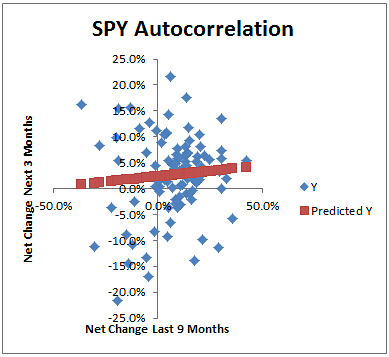 .
.
.
.
.
.
.
.
.
.
.
.
The Unexamined Life is Not Worth Living, from anonymous
I would suggest that one can usefully take the fasting model of diet and benefit from applying it to one's overall consumption of everything, i.e., set aside periods of time to voluntarily minimize food, drink and all forms of mental and physical stimulation except perhaps some exercise. It cleanses the whole system and provides new and interesting perspectives.
Book Recommendation, from Scott Brooks
A very interesting read: The University We Need by Warren Treadgold
Anecdotal Economic Observation: Traffic, from George Devaux
 Because of wireless toll payments, the choke points at toll booths have disappeared.
A 15 to 30 percent reduction in vehicle counts will eliminate most choke points.
The levelized cost of a private car is about $0.75 per mile (the IRS allows you to deduct almost $0.60 per mile). Your private car provides you with door-to-door service on your schedule. The cost of parking is extra (whether at your home or destination).
Large public transport systems cost about $0.50 per mile. Half of this is provided by fares and the balance by taxes of one sort or another. Service is not door-to-door and the service is not on your schedule.
A large, autonomous van can easily accommodate 12 passengers. At a levelized cost of $1.00 per mile, the cost per seat mile is just $0.08. There will be no parking costs.
Assume that each car carries 1.5 passengers. Each fully loaded van (autonomous, non-unionized, minibus) displaces 8 cars. A 15% reduction in 4,000 vehicles per lane per hour, requires only 60 vans. For two lanes, double the number. For a 30% reduction, double the number again. The result, 240 vans, is the equivalent of expanding the two lanes to three.
If public policy allows private, mini-buses the public investment in infrastructure will be zero. The public subsidy for the additional transport will be zero. Initially the routes can be from suburban parking or assembly areas to urban dropoffs. Later, a system similar to uber can be used for timely, pickup and dropoff at user selected locations.
An American Abroad: Stockholm Edition, from Marty Fridson
 A friend jocularly asked if I was going to Stockholm to receive a Nobel Prize. Actually, the idea is not as far-fetched as it sounds. The Nobel outfit's choice of categories is somewhat random. Why Literature but not Music? Why Physics but not Geology? Why not High Yield Bond Research?
Given that they generally hand out these things every year (aside from suspending the Peace Prize for world wars) I believe they'd get around to me eventually if my discipline were not arbitrarily excluded.
Really, these people remind me of the joke about God's response to man who complains that despite praying fervently each day for many years, he has never won the lottery: "Help me out; buy a ticket."
Anyhow, I did the next best thing to accepting a Nobel myself: I took the guided tour of the Stockholm City Hall, where they hold a banquet and a ball each year for the Nobel recipients.
The banquet is held in the Blue Hall, which is not blue. The architect's original plan to color it blue was so widely publicized prior to construction that the press stuck with the name. The Blue Hall must accommodate 1,300 Nobel banquet guests in 1,500 square meters. Each guest is consequently allocated just 57 centimeters (22.4 inches) of space at the banquet table. Except for Sweden's monarch, who gets 61 centimeters. As Mel Brooks said, "It's good to be the king."
There appears to be no basis in fact for the widespread belief that Alfred Nobel decided against establishing a prize in Mathematics because of a romantic rivalry with a mathematician. He apparently preferred branches of science with practical applications and didn't consider Mathematics one of them.
Let me point out that High Yield Bond Research, with its emphasis on avoiding financial ruin through corporate defaults, is eminently practical.
The Peace honorees receive their laurels in Oslo. So if you're very ambitious but still at the stage of choosing a field, think about which Scandinavian capital you'd prefer to visit one day.
Training Camp for the Political Season Ahead, from Stefan Jovanovich
I will keep to my promise not to make any predictions before October 9th; but - like the Penguins (who have replaced the Peyton Manning Broncos as my favorite winter team) I have to get ready for the real political prediction season by working through the necessary exercises and drills.
There are two big things for political prediction: (1) getting the sample - like trades - correctly sized and (2) guessing the turnout - what those you who trade call the trend.
Last year's Senate race in Alabama taught me a lesson that I should have already learned from reading what LW and the other pros have said about trends. The only proper times for guessing turnout are when people are going to the polls; anything but recent "history" is, by itself, no guide at all.
What you can do early on, before the political season starts for real, is being figuring out what the proper allocation of the actual voters (Republican, Democrat, Independent) will be. Trump's odds in 2016 were far less of a longshot bet than the "expert" journalists and pundits said, once you at the cross-tabs in the polls. In an national election in which the Republicans controlled both the House and Senate and a clear majority of statehouses and governorships, the respectable polls and pundits were still allocating to the Democrats and Democrat-leaning Independents over 50% of the likely voters.
The drill this week is to read all the recent polls that are NOT about the elections but include cross-tabs that define party affiliation. First up is one from Harris surveying "Blue Collar" workers.
Their unweighted sample shows a break-down of 1049 respondents as 353 Conservative, 444 Moderate and 252 Liberal. This is hardly surprising, given that the sample is heavily weighted toward males (628 Men, 421 women). Yet, even before we get to the pollsters own weighting, the thumb begins pressing down on the scale. Somehow, when the question of party affiliation is asked, 80 respondents disappear from the sample base and the remaining 969 report themselves as being 333 Republicans, 327 Independents, and 309 Democrats.
A sample that was 33.7% Right(Conservative), 42.3% Middle (Moderate) and 24% Left (Liberal) magically becomes 34.3% Right (Republican), 31.9% Middle (Independent) and 33.8% Left (Democrat). The party of segregation, slavery, racial quotas and unConstitutional naturalizations finds its allocation increased by 40%.
Harris' weighting of their sample show comparatively minor bias. The weighted sample for Party affiliation does add back 36 respondents and give them all to the Democrats; it also finds 19 respondents who, in going from unweighted to weighted sampling, have magically changed their affiliation to the Democrats (10 from the Republicans, 9 from the Independents). But these are - compared to the slight of hand in the unweighted sample from political sentiment to party affiliation, relatively minor changes; in percentage terms the Democrats only gain 1 point and the Republicans and Independents shares only lose a half point each.
To their credit, the Harris people do keep the complete survey data for their weighted sample of political sentiment; yet even there the Conservatives find themselves losing 30 respondents, while the Moderates gain 7 and the Liberals 23.
Preliminary conclusion: If 2016's numbers were distorted by sample bias, the ones for this year are trending towards being being actual works of fiction.
anonymous writes:
Some good thoughts there.
Mr Market has already made a pretty hard-and-fast prediction though, and, rather cryptically says "Nothing changes, it;s the same bull market we've been seeing since early 2016, just a little noise in Feb and March of this year, and back to the same chorus."
Whether or not this means the party in power in the various chambers change is uncertain, but the bass line will remain the same.
The Count of Monte Cristo, from Victor Niederhoffer
 The Count of Monte Cristo has numerous financial data and speculations in it that shows that during the Napoleonic years there was active speculations. For example when Villefort learns that Napoleon has escaped from Elba he immediately tells his wife to sell french government bonds. Eventullly the count destroys the betraying Danglars by selling all the stocks he owns short. I am listening to the Bill Homewood reading of the story and his narration makes the story exciting.
Comments
Andre on September 18, 2018 9:30 am
Most airplane accidents occur when the pilot becomes emotional and instead of trusting instruments he overrides them and trusts gut instinct but in the markets when this happens like in the air its often wrong. Better to stick to objective decisions before trade initiated instead of reacting.
Prediction Update, from Alston Mabry
538 version:
HOR: 5 in 6 the D side wins control
Senate: 2 in 3 the R side maintains control
Stefan Jovanovich writes:
538 offers us their assurance of the accuracy of their 3-headed model by telling us how successful it has been. After all, their accuracy score in actual election predictions has been between 95.7% and 96.9%. Or, to put is another way, their inaccuracy score has been between 3.1% and 4.3%; on average, they have been wrong in only 3.7% of their predictions.
That looks wonderfully impressive until you remember that, in House of Representative elections in the United States, you have to look through the small end of the telescope. Since the passage of the Permanent Apportionment Act in 1929, only 22 of the 44 elections have seen a change in either party's seats that was greater than 538's strikeout average.
If you limit the sample to the current period in which the House changed hands between the two major parties - i.e. 1994-present, there have been only 4 elections out of the 12 that have seen a change greater than 3.7%.
Their astounding "accuracy" is built into the game. Since 1929 the mean change in the number of seats has been 1 (.2%) and the median change has been 3 (.6%). Even when you look only at the "wave" elections - those whose changes are greater than 538's inaccuracy percentage, the mean change has been 44 seats (10.2%), the median gain by the Democrats has been 37 seats (8.5%) and the median gain by the Republicans has been 46 seats (10.6%).
I trust Big Al's and others' math more than my own; but these spreadsheet calculations suggest to me that we are playing the 95% confidence interval game.
In any case, this seems to me a bit like forecasting the pennant based on teams' records in spring training. The primaries are only now ended and even "well-informed" citizens barely recognize the names of the candidates the parties have chosen. The one survey that no political polling firm will ever take is the name recognition one where citizens are asked to match their local candidates with their party affiliations; even among likely voters the results are wonderfully bad. It will not be until 4 weeks before election day that a majority of them will be able to guess the names of the people on whom the fate of the Republic depends.
At that time guessing about the likely results becomes less like propaganda and more like the speculation that we all enjoy.
Back on October 9th.
A Tangled Tree, from Greg Van Kipnis
 A Tangled Tree: A Radical New History of Life
That is the new and excellent book by David Quammen, here is one summary excerpt:
We are not precisely who we thought we were. We are composite creatures, and our ancestry seems to arise from a dark zone of the living world, a group of creatures about which science, until recent decades, was ignorant. Evolution is trickier, far more intricate, than we had realized. The tree of life is more tangled. Genes don't move just vertically. They can also pass laterally across species boundaries, across wider gaps, even between different kingdoms of life, and some have come sideways into our own lineage — the primate lineage — from unsuspected, nonprimate sources. It's the genetic equivalent of a blood transfusion or (different metaphor, preferred by some scientists) an infection that transforms identity. "Infective heredity." I'll say more about that in its place.
My favorite part of the book is the section, starting on p.244, on bacteria that are resistant to antibiotics that have not yet been invented.
The A Cappella Sea Shanty Playlist, from Pitt T. Maner III
"The A Cappella Sea Shanty Playlist"
Interesting and catchy–that it increased productivity and ship morale seems right.
Nobody Asked Me But, from Victor Niederhoffer
 1. All non-scheduled announcements will go against the trend of the stock market, i.e. if the market is going up the announcement will be bearish.
2. Big market declines on Friday have an inordinate tendency to continue as gov over the weekend don't have time to get their act together.
3. All the fact checking reports are biased to say what the fact checkers wish politically. The fact check on the senator who passed away is a case in point.
4. The lynch pin of the market and the economy is corporate profits. Profits get back to consumers via capital spending, dividends, stock market increases, higher salaries, more hiring, and other areas.
5. The market is at a very halcyon state as 30 year yields are near 3% and the forecasted earnings price ratio is way above.
6. Markets that are up in the first 8 months of the year tend to have a fine last quarter the four musketeers take turns in joining the fray.
7. The Westerns of Louis L'Amour all have a boxing match by a man who has the build of Louis, and there is always some sign reading and advice to read books, especially Plutarch and Blackstone.
8. The rules against spoofing tend to prevent the deception in order placement price and size that are necessary for an active trader to overcome the vig from front running by the high frequency firms.
9. The second best trader I know recommends that all his people start out by reading The Godfather. I would suggest Monte Walsh and Atlas Shrugged and a good book on survival statistics and ecology.
10. The move of down 150 on Monday, February 5th was twice as great as ever had happened before and for those who didn't have one or two days to meet the margin calls it was catastrophic.
11. The real estate market in New York and London is forecasting hard times for the stock market as it tends to lead.
12. The idea that core price indexes which take out energy and food are better at describing and forecasting the economy is un-tested and wrong.
13. There is hardly any lobbyist who deals with foreign clients who would not have similar rule infractions to Manafort.
14. It is highly unlikely for someone with a strong bias to make an impartial finding nor can an individual who knows of an acquisition to be announced to sell the stock or advise others to do so. The refraining from selling is enough to create an imbalance on the buy side.
15. The idea that it is better to wait for a down day to buy rather than an up day is invalid for many markets for all time and for most markets in recent times.
16. The movie Papillon is very well acted and exciting and is worth seeing.
Food is Getting Less Scarce, from Jeff Watson
Thank you Dr. Borlaug: "How Humanity Won the War on Famine "
Serena, from anonymous
The “but for” moment was her breaking her racket. Whatever provoked that conduct, it was not a comment or penalty ruling from the Chair umpire. Without that intervening conduct, no game penalty, only the loss of a point. Those of you who know racquet sports are qualified to judge. To this at best semi-pro baseball catcher, it looked like a pitcher choosing to fight with the umpire so that he could be excused for having grooved one to the last batter.
Comments
marion dreyfus on September 15, 2018 12:01 pm
Serena was playing badly, still perhaps recovering from months on leave after having her baby. To some extent, though, she was being a bully because her past ‘entitled’ her, and she doubted anyone would challenge her racquet racket. But she committed not one, but numerous infractions, including the suspect guidance from her coach in the stands–though she rejects that charge.
The distinct lack of courtesy to the ref is a disappointing return to the mean, as it were, because becoming more uncouth is not where we want to go. Tennis has for the most part, for decades, been a gentlemanly sport, even with spoiled-brat stars.
Serena betrays her name with this unseemly display. She betrays, too, her community of fans and the implicit and explicit rules of the court.
A shame that acting out has become a spectator sport for us, which it should never be, and a rite de passage for disorderly privileged talents who fail to measure their longevity on the field beyond the afternoon bell or the evening’s news clip.
mdsd 13 September 2018
Lodestar, from Larry Williams
The word 'lodestar' was an early hint, and seemed to indicate Vice President Mike Pence, who has since claimed his innocence. Some now think this could be either the work of a speechwriter or something meant to misdirect any possible investigation.
Pence is not the only administration member who uses the word 'lodestar,' either.
As Cillian Zeal, a fellow writer at Conservative Tribune, found, sitting director of the National Economic Council Larry Kudlow once penned an article called 'Look to the Lodestars.'
This puts Kudlow as the prime suspect for many. As of the writing of this article, he has not denied the claims. With the few clues we do have, Kudlow seems to fit the bill.
George Zachar writes:
Kudlow is a New York/Wall Street guy. The op-ed writer patted himself on the back for being a part of Washington's 'steady state,' as opposed to its 'deep state.' I doubt it was Kudlow.
To me, what's significant is that the times happily validated the deplorables' contention of a willful, obstructionist GOP deep state, working against its base.
Peter Ringel writes:
My first thought after this article came out was the following:
If I want to poison the relations and working climate of your group - I will tell you that I placed a spy in your midst. Then it does not matter if I really have a spy or not.
Also the next election seems near and the wave of banning of "multipliers" from twitter and other social media happened simultaneous.
Andy Aiken writes:
My first thought was that the editorial was written by a NYT staff writer, making do with scraps that didn't make the final edit of Woodward's book.
What evidence has the NYT provided that their claim has more veracity than that of other opinion journals?
Let me know when they give the Pulitzer back for Walter Duranty's reportage that the purges, show trials, and famines in Stalin's USSR are fairy tales manufactured by fearful plutocrats.
Stefan Jovanovich writes:
Thx to the list, I have become fascinated with the facts of how information has actually been shared by people so they could try to answer the political economic questions that troubled/fascinated them. It has been a wonderfully encouraging study. I find, for example, that the effectiveness of the hub-spoke model for the transfer of political economic information is almost entirely an academic myth. Under that model the New York Times (and, as T. S. Eliot reminds us, once upon a time the Boston Evening Transcript) is the hub; and we the voters and Congress and (when he was a properly educated lawyer) the President were the spokes. If only. AA is right about Walter Duranty; his lies were truly awful. But, I think we can all take heart from realizing that they never persuading anyone in Congress to change their vote. You can study the budgets of the Roosevelt Administration in great detail and not find a single appropriation that sent a nickel to the Soviet Union before December 11, 1941 (the date Germany declared war on the United States).
The present nonsense from the "name" bureaucrats (fascinating how many of them are - like Joe Crowley - aging good Catholic boys with Irish ancestry) is yet another retelling of the same hub-spoke story. If you want to believe that paid-for published political opinions greatly matter - like televised speeches about "Black Lives", it is a comforting fairy tale; but it has very little relation of electoral reality.
Ms. Ocasio-Cortez won her 4,138 vote margin over Joe Crowley because Thomas Manton's Queens Democrats got out of the business of winning elections once the last faint whispers of the Republican Party on Long Island died away. Her "Socialism" mattered not as a question of policy but as an indication of how effective the Sanders campaign had been in creating its own lists of precinct captains.
Comments
marion dreyfus on September 10, 2018 1:52 pm
Several points to keep in mind:
With technology available to all, not least th tech-savvy millennials trolling the current presidency, feigning [perhaps] respect for their CEO, Pres.Trump, it is a simple thing to suss out writers’ frequent usage of standout words, such as, of course, the so-called telltale “lodestar.” That Kudlow used it too, once, is no guarantee of anything, as it would be highly uncharacteristic of the man who is Larry Kudlow to pen such a froard, combative piece against a man he has professed as worthy of our attention and respect. Thus, the frequency of such ideosyncratic terms as lodestar is debunked: Any high schooler could have divined that Pence, say, hit that word X-number of times. It would be, furthermore, a usage that would deflect adults into a slotted canyon of blame; a millennial would savor that. An adult over the age of normalcy and thought would not have done that word-usage search and then planted that ‘giveaway’ telltale. So-called.
Another aspect is that the anonymous op-ed was not crafted to reveal anything much that 99% of the electorate and citizenry above room-temperature IQ already knows, from the invocation of those anti-Trump memes over and over and over in the pulpy New York Times, running tabloidized fungal pieces so regularly that it might well change its masthead to All the anti-Trump news, all the time, that’s maybe unfit to print, but we’ll do all the heavy lifting and print it anyway.”
Not least is my observation that though the insightful brilliance-industry Rush Limbaugh acknowledges that the hit-piece recognizes and reifies the accuracy of the Deep State conspiracy Trump has been alleging all along is indeed a “Quiet coup”, I would assert, instead, that the coup is as noisy as can possibly be, with endless reams of faux fact “books” reeling out of the mouths of top Obamaesque printing shops, top tier though they are presumed to be. The noise includes the aforementioned op-ed and its sibling obloquies in WaPo and elsewhere in the seeded poisoned forest of print, but also the harangues from the paltry but peekaboo-worthy MSNBC, the once-respected CNN, the harlots of harangue across the fruited plain that can be heard in miraculous chorus all chiming the epithet and favorite memes of the day on program after program. The disspiriting choral orchestration continued with the nearly-sci-fi craziness of the Brett Kavanaugh confirmation circus a few days past, all in service, of course, to the hatreds festering in every Democrat garden, for the President and anything he touches, like a king midas in reverse.
Silent coup?
Not unless Krakatoa’s explosion in the early 20th century was silent. not unless the atom bomb explosions of ending WWII by Japan were silent.
Dinesh D’Souza, right out of the gate the day Anonymous was published tweeted that he suspected the author of the op-ed was a writer at the New York Times, mascara’ed over by a light coating of persiflage about the NY Times “knowing the author” well, and the authoor being “a senior official of the Trump white House.” since there is no checking that assertion, and there are no biographical facts attending the Times little notation of justification, we cannot tell. There are approximately 2,000 persons, according to many estimates, across the tier of what might be called “top level officials” ‘at’ the White House, many actually serving out of the venue proper, but still deemed at a top official level. Most seriosu==us analysts assume it is a millennial writing, which explains why the piece ends with such a hosanna and bouquet to the deceased and well-known RINO Sen.John McCain. Senior officials, adults, would not have included such an encomium, because McCain was mercurial, quixortic, given to bluster, impetuous, changeable and many other adjectival monuments as valid for him as for the President. Perhaps more so.
In any case, persons of my acquaintance have confided that even absent the offices of the tainted CIA and FBI, following their fatal compromised neutrality after Obama, President Trump will be able to unearth the identity of Deep State Anonymous using his own mighty prowess and sourcings.
Luckily, nothing in the op-ed managed to shake any trees, except among the already committed antiTrumpers and dyed in the wool furies still shrieking in the void of Hillary’s unambiguous loss.
Winning, as Obama once stentoriously intoned, has its privileges.
Yep.
Patrick Sullivan on September 10, 2018 2:49 pm
Doc, I think Pence or Mnuchin
Not Kudlow.
Market Quotes from Louis L’Amour, from Victor Niederhoffer
When defending against an enemy stay away from the same place.
Where it's most unlikely to be an ambush, the Apache and others will attack.
There will come a time when you believe everything is finished. Yet that will be the beginning.
A good beginning makes a good end.
A wise man fights to win, but he is twice a fool who has no plan for possible defeat.
The only thing that never changes is that everything changes.
A ship does not sail with yesterday's wind.
I really learned how to write from Robert Louis Stevenson, Anthony Trollope and de Maupassant.
Knowledge is awareness one is led by something felt in the wind, something seen in the stars, something that calls from the wasteland to the spirit.
To receive the message, the mental pores must be open.
"Yo Bolson"
May there be a road.
Letter from Union Street, from David Lillienfeld
Today is my (our, I guess) 29th anniversary. To celebrate, we decided to go the day before up to San Francisco. Sunday rather than Monday since the parking is better. One of the first places in San Francisco we went when we first met and came out west to visit friends was Union Street. It's a nice shopping district. Lots of nice cafes. Perfect for a Sunday. (Granted, it's summer, so the city was a tad cold, and the stiff breeze didn't help, but still, it's San Francisco. The place of lonely hearts (well, they're out on a hill, so they must be lonely. Or at least alone.)
Something seemed strange to me though. In 5 blocks, I counted 12 stores available for lease and 5 available for sale. Empty stores. That's unusual for this street. Three years ago, it was bustling. Today , not so much. Not many people walking on the street either. Schools reopened a couple of weeks ago, but maybe everyone is coincidentally taking off at the same time. Probably not, though.
I made a similar observation in May on upper Madison Avenue in Manhattan. Both are places where traditionally, it's been pretty easy to fill an empty store. Sure, those are places that are a bit expensive, but in San Francisco at least, there's lots of money floating around the city. That money is going somewhere. It's not all for 80 inch monitors. Union Street tended to get its "fair share" in the past. Consumer confidence is at record highs. I know that Amazon and the rest of the net has taken over much of retailing, but there's still a need for neighborhood shops for impulse purchases—as in, " forgot it's our anniversary." Or "If I don't do something for her birthday, it'll be a week of sleeping on the couch."
I have to wonder, then, as the Fed drones on about the need to hike, if the economy really is as healthy as many suggest. After all, 20 years ago, when the same measures used today were in use, it wasn't a gig economy. The Fed may have hiked, but it wasn't concurrently selling off its portfolio of debt instruments. And while there are lots of "for hire" signs out, the wages of a given job may not be what they once were. Just some observations and speculations.
Peter Drucker used to note that if what you see doesn't agree with the data at hand, maybe the data at hand are misleading. I have to wonder if the same thing is going on here. The numbers look good, but is the economy really as good as the numbers suggest? If it is, why are the shops now empty? 6 mos to a year ago they weren't. Did Amazon move that fast? Maybe, but somehow, that just seems unlikely. The disruption in retail has already hit the bricks and mortar stores. Except for Sears, which seems to have missed the memo.
Or is the Fed really justified in raising rates, as it did in 2007 and 2000 and 1990?
Mr. Isomorphisms writes:
Low interest rates benefit only those who have access to them (established firms). Another decade of QE wouldn't help America's poor; only change can do that.
Alan Wolfe, in "the seamy side of democracy", argues that the USA is a story of conflict between stability and freedom–and that stability has always taken precedence. This was 1973.
Yes, people can and do take dogsh__ companies public (doesn't make their bonds good), but that's still different from healthy capitalism. Dynamism requires failure. With regard to everything being expensive but empty, I posted a note about Al Jazeera east 101's takes on paper holdings of China's million millionaires. As a simplistic story, ask yourself where the USA's lost manufacturing wealth 1980-2010 went. Then ask where they park their money. Vancouver is one answer for Chinese wealth. London/NYC are an answer for Saudi money. Qatar had the good sense to make their own BBC, investing in people instead of buildings.
Then turn in your copy of Sidney Homer's history of interest rates to the part where a Swede buys California ranching property based on figures, with no knowledge of how to run the thing.
anonymous writes:
It is easy to get caught in the echo chambers of the two coasts. I've often heard, but only recently, recently how "nice" people are in the Midwest and South. Foreigners here in Los Angeles are frequently replacing locals who are leaving for many reasons. My town's Chinese population has jumped dramatically in the last 18 months.
Stefan Jovanovich writes:
Data from IHL: "Grocery, drug stores, mass merchants/supercenters, and convenience stores are adding a net 2,694 stores in 2018 on top of 3,115 net new stores in 2017. Department stores, specialty soft goods (apparel, shoes), and specialty hardgoods (DIY, electronics, sporting goods, books, furniture) are closing a net 682 stores in 2018 on top of 2,557 net closings in 2017."
Henry Gifford writes:
High end retail areas in New York City, such as Madison Avenue (as mentioned on this site a couple of days ago) have higher vacancy rates than last year. But, retail rents outside of the 6 or 8 fanciest areas went up since a year ago, and vacancies remain fairly low.
All I've written above is to be taken with a grain of salt, however, as nobody really knows what retail rents go for, and even vacancies are hard to track with the increasing popularity of temporary (pop-up) stores. Apartment rents are easy to track, but retail leases usually include the building owner spending some money on repairs/buildout, and the owner usually gives some months of free rent. Owners used to bring electricity and water and sewer into retail spaces, and maybe nothing else, but now more and more owners pay large sums of money toward the cost of building out a space.
The reason is that the more money the owner pays, the higher the rent will be, and thus the larger the mortgage the owner can get on the building - based on the reported rent. If/when mortgage rates change, or mortgage availability changes, owners will pay more or less toward buildouts, and the retail rents will change accordingly, making any effort to track retail rents very difficult.
Benefits of Fresh Air, from Bo Keely
 The story of fresh air in hospitals ends in 1942 when a leading New York City hospital architect named Charles Neergaard published a layout for a hospital inpatient department that was so innovative it demanded copyright. The plan was two patient rows in a single building wing separated by a corridor that was conveniently serviced by one nursing station. One wing joined another wing - like an airport - and patients arrived, in many cases, healthier than they were released. The feature that made his plan so innovative was most of the patient rooms had no windows.
/https://public-media.smithsonianmag.com/filer/b4/c6/b4c65fd0-01ba-4262-9b3d-f16b53bca617/istock-172463472.jpg) A windowless patient room today hardly seems daring, but in the 1940s it was a shocking proposal! It violated the centuries-old medical practice of the central role of hospitals in providing fresh hair to promote health. For hundreds of years, hospital designers had based their layouts on the foundation that in order to remain disease free and health giving, hospital spaces required direct access to fresh air and sunlight.
A windowless patient room today hardly seems daring, but in the 1940s it was a shocking proposal! It violated the centuries-old medical practice of the central role of hospitals in providing fresh hair to promote health. For hundreds of years, hospital designers had based their layouts on the foundation that in order to remain disease free and health giving, hospital spaces required direct access to fresh air and sunlight.
Neergraad's idea, however, won out. It was cost efficient, reduced the square footage required, saved nurses' sore feet, and has been followed to this day in nearly every modern hospital around the world. Today, a hospital room is to be endured, not enjoyed. I have often sneaked out in the cloak of the night, after paying the bill at the night cashier, to sleep in the woods, returning during the day for out-patient care.
Most studies show that fresh air brings these benefits:
• Boosts your immune system
• Calms the nervous system
• Cleans your lungs
• Good for the digestive system
• Strengthens the heart
• Enhances brain health
• Makes you feel happier
Mother Nature always seems trying to tell us she has some great secret. And so she does. Open the window, and the next time you feel a sniffle coming on, go to the country side.
Notice How, from Victor Niederhoffer
Notice how the bearish announcements that are uncertain as of time all come after a good to great stock market.
Steve Ellison writes:
I wonder if there will be mischief related to Turkey or Argentina during the extended US market closure this weekend.
Global Cap Over Product, from Alston Mabry
 US Market Cap/GDP
Steve Ellison writes:
This indicator was also mentioned in Mark Hulbert's article in the Wall Street Journal on Sunday. People who cite it as an indicator usually implicitly assume that the aggregate value of the stock market should grow at the same pace as GDP over the long term.
I believe this assumption is flawed for two reasons. Privately held companies are not counted, so changes in the relative percentages of public and private companies affect the ratio. More importantly, the traditional capital structure of 50% debt and 50% equity, in which all upside value goes to equity holders, is a good reason why stock valuations should increase faster than GDP, especially over very long periods. Indeed the inflation-adjusted compound annual growth rate in the S&P 500 between the generational lows of 1982 and 2009 was 4.4%, significantly more than GDP growth during the same period. So I don't lose any sleep over this ratio being higher now than in 1929.
Stefan Jovanovich writes:
In a recent speech Jorg Meuthen made a simple point: GDP calculations assume that civil servants are somehow as magically "productive" as the people who have to do work for a living and successfully sell their work for cash.
No one in the "mainstream" (sic) wants to do calculations that remove all the recipients of government payments from political economic calculation. It is, from the point of view of modern economics, heresy.
I took Big Al's elegant calculation and found its "private sector" derivative.
The results are precisely what spec and others see in their views of the data. Not at all a pretty picture. If you take private earnings from wages net of taxes as a proxy for the country's additions to wealth, the 5 years up to and including 2017 only recovered the amounts lost from 2007 through 2011. From the point of view of people to do work that other people actually pay for, the last decade has been a complete wash. It is only the gains for this year and beyond that can be counted as actual increases in wealth.
Mr. Isomorphisms writes:
Thanks for doing the work for this calc. I would argue your characterisation of government work is overly harsh. Shuttering IndyMac took real work, was productive, and experienced a boom during the decade in question.
There was a boom in useful work for bank regulators around the time of Continental Illinois as well. Stefan, as you pointed out with regard to an economic historian's writing, details matter. Even if on average government employees are worse, that varies across time and across agencies/remits.
More importantly certain kinds of useful work are not privatised. In fact anything that was privatised (parks management, penitentiary management, utilities) by construction used to be a government job that accomplished something. Furthermore various government initiatives do often produce private benefit–I'm thinking of the stories of Bureau of Land Management and Army Corps of Engineers in Marc Reisner's Cadillac Desert. Whether irrigation ditches are dug on Brigham Young's holy command, on debt-financed speculative capitalist entrepreneurship, or bureaucratic mandate, water changes course.
Flexion of the Day, from Victor Niederhoffer
The flexion of the day stayed in Germany [8/30/2018]. Note how the Dax is down 110. Apparently they left for beer at 11. And the bunds are up 78.
Anatoly Veltman writes:
Note the reluctance to discuss or contemplate LEADING indicators that actually present economic sense. For example: everyone knows that EUR currency is associated with economic development and "order". While Swiss currency is associated with defensive posture and "calamity" hedge. The EURCHF pair doesn't move as much as other pairs in FX, because both currencies in the end are European currencies. Yet the pair has reversed since yesterday's SP record, and managed a straight 1% drop since…Now(?) Steve here is raising a possibility of a calamitous announcement over the weekend, but he wasn't raising it "before" the SP moved lower?
Cagdas Tuna writes:
Average short interest % to floating shares in FAANG is 1.64% and if we exclude Netflix it is 1.07% Does that kind of statistics provide any hint to market tops or bottoms?
Bill Rafter writes:
In our shop we have done a lot of work with short interest (SI). First, we noted that THE expert on SI (Erlanger) first identified "stocks to buy" and then screened them for any added benefit that could come from SI. Next, we worked the research from the opposite angle. That is, we first identified stocks with good SI potential, and then went on to screen them.
We were wrong. Apparently half of the stocks with high SI are truly good shorts. Of the remaining a relatively small percentage became good short-squeeze candidates. The others just went nowhere.
However we went further, studying stocks with extremely low SI. The theory is this: If you have a stock that even a damn fool idiot will not short, it probably means something. Assuming that certain fundamentals are unknown, we came to believe that it reflected on the quality of management. Of course we have no way of proving that, but still consider extremely low SI as bullish sentiment. That's intuitive, but at least we have some research to back it.
Book Recommendation, from Mr. Isomorphisms
 Jerrold Fine has written a novel which should be of interest to dailyspec readers:
This debut novel, Make Me Even and I’ll Never Gamble Again, follows a young man who, hoping to achieve financial independence, finds himself drawn to the stock market.
By the early 1970s, Rogers Stout is only 16 years old, but his father, Dr. Charles Stout, wants his son to live up to his potential. The Ohio teen is bright but putting minimal effort into high school studies. This changes the summer before his senior year with an internship at Prescott & Prescott, a stock brokerage and investment banking firm. Rogers becomes fascinated by the stock market and sets his sights on a finance major at Penn-Wharton in Philadelphia. He closely follows the market all through college, gradually developing abilities, such as how to deconstruct a company’s financials and analyze its prospects.
As an exceptional poker player, courtesy of regular sessions with his dad, Rogers equates his investment philosophy with the card game. He plays while winning and stops to reassess his strategy after he’s lost. Rogers hard work pays off, as he lands a gig at a research and money management firm in New York. But his subsequent plan to invest in a small company is an unquestionable risk, and life, like the financial markets, can change instantly and unexpectedly. Despite the desperation implied by the title, the levelheaded protagonist is rarely distraught. (The title is derived from a line that a losing poker player “not Rogers” utters.) Still, Fine’s coming-of-age tale is engrossing. The historical backdrop, for one, is an enhancement: Rogers witnesses the 1973-74 stock market crash and worries about his girlfriend, Charlotte Marks, who, in 1977, is in a war zone in Cambodia for Doctors Without Borders. There’s also turmoil in the protagonist’s personal life, as banker Elsbeth Aylesworth fills the void created by his geographical separation from Charlotte. Prose is detail-laden, including poker and baseball games as well as investments, while financial terminology is adequately explained. But there’s still room for humor: Rogers description of his job is to read and think and then occasionally make a bold decision. A leisurely paced but ultimately absorbing story of an aspiring Wall Street trader.
Comments
marion dreyfus on September 5, 2018 7:56 pm
Another book of interest, and a writer of note:
Dr.Phyllis Chesler reads from her 18th at the Strand
By marion d s dreyfus
World-renowned author and politically forward Dr. Phyllis Chesler has written her 18th book.
In the Jewish religion, there’s special significance to the number 18, which in numerological terms, adding up the letters that comprise the word Chai—life–equals 18.
Dr. Chesler, Professor Emerita, from the inception of the Women’s Movement, and the publication of her WOMEN AND MADNESS (1972), has been a champion of maligned, all-but-invisible, abused people in areas of the globe where they have always lacked a voice.
Dr.Chesler read from her A Politically Incorrect Feminist at the iconic Village-located Strand bookstore’s third floor event-space on the day her newest work was published by St. Martins.
Chesler has in the past published scholarly—yet always lively and readable—works on the new anti-Semitism, on gender-apartheid, on honor killing, on her life as a young bride in a Muslim near-hareem in Kabul, on FGM, and topics that have been touted and promoted by the scions of the media loudspeakers we looked to for imprimaturs, as well as those fields of concern the megaphonic media chose not to notice, as inconvenient.
The major organs of bespectacled endorsement have not thought to correct or notice that women as topic have been “largely disappeared” from curricula and scholarly study.
The storied author notes that there are virtually no courses that work with the historic documents or filmic records of the Movement, the which gave birth, recently, to the “Me, Too” thing ricocheting in ongoing debate.
One has to journey to the UK to find a course that teaches Simone de Beauvoir. Apparently, women are overshadowed by that endless and irritating darling of the Jurassic media, Racism. Ta-daah! Gender studies is perhaps a cover for transgenderism and newer, isms. Women’s studies and theory are consigned to the back of the jitney.
During the hour-plus reading at the Strand, a car horn, somewhere downstairs on Broadway or East 12th Street, tocsinned on and on, insistently, as if it were the court-appointed courier of New York City, waking the locals to what was being memorialized upstairs.
Chesler champions Zionism and Israel, departing from so many of the current feminists who hold more with the shabby tenets of leftism and Marxism, forgetting that, many are themselves the results of the Hebraic thread through history. Self-denying Jews.
And there is, no mistaking it, a price to be paid for running against the herd. The feminists of today are, for the most part, loud in their non-crit of the Palestinians, drenched in the blood of terrorism, infamy and history-denial. The left, as ever, unreasonably ugly. Cold,
Attendees at the Strand reading room included numerous ‘originalists’ (if we might borrow that term from occasional Supreme Court juridical descriptors), as well as scholars and leading lights in many fields, though some of the names may not be familiar.
Prominent “pioneers” were there — and Jewish scholars, linguists, historians and others, advocates for freedom, advocates for justice, advocates of reform of Islamism, especially its muted and abused moiety of women.
So. Despite the changing fashion of support for or abstinence from certain issues that enter or leave political correctness, Chesler fearlessly continues her advocacy for freedoms and consideration for the millions of silenced who have forgotten to remember those die daily, and who need our voices.
A voice always mindful and life-affirming. And heard.Chai, life, indeed.
marion d s dreyfus . . . 29 August 20©18
The Little Book of Talent, from anonymous
 I have the audiobook version of this book The Little Book of Talent and find it to be something I re-listen to because of the density of useful and interesting ideas:
The Little Book of Talent is an easy-to-use handbook of scientifically proven, field-tested methods to improve skills—your skills, your kids' skills, your organization's skills—in sports, music, art, math, and business. The product of five years of reporting from the world's greatest talent hotbeds and interviews with successful master coaches, it distills the daunting complexity of skill development into 52 clear, concise directives. Whether you're age 10 or 100, whether you're on the sports field or the stage, in the classroom or the corner office, this is an essential guide for anyone who ever asked, "How do I get better?"
Meteorology Today, from anonymous
 Meteorology Today by Ahrens is a text book and provides an antidote to the news hype surrounding Hurricane Lane and market moving weather events.
Add actual data readings and a more accurate picture forms clearing the news fog and fear Mongering.
Our late friend Mr E and I would talk late into the night during major hurricanes and monitor data that could and did swing markets.
The Market, from Victor Niederhoffer
The market is amazingly resilient today [8/21/18] vis a vis the two decisions on cases. All the Asian Markets are strong as a stone wall. And eminis are down only 7. We will see if the European markets can hold up especially since they have been very strong the last two days. I would posit that a bad market would show that Trump is good for markets and this would keep him in the battle.
Kim Zussman writes:
A hostile deep state bringing felony convictions (with ridiculous sentences compared to violent youth's) of associates in order to upend the presidency in the name of Russian collusion will bring great succor to the Russians. And it would seem to put the finishing touches on anyone who isn't completely cynical toward all forms of aggressive government.
Stefan Jovanovich writes:
KZ's basic point is incontrovertible. Manafort was and is guilty of the counts on which he was convicted (tax evasion, bank fraud, failure to report himself as a lobbyist); but the sentencing is out of all proportion to what other taxpayers would receive in a "normal" case.
One of the many, many things the List and our Host have taught me is to trust the verdict of the markets. What they seem to be saying today is that Mueller has yet to lay a legal glove on the Great White Hope.
And now for another message from the past:
"The Tenure of Office act, it will be remembered, was passed in 1867 for the express purpose of preventing removals from office by President Johnson, between whom and the Congress a quarrel at that time raged so bitter that it was regarded by sober and thoughtful men as a national affliction, if not a scandal.
An amusing story is told of a legislator who, endeavoring to persuade a friend and colleague to aid him in the passage of a certain measure in which he was personally interested, met the remark that his bill was unconstitutional with the exclamation, "What does the Constitution amount to between friends?" It would be unseemly to suggest that in the heat of strife the majority in Congress had deliberately determined to pass an unconstitutional law, but they evidently had reached the point where they considered that what seemed to them the public interest and safety justified them, whatever the risk might be, in setting aside the congressional construction given to the Constitution seventy-eight years before.
The law passed in 1867 was exceedingly radical; and in effect distinctly purported to confer upon the Senate the power of preventing the removal of officers without the consent of that body. It was provided that during a recess of the Senate an officer might be suspended only in case it was shown by evidence satisfactory to the President that the incumbent was guilty of misconduct in office or crime, or when for any reason he should become incapable or legally disqualified to perform his duties; and that within twenty days after the beginning of the next session of the Senate, the President should report to that body such suspension with the evidence and reasons for his action in the case, and the name of the person designated by the President to perform temporarily the duties of the office. Then follows this provision: "And if the Senate shall concur in such suspension and advise and consent to the removal of such officer, they shall so certify to the President, who may thereupon remove said officer, and by and with the advice and consent of the Senate appoint another person to such office. But if the Senate shall refuse to concur in such suspension, such officer so suspended shall forthwith resume the functions of his office."
On the 5th of April, 1869, a month and a day after President Johnson was succeeded in the presidency by General Grant, that part of the act of 1867 above referred to, having answered the purpose for which it was passed, was repealed, and other legislation was enacted in its place. It was provided in the new statute that the President might in his discretion, during the recess of that body, suspend officials until the end of the next session of the Senate, and designate suitable persons to perform the duties of such suspended officer in the meantime; and that such designated persons should be subject to removal in the discretion of the President by the designation of others. The following, in regard to the effect of such suspension, was inserted in lieu of the provision on that subject in the law of 1867 which I have quoted:
"And it shall be the duty of the President within thirty days after the commencement of each session of the Senate, except for any office which in his opinion ought not to be filled, to nominate persons to fill all vacancies in office which existed at the meeting of the Senate, whether temporarily filled or not, and also in the place of all officers suspended; and if the Senate, during such session, shall refuse to advise and consent to an appointment in the place of any suspended officer, then, and not otherwise, the President shall nominate another person as soon as practicable to said session of the Senate for said office."
Grover Cleveland (Ma, Ma, Where's My Pa) made this speech to the Princetonians after leaving Presidential office (for the 2nd and last time).
anonymous writes:
A hostile deep state bringing felony convictions (with ridiculous sentences compared to violent youth's) of associates in order to upend the presidency in the name of Russian collusion will bring great succor to the Russians. And it would seem to put the finishing touches on anyone who isn't completely cynical toward all forms of aggressive government.
Comments
NELSON RIDDLE on August 26, 2018 7:24 pm
Lesson of the market since ‘71 is that it doesn’t care.
https://www.nasdaq.com/markets/nasdaq-composite
Anonymous on August 28, 2018 3:50 pm
Did he really say “great white hope”
What does he mean by that
Other Methods, from Victor Niederhoffer
 By using the same techniques and statistics that are generally used to describe and forecast markets, i.e. means, measures of variation, and bootstrap estimates, based on prices, and balance sheet and income sheet data, you will be beating down a well traveled path. There are approximately a hundred articles a quarter, and numerous textbooks that use these methods. Chances are that as soon as a paper is published, the non-random effect will be dissipated by copying or the theory of ever changing cycles. Thus, I have turned to methods that are used to study the dynamics of insect and vertebrate populations. In particular, I have found the following books very helpful for thinking out of the box:
Ecological Methods by Southwood and Henderson
Game Theory and Animal Behavior by Dugatkin and Reeve
Individual-Based Models and Approaches in Ecology by DeAngelis and Gross
I will review some of the novel methods and approaches in this books when a calm in markets prevails.
Richard Feynman, from Jeff Watson
 There are some wonderful market lessons contained within this short video.
.
.
Aren’t Trade Wars Better Fought by Imposing Price Reductions on Imports? from Leo Jia
 So the traditional way of trade wars is to levy high tariffs on goods imported from the opponent country. The logic is that the higher tariffs result in higher prices in the market for those imports, so the compatriots will buy less of those, resulting in less exports by the opponent country, and hence damaging the economy of the opponent country. A critical condition for the traditional way of fighting is that there is sufficient competition in the market for the targeted imports. Otherwise, the compatriot consumers will end up paying more and get hurt. In many cases, this latter case is true. This is why many say there is no winner in a trader way.
So can't a trade war be fought better with a better strategy? Instead of imposing tariffs alone on the imports, the policy is to force reduction of import prices on goods from the opponent country, and then levy the tariffs. The percentage of reduction can be deviced according to market conditions in the imposing country and in the opponent country. Should we term this as "managed pro-dumping"? With the price reductions and tariffs, the prices of the imported goods will likely stay relatively the same as before in the market. This way, the compatriot competing indutries don't get hurt much, the compatriot consumers don't get hurt as much, but the opponent country bleeds if they continue to export.
Stefan Jovanovich writes:
There tariff question was one of the 3 issues that Americans disagreed about enough to make them a constant political argument. The others were (1) the expansion of slavery to new states and the Federal territories and (2) the currency question which was about everything from internal improvements to national banking. Neither side argued that there should be no tariffs, just as neither side argued that all slavery should be instantly be abolished. The question was whether tariffs could be protectionist or had to be for revenue only. In the current debate the revenue question has been largely ignored. I doubt that it will be much longer. For 2016 total U.S. imports were roughly $2.25 trillion. The average rate for the Walker tariff - written and passed by the revenue only side of the debate -was 25%. Applied to total imports a modern Walker tariff would produce $550 billion - 55% of all the employment taxes collected last year. I doubt very much that I am the only person who has made this back of the envelope calculation, and the geezers among us remember the last time a non-establishment Republican President considered tax changes based on numbers that could be scribbled on a napkin. What no American in the 19th century disagreed about was that foreigners should pay the taxes and leave Americans to worry about the costs.
anonymous writes:
All taxes are (pick one or more) fascist, communist, democratic socialist, Gaullist, Whig…..They are, as the Libertarians justly remind us, enforced at the point of a gun. The question that must always be asked is which official theft is least threatening to citizens' individual liberty. Direct taxes are everywhere and always the worst because they are imposed on people directly (hence the name) and not simply on their transactions and property. That is why the Constitution did not allow them until the party of slavery, segregation and socialism and the theocrats (aka Prohibitionists) made their evil bargain. Tariffs work, for the same reason sales taxes do; the rates can, in a political economy not wholly corrupted by wage bribery, be set low enough that cheating is not worth the bother - as Amazon's recent conduct illustrates. (Collecting sales taxes has not affected their volume of trade, contrary to what do many analysts once feared.) The fundamental point to be understood is this: income taxes and employment taxes, in particular, demand the greatest oppression because individual extortion is built into the process of collection. People will cheat much more on direct taxes because they reward cheating. The rate differential is enormous (25% is the minimum) and the taxpayer has the "freedom" (sic) to characterize his/her/its transactions. (Contrast the enduring simplicities of the Uniform Commercial Code with the exponential mushrooming of every income tax law.). Like the drug laws and other forms of outright prohibition, direct taxes are guaranteed to be an abomination. No wonder Marx loved them.
The Hapless 2018 Baltimore Orioles, from David Lillienfeld
/cdn.vox-cdn.com/uploads/chorus_image/image/59049391/856025960.jpg.0.jpg) For those on the list following the Birds, they are finally above .333 on their win-loss percentage. But I have great faith in these boys of 2018, and if they make an effort at it, I'm sure they will continue to pursue and exceed the 1962 Mets record for the most losses in a season (at least I think it's the Mets). After all, those arms are only going to get weaker with the further along we go in the season. Not that they were ever strong to begin with. Actually, pretty weak to begin with.
For those on the list following the Birds, they are finally above .333 on their win-loss percentage. But I have great faith in these boys of 2018, and if they make an effort at it, I'm sure they will continue to pursue and exceed the 1962 Mets record for the most losses in a season (at least I think it's the Mets). After all, those arms are only going to get weaker with the further along we go in the season. Not that they were ever strong to begin with. Actually, pretty weak to begin with.
There is one upside to this season of ignomy: It is almost impossible (though I'm sure there may be only a non-zero (read: epsilon) chance) to imagine the GM Danny Duquette surviving into next year. Even Peter Angelos will be hard pressed to excuse the miserable team that goes under the name of the Baltimore Orioles.
And when the end of the season comes and the Os have successfully displaced the 1962 Mets, I suggest noting the epicenter of the strongest earthquake experienced on the East Coast of the United States in millennia. It will be at Earl Weaver's grave.
Comments
Allen Johnson on August 19, 2018 1:19 pm
Fire Duquette and Showalter. Sell team to Ripkin led group.Should have signed Machado and Schoop.
Regarding Mid-Terms, from anonymous
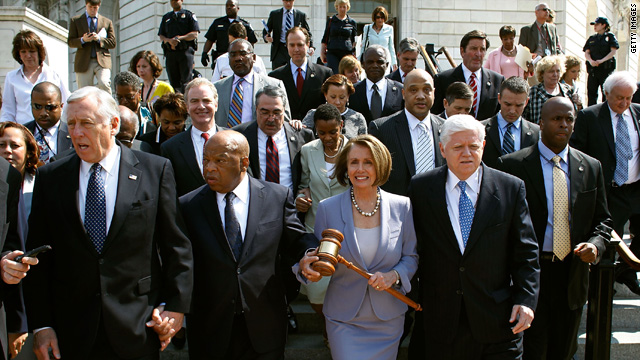 I speculate that if Dems take the house this will be bearish for stocks, to the extent this would damage the current pro-business regime.
On the other hand, it doesn't seem like congress does much anymore, and for the past decade or so regulation and de-regulation is via executive orders.
Other thoughts?
Comments
Pete M on August 20, 2018 5:15 am
Dems will not take the house. The fact that fivethirtyeight is predicting a 75.3% chance Democrats win control tells you all that you need to know.
Allen Hines on August 22, 2018 11:20 am
Yes, I agree. Anything that takes the country and its politics back toward the left and socialism is ultimately bad for not only stocks but just about everything.
The Worst Feeling in the World, from Zubin Al Genubi
 The worst feeling in the world is the feeling of fear and anxiety in the pit of your stomach. I can ball up from discomfort into pain and nausea. It is the thing that can make trading so hard. It's the ugly side.
This bad feeling arises in many circumstances and I'm sure everyone has had it.
Different forms of training can help cope with the feeling, or alleviate it. Sports, yoga, practice, exercise might help. But its there, and sometimes its forces you out of a trade just to alleviate the pain. Having fixed criteria and contingency plans help avoid pain inducing situations, and help with decision making in times of crisis.
anonymous writes:
On my short term operations, that particular account I have blocked the account balance. This is a recent experiment that I am going to keep and turn into a habit. The amount of time just observing up's and down's was a waist and caused improper decisions at times.
The last two weeks I've done pretty well, and I have only a slight idea of the amount of my gains.
This account I don't hold positions over the weekend, and on Fridays I simply call my broker to double check if all my positions are closed.
Making Stock Cheap Again, from anonymous
Arm waving aside, whenever they advocate about officials deciding about who should get what, I think of Czech or Hungarian limp bodies swinging from lamp posts.
Laborers don't want their good efforts expropriated. As do not those smart and industrious enough to create profitable systems in the first place.
There is a zero sum sense short-term, but the battle is positive sum and unending. The problem lies in subsidizing profiteering champions of your cause when you wind up on the wrong side.
Zubin Al Genobi writes:
Under capitalist theory, the purpose of capitalism is to use workers labor to provide a return to those whose capital is being utilized. Labor cannot really be levered, and is limited in a way that capital is not. I suppose productivity is a leverage of labor but does not grow exponentially in the way capital does. The worker does not reap the benefit of productivity. Capital has mobility. Labor is less mobile.
Stefan Jovanovich writes:
Discussing commerce using the academic Marxist term "capiatalism" is like listening to a former communist explain why freedom is a good idea. They mean well, but they never quite escape the notion that liberty has to have an underlying dialectic. It doesn't. Money is movable only in the abstract; in practice, it's owners have to go with it. If they don't keep an eye on where it is parked, both digitally and physically, it has a terrible likelihood of disappearing. Labor can be levered; that is precisely what enterprise is - the ability to get people and machines to work together better, faster, cheaper. And cheaper is measured by unit costs of outputs, not individual rewards. The reason American and most other progressive countries' labor laws outlaw payment by piece work is that it rewarded the people who could work faster and smarter. The unacknowledged part of U.S. labor history is the struggle between the home grown craft guilds and the mass unions promoted by the (mostly) German immigrant believers in syndicalist labor organization. Of course, workers reap the benefits of their greater skills and productivity. The question is whether the law, in the name of social justice, will allow them to do so. My Polish grandmother figured out in 6 weeks how to work two looms at once and more than doubled her wages (she said her work had better quality when she could follow the rhythm of 2 machines). She then learned how much of poverty is about people acting like crabs in a barrel and preventing anyone from being able to climb out. A Socialist comrade complained that Hedwiga was not showing proper solidarity and that was that.
Peter Ringel writes:
Stefan's great reply saves me from a rant. He checks all the boxes. Some additions (not well sorted):
-
there are leverage winners and leverage losers. More or less a zero-sum game.
-
leverage facilitates the animal spirits, which is an important driver of an economy (H/T G.Gekko)
-
labor is leveraged
-
I agree with ZAG & Stefan: productivity is a form of labor leverage, especially the work-time saving aspect.
-
we are all highly specialized workers with specialized skills, standing on the shoulders of earlier generations.
-
In my whole lifetime I could not build a machine, that brings you this email. I can not pump the oil to build a PC, and If I could, I can not build the wafer or the chips, and if I could, I can not build the undersea cable or the satellite, and so on, yet I produced this email in a few minutes.
-
I see this accumulated knowledge as leverage.
-
by many measures, my wealth is greater than the historical wealth of British royals. I have a car. They had a horse (or two)
-
"they" call it capitalism. "We" call it freedom. It's about where to move and apply spare capital most efficiently.
-
Smith's invisible hand moves the investor and the laborer (and the politician). Every laborer is also an investor.- the German immigrant communists in America were an embarrassment. Something is wrong with us. An analysis would bring us back to Kafka and his characters.
-
Stefan's Polish grandmother is exemplary: I believe the urge for freedom of the Polish people where always stronger compared to the Germans. I grew up in East Germany. In the 1980s from an age of ~8 to 12 my father took me to Poland each Summer. It was the Poland of Solidarność and it was the land of freedom for me. My definition of freedom back then was: CocaCola, Pepsi and arcade Games. None of this existed at my home. This was all that counts.
Comments
Heterosaucer on August 17, 2018 3:49 am
Why 1789?
Why 1917?
Why 1991?
For me, the most interesting question is why does it take so long for excess to catalyze the reorganization of any group of people who consider themselves a united group?
Man never regards what he possesses as so much his own as what he does & the laborer who tends a garden in perhaps in a truer sense its owner than the listless voluptuary who enjoys its fruits.
Yet toil the serfs did, and for so long. Until one day, for some reason, the demands of those far enough removed from the true cost of their fantastical designs, the costs imposed upon the actors, destroys the faith of those who believe.
The chaos that ensues, the destruction of systems incapable of recognizing their neglect of their obligation, provides a chance for something new to emerge. While the flux period is often terrible, history suggests it is how we iterate new systems of cooperation.
Truly human action is that which flows from inner impulse, and freedom is undoubtedly the indespensible condition without which even the pursuits most congenial to human nature can never succeed in producing salutary influences.
If a man acts in a mechanical way, reacting to external demands or instruction rather than in ways determined by his own interests, energies, and power we may admire what he does, but we despise what he is.
Power will always be the enemy of the progress. It manifests itself in many ways, including control of distant productive resources by those who would call proclaim “management” to be the most valuable contribution. But the major advancements of human understanding were never pursued for remuneration. Calculus, formal logic, the advancements of principle that gave birth to new comfort in the form of products, the people who gave us these things were motivated by a type of inquisitiveness as compulsive as the need of the needle.
However, whether the conditions of a society promote individual autarky or engender innovation depends upon the trustworthiness of specialists.
The ability of a person to use their productive hours specializing flourishes in a system where that person can rely on the advice of other specialists.
And it is good that bodies hang from lamp posts when power concentrates, and those with power abnegate the responsibility implied by the advantage their position.
To deny that decomposition enriches the soil is to deny nature itself.
Biological Invasions, from Victor Niederhoffer
 The bookBiological Invasions by M. Williamson contains many topics of interest to market people interested in the impact of one major move in one market on other markets. The book case studies of invasions of fulmars, rabbits, and impatiens. It describes the spread with chronological maps. Topics covered are the process of spread, contagion, diffusion, rate of natural increase, pests, spread, and interaction with the food web. There is a brief introduction to the mathematics and statistics of invasion. I find the book relevant to big moves in one market, say, wheat and its effect on say, the stock market, and the effect of an usual move in one market on another. The book is full of examples of invasion with their ecological effects; Williamson posits a rule of 10% to describe the 10 % of invasions that last, and describes the reasons that they fail and diffuse. The framework could be very useful for thinking about invasions in life and markets.
Jim Sogi writes:
I live in Hawaii. About 8 years ago a handful of coqui frog came on some plants in a container and landed in Hilo about 90 miles away. A nursery 5 miles away brought to this side of the island. Over the next years they slowly but surely moved down and have invaded my land by the hundreds. They are very loud at night. In the dry season, they dry up and go dormant. As soon as it rains they return.
About 80 years ago a friend's grand father, who was a missionary, brought a few seeds of tussock grass from Africa. When he planted it and saw it spread, it tried to burn it, only to discover burning is what it needed to germinate. About 30 years ago, it only appeared in a few spots along the road. Within the last ten years, what was one bare black lava, is now completely covered by this grass as far as the eye can see over the entire West Hawaii region.
Amazon might be a good analogy. Available in 2008 for $8 its now taken over the entire retail landscape and a global shift. Look a Apple and iphones, valued at over a trillion, and the largest cap ever. It grew until now as far as the eye can see, everyone has one in their hand and is mesmerized by the device. These invasive ideas have the potential to change the world.
Several billion years ago, small microbes that ate carbon and produced oxygen changed the atmosphere to an oxygen rich environment where life as we know it began.
Stefan Jovanovich writes:
The precursor to our species relied on a similar invasion–the rise of flowering plants.
"Primate Origins Tied to Rise of Flowering Plants"
anonymous writes:
Although I don't agree with deep ecologists that humans are an invasive species, the spread of humanity over the earth's surface is impressive.
Steve Ellison writes:
Cheatgrass, which originated in Russia, similarly displaced many of the original native grasses in the US Mountain West. Cattle grazing of the original grasses by early American settlers weakened those grasses and encouraged the spread of cheatgrass, which was unappetizing to cattle. Cheatgrass's high flammability also aided its spread once established.
When my daughter had a project to collect seeds of original native grasses for the local university, she went to the cemetery in Virginia City, Nevada, once a silver boomtown and now a tourist trap with a small fraction of its 1860s population. The sacred ground of the cemetery had never been grazed, and the original grasses were still flourishing within its fence.
The Dollar, from Jim Sogi
 The dollar is strong and looks like its getting stronger. CAD is .76 NZD is .66, Eur is down to 1.14. Not sure if this is good or bad. Using the big mac scale, prices in Canada were high, but their economy is suffering. They rely on resource extraction, and its a losing economy, because once the resource is gone, the place is ruined, the multinationals leave, and the local get the shaft. Land is cheap in Canada. By the way, the Okanogan wines are fantastic.
I'm heading to New Zealand, and will report, but its getting really popular down there with Chinese. Busloads of very loud and arrogant acting tourists with expensive clothes fill tourist spots. Land used to be quite cheap but has boomed over the last few years. Gas was over 8/gal.
Last year, Japan was really cheap. Cars are cheap. Hotels are under 100, meals are cheap. People work incredibly long hours there. You see the same people working the restaurants early in the morning and late at night. They are polite, but there is a weird underlying tension. in Japan, French wine is $7 a bottle from the prime regions.
Someone once said if there are major tectonic shifts occurring, look to the currencies. With rising rates, one can understand the strength of the dollar.
Sixteen Jewish Refugees who Fled Nazi Germany Went on to Win Nobel Prizes, from Larry Williams
 I found this article about Gustav Born quite fascinating.
Gustav Born was a physician and pharmacologist who taught the world about blood clotting. In 1945, he was posted as a British army doctor in Hiroshima, and noticed that most of the survivors of the atomic bomb suffered from chronic bleeding. He demonstrated that exposure to radiation destroys the body's platelets to cause bleeding and laid the basics for treatment of bleeding and clotting disorders, some of which are still used today.
In a lifetime of research, he made major breakthroughs in histamine, stomach acid secretion, how involuntary muscles work, how adrenaline works and much more. He demonstrated how aspirin helps to prevent heart attacks and strokes, how high blood pressure can cause heart attacks, and how plaques break off, which causes clots to form resulting in heart attacks. He showed how white blood cells help to prevent infections.
Brilliant achievements often come from having outstanding genes and being exposed to brilliant people. The number of famous and brilliant people in Gustav Born's family is impressive and the creative genius of their close friends and colleagues is almost unbelievable.
Refugees from Nazi Germany, Gustav was the son of physicist Max Born, who received the Nobel Prize for his work on quantum mechanics and whose friends included two of the greatest physicists of all time, Werner Heisenberg and Albert Einstein. In 1933, when Gustav was 12 years old, Hitler came into power in Nazi Germany and his father lost his job as physics professor because he was Jewish. Gustav Born remembers his classmates refusing to play with him and hitting him because he was Jewish.
Albert Einstein told them to leave Germany immediately. These were horrible times, but some non-Jews showed great courage. Nobel prize winner Max von Laue, who was not Jewish, suffered greatly for supporting his Jewish colleagues. World famous and Nobel Prize winning physicist Max Planck went to see Hitler in person to ask him to let Jewish scientists keep their jobs, but Hitler "foamed at the mouth and wouldn't let him talk any more". Sixteen Jewish refugees who fled Nazi Germany went on to win Nobel prizes.
The Born family moved to Cambridge University in England, then to the University of Edinburgh where Max Born became professor of physics. Gustav was a brilliant student who could have studied anything, but his pacifist father encouraged him to go to the university's medical school so he could avoid having to kill anyone in the coming war with Germany. His grandfather was also a physician.
Stefanie Harvey writes:
It would be 17 if Lise Meitner had not been excluded in 1944 (the prize for Chemistry went to Otto Hahn exclusively.)
Reconciling the Data with the News, from Bill Rafter
 "Payroll Tax Receipts Growth"
Reconciling macroeconomics and "job chatter", understand that the data do not support the enthusiasm of the news. Everywhere there are reports that the number of job openings outweigh the numbers of those looking to be employed. That may be the case, but the fact is that they are not being employed. Not yet at least. Maybe it is because the prospective American workers are unqualified (e.g. cannot pass the drug tests).
Whatever the reason, the jobs are not getting filled. That will change, but it may require some technology to assist the new workers. The trick is to make the job simpler for the unqualified, but no so much so that their jobs can be taken over by robots.
There are countries that have significant growth, and it is usually where the education system has provided the students with more than a sense of entitlement. Pardon my pessimism. We are actually quite bullish, but we would appreciate it if the numbers confirmed. Soon.
Nitrogen Fixing Bacteria on the Corn Plant, from Jeff Watson
This could be a game changer: "The Corn of the Future is Hundreds of Years Old and Makes its Own Mucus"
Multiple Comparison Fail, from Victor Niederhoffer
A case study in multiple comparisons and a warning against using cart for market prediction:
"Exercising for 90 Minutes Or More Could Make Mental Health Worse, Study Suggests" by Sarah Knapton, Science Editor
Steve Ellison writes:
A statement by Mark Hulbert in Sunday's Wall Street Journal raised my suspicions. He said that the percentage of household financial assets invested in stocks had an R-squared of 61% since 1954 in forecasting the net change of the S&P 500 over the next 10 years.
There have only been 6 non-overlapping 10-year periods since 1954. I have not gotten around to getting the data for household financial assets, but how could any factor possibly have an R-squared of 61% with any significance after 6 observations?
I will grant that the indicator makes some intuitive sense from the perspectives of "copper[ing] the public play" and waiting to buy until the old men are hobbling on canes, but I question the statistics.
Link and relevant excerpt below:
The most accurate of the indicators I studied was created by the anonymous author of the blog Philosophical Economics. It is now as bearish as it was right before the 2008 financial crisis, projecting an inflation-adjusted S&P 500 total return of just 0.8 percentage point above inflation. Ten-year Treasurys can promise you that return with far less risk.
Bubble flashbacks
The only other time it was more bearish (during the period since 1951 for which data are available) was at the top of the internet-stock bubble.
The blog’s indicator is based on the percentage of household financial assets—stocks, bonds and cash—that is allocated to stocks. This proportion tends to be highest at market tops and lowest at market bottoms.
According to data collected by Ned Davis Research from the Federal Reserve, this percentage currently looks to be at 56.3%, more than 10 percentage points higher than its historical average of 45.3%. At the top of the bull market in 2007, it stood at 56.8%.
Ned Davis, the eponymous founder of Ned Davis Research, calls the indicator’s record “remarkable.” I can confirm that its record is superior to seven other well-known valuation indicators analyzed by my firm, Hulbert Ratings.
To figure out how accurate an indicator has been, we calculated a statistic known as the R-squared, which ranges from 0% to 100% and measures the degree to which one data series explains or predicts another.
In this case, zero means that the indicator has no meaningful ability to predict the stock market’s returns after inflation over the next 10 years. On the other hand, a reading of 100% would mean that the indicator is a perfect predictor.
Since 1954, according to our analysis, the Philosophical Economics indicator had an R-squared of 61%. In the messy world of stock-market prognostication, that is statistically significant. Our analysis begins in that year because that is the earliest date for which data are available for all of the other indicators that we studied.
Jared Albert writes:
As I understand the statement, the R**2 is generated from the correlation between the end of one ten year period and the end of the other.
Is this a fair model:
1) Use the annual returns for the SP500 for the period 1954-2014 broken in the 6 decade buckets.
2) Use the standard deviation of returns for each of those 10 years periods (STD calculated on only 10 yearly values for simplicity).
3) Generate a random return value from a normal distribution for the end year of each period
4) repeat the above for cash and bonds
5) create the portfolio ratio of stocks:bonds:cash
6) calculate the r**2 value between every 10 year period for stocks
7) do this 1000 times and calculate the summary stats for the R**2
Is this the way to build the model? I may do this later, if I can quickly find the cash and bond return. Thank you,
Kafka in the Ghetto, from Mr. Isomorphisms
 Crumb & Mairovitz's book about Kafka argues that 1. Kafka has been reduced to a single adjective by those who haven't read him thoroughly 2. Jewishness, Jewish mysticism, and the mystical experience of the Jewish ghetto where Kafka spent almost all of his life, are the real takeaways from his work.
The second piece was strongly coloured by a father who always called him a failure, who frightened him even as Kafka tended to the old man in his dotage. The US census shows that more 20 somethings are living at home (with more degrees than ever). Pace Charles Murray, changes in living arrangement particularly the American (versus, eg, Saudi, Surinamese, Pakistan, Burkina Faso) seem to me a likely change if the U.S. jobs picture stays bad.
Stefan Jovanovich writes:
It is difficult to tease out of the census how many "children" lived at home while working in the 19th and early 20th centuries. Our present world only began with the Fair Labor Standards Act which Congress and the President enacted in 1938. It made employment of anyone under the age of 16 a crime; but the Census had not bothered tabulating the numbers for the problems that the Progressives were solving.
The 1900 Census questions, for example, do not ask how many children are working.
Neither, for that matter, do the 2010 questions.
The American Community Survey–the "long form" questionnaire–does ask the question; but it has only been used since 1998.
It may be a scandal that people are living at home; but it may be that people are sensibly concluding that, in "average" residences that are 3 times the size they were in 1950, there is no more reason for the "children" to move out before they get married than there had been when most people still lived on farms.
I don't have the answer; but, then, neither does Charles Murray. He just likes the idea that there was once a golden era when all Americans were "normal".
Mr. Isomorphisms writes:
Freud lived at home until a wealthy patron set him on his course of nervous therapy, setting him up with enough wealth to afford a home in which to put himself and Martha Bernays.
So did D'Alembert (inventor of the wave equation)–with his adoptive mother–until his 40s.
Early US video, eg the "Brooklyn ghetto fish market" (and you can cruise around on loc.gov or getty images to see more), shows a lifestyle much like what Mairovitz tells of Kafka's upbringing. As for people who neither would be worthy of depiction by Ms. Austen nor influenced the course of intellectual history–information on their lives is scarce indeed.
I'm not sure it's scandalous for families to share houses. For whatever reason, that became Americans' expectation, even though only a couple generations ago flophouses, boarders, county poorhouses, and many other arrangements were common. It's still an open question how money and jobs link to fertility and housing arrangements. Chinese migrant workers come to mind. I heard there is a law that children who work in factories MUST return on certain dates to their parents in the country.
The part of Murray's most recent book that I like to focus on is the geographic segregation of rich and poor. He contrasts Manhattan in the 1950s to the 2010s. The point was made by Tom Wolfe as well (Bonfire of the Vanities is now 30 years old, if you can believe that).
It was a ten-dollar ride each morning, but what was that to a Master of the Universe?
Sherman's father had always taken the subway to Wall Street, even when he was the chief executive officer of Dunning Sponget & Leach. Even now, at the age of seventy-one, when he took his daily excursions to Dunning Sponget to breathe the same air as his lawyer cronies for three or four hours, he went by subway. It was a matter of principle. The more grim the subways became, the more graffiti those people scrawled on the cars, the more gold chains they snatched off girls' necks, the more old men they mugged, the more women they pushed in front of the trains, the more determined was John Campbell McCoy that they weren't going to drive him off the New York City subways. But to the new breed, the young breed, the masterful breed, Sherman's breed, there was no such principle. Insulation! That was the ticket. That was the term Rawlie Thorpe used. "If you want to live in New York," he once told Sherman, "you've got to insulate, insulate, insulate," meaning insulate yourself from those people. The cynicism and smugness of the idea struck Sherman as very au courant. If you could go breezing down the FDR Drive in a taxi, then why file into the trenches of the urban wars? (The same review critiques Mr Wolfe for drawing characters for whom he has no sympathy.)
Howard Gillette Jr's book on Camden, NJ, begins with a similar outlook from even earlier.
Hazzard of New Fortune, William Dean Howells
A HAZARD OF NEW FORTUNES.
At Third Avenue they took the Elevated, for which she confessed an infatuation. She declared it the most ideal way of getting about in the world, and was not ashamed when he reminded her of how she used to say that nothing under the sun could induce her to travel on it. She now said that the night transit was even more interesting than the day, and that the fleeting intimacy you formed with people in second and third floor interiors, while all the usual street life went on underneath, had a domestic intensity mixed with a perfect repose that was the last effect of good society with all its security and exclusiveness. He said it was better than the theatre, of which it reminded him, to see those people through their windows: a family party of work-folk at a late tea, some of the men in their shirt sleeves; a woman sewing by a lamp; a mother laying her child in its cradle; a man with his head fallen on his hands upon a table; a girl and her lover leaning over the window-sill together. "What suggestion! what drama! what infinite interest!
Gillette compares this to himself as a suburb-dwelling commuter living the good life whilst gawking at the commoners in the United States' favored image of its post-industrial failure.