The Market Comedy, from Laurel Kenner
Victor and I have written extensively about stock market cons, but I realized recently that we missed one crucial aspect: entertainment value. In fact, drama has been important in the marketplace for as long as the marketplace has existed, as merchants need to attract a crowd if they are not to go hungry. What brought it to mind is my study of the Commedia dell'Arte, the 16th-century Italian folk comedy whose archetypal stock characters have permeated Western culture from low to high over the past few hundred years – the rich old miser, the boastful but cowardly military man, the wily servant, the hapless lovers.
The link between charlatans and comedy is explored with great sagacity in John Rudin's handbook for Commedia actors. Rudin views the charlatan as a kind of shaman who enchants the audience; the spell can only be broken by the transfer of hard cash. He passes along this list of the various types of charlatan from his own teacher, the great scholarly practitioner Antonio Fava:
- The medicinal quack selling patent cure-alls.
- The mystical peddler of exotica, supposedly from the Far East.
- The inventor with an amazing patent device.
- The religious fanatic declaring “the end of the world is night.”
- The s-x monger offering forbidden pleasures.
- The magician and illusionist.
- The beggar with a specialty.
I would add:
- The writer of newsletters featuring “the next hot stock.”
- The once-successful trader now selling his secrets for thousands of dollars.
- The sellers of fancy software programs found at traders' conventions.
- The publisher of books on trading methods.
- The seller of supposedly fail-safe money-making techniques of whatever variety.
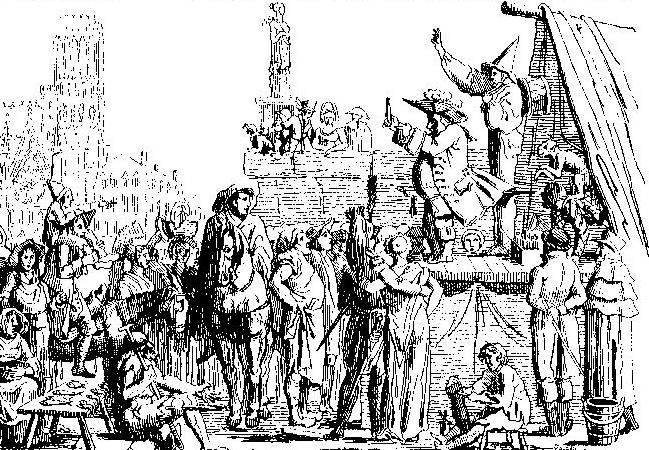
Rudin urges actors to observe street merchants making their pitch. What these hawkers do, he notes, is to broadly hint that the goods just might be stolen. Students of big and small cons will observe at once that this technique is fundamental to all cons. If you can appeal to the mark's dishonesty, you've roped him! (At one point in long history of the Commedia, the actors wore out their welcome in Italy and dispersed all over Europe, sometimes falling so low as to serve as come-on men for quacks, as pictured in the print of Notre Dame above.)
Here's an English tourist's description, published in 1776, of St. Marks Square in Venice, which served as a center of the charlatan world thanks to the toleration of the local authorities. (The word “mountebank” comes from the practice of these sellers to mount benches fastened together as a makeshift stage.)
These Mountebanks at one end of their stage place their trunke, which is replenished with a world of new-fangled trumperies… the principal Mountebanke opens his trunk and sets abroad his wares, [then] makes an oration to the audience of almost an hour. Wherein he doth most hyberbolically extol the virtue of his drugs and confections…though many of them are very counterfeit and false. They would give their tales with such admirable volubility and plausible grace that they did often strike great admiration into strangers that never heard them before.
One could not say more of our own modern-day market mountebanks. In fact, today's charlatans could learn a great deal from the Commedia dell'Arte.