Are Declines Bigger After Longer Up Runs? from Kim Zussman
DJIA weekly returns (1928-p) were used to look for runs of consecutive up-weeks, such as the recent run of 8 consecutive (ending week before last). As a check on whether longer up-runs end in bigger declines, regressed the run-terminating down week return (the week ending the up-run) against the count of consecutive-ups ended:
Regression Analysis: week ret versus run up wk
The regression equation is week ret = - 0.0155 + 0.000405 run up week
Predictor Coef SE Coef T P
Constant -0.015497 0.001188 -13.04 0.000
run up wk 0.000405 0.000319 1.27 0.204
S = 0.0131489 R-Sq = 0.3% R-Sq(adj) = 0.1%
Conclusion: No significant correlation between run-terminating decline and length of up-run.
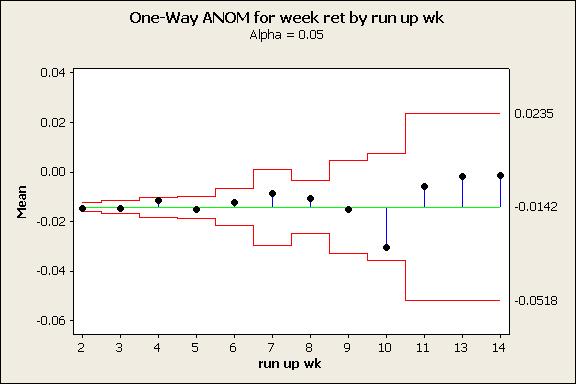
The attached chart compares means of run-terminating decline weeks, by length of prior up-run. As with the regression, there are no obvious differences between run-ending decline week returns as a function of run length. (If any of the decline means differed significantly from the global mean, it would be beyond the red confidence interval limit-lines. The lines diverge as run-length increases because there are fewer long runs than short ones).