Earlier posts · Page 21
Reasons on Twitter, from Victor Niederhoffer
I am predicting one of best weeks in history next week starting with Mon. Reasons on twitter.
Ralph Vince writes:
Yes indeed. Gold was down on the week last week, credit quality spreads didn't blow out — the coup e grace was the videos shot on smartphones supposedly of Chinese police chasing after guys with Covid19 (because, you know, they can tell the guy had Covid19, not the flu, those Chinese cops just "knew").
A month from now I suspect the foolishness we've witnessed will be apparent, which is not to say it's not deadly for one in 50 who catch it or less. Americans will be a country of total germaphobes by the time this weekend is over - a form of self-isolation which will further mitigate the viral spread.
March will be made in the first week I suspect, on a violent, rather disorderly lurch upwards. Then the volatility will return to normal, a process that will take time. After this quick, abrupt rebound (which no on will be able to get aboard if they aren't already, I further suspect) we'll go sideways, punctuated with head fakes, stutter-steps, and feints of breaking out to the upside or downside. But the ensuing move is well-over the horizon, the crowd needs to be ground down into total ennui. Eager to recover their losses and missed opportunities, the market will do the most perverse thing it can to the most players, as it always does.
Not until we feel like we're watching paint dry will the next move come.
Comments
Tim Brown on March 6, 2020 4:03 pm
I’m poised in my doorway, cane in hand.
William Hall on March 8, 2020 7:36 am
I put 25 percent of my cash reserves to work last week and will add another 25 percent this coming week if the market continues to crash. This too shall pass.
Sam Veneer on March 8, 2020 11:35 am
If several vaccines are now being fast-tracked some good news may arrive soon and then a large upswing to “normalcy”?
Coronastimulus, from Boris Simonder
Here we go, Italy goes first with stimulus to counter COVID-19.
China: The Leverage Cyclotrone, from Sushil Kedia
Russia was the erstwhile leverage cyclotrone, selling its primary produce the commodities below cost of production. Went bust.
China the next cyclotrone is even more aggressive. Not only the highest operating leverage anywhere in the world as an economy but the Chinese Gummint facilitated layers and layers of cross holdings and paddings within all balance sheets.
Today it's a house of cards. It can collapse. Everyone knows this can bit.
Question is how probable that is and what sort of time for the dragon to roll crumbling on the floor?
Peter St. Andre writes:
What are the measures for "going bust"? Unless we have criteria, we'll be stuck in the domain of subjective opinions.
(I leave aside for now the question of whether the CCP provides accurate measures of economic activity.)
Jeff Rollert writes:
Suggestions:
1) Abandoning their managed currency;
2) Significant nationalization of lending institutions;
3) Direct monetization.
Sushil Kedia writes:
Going burst has a simple definition: unwillingness and /or inability to fulfill contractual obligations.
1st Failure has happened: They dug roads out of Wuhan and left their own people to die. Its the worst form of bankruptcy any state can ever undergo. Tell-tale signs that if they can kill their own with impunity, they will have no shame in reneging on any contract that they are compelled to.
A list of further signs would be, not necessarily in any order of gravity:
a) Letters of Credits issued by Chinese Importers lapsing & banks denying their fruition. (Is there some place on the net where it can be tracked?) b) Abandoning the currency peg would be of course a public confession of admitted weakening of their financial juggernaut & not a true case of going bust but a strong warning sign that the bust is coming round sooner. c) Failure to meet with any contracts for imports or exports by a Government agency or a Government backed enterprise.
Its simple. Mr. Tweeter should let the FED front-run the Chinese hoard of US Treasuries & send the US Yield Curve hurtling, now. As the Chinese are left with nothing else to pay with except their US Treasury holdings extricate a Trade Deal of the Millennium, offering support to the Chinese via a "friendly" QE.
And by the time its voting time he can tweet "Make America Great Yet Again" and push the S&P500 from 2200 back to new all time highs in a rocket like move.
anonymous writes:
I'm told that Chinese contracts with "force makeup" clauses are worthless, here and in China.
Tracking those is impossible, as far as I know, as they are usually very private.
J.T writes:
Can you even imagine the nuclear winter if they liquidated their holdings in U.S. debt? Not going to happen but it would make a great script.
Art Cooper adds:
Cf. the 1981 thriller, "Rollover".
What are the Chances, from Victor Niederhoffer
What are the chances that Dr. Nancy, the messenger who delivered notice that the pandemic was likely the proximate cause of the 1000 Dow drop on Tuesday was hearing crawdads since from the deep swamp like so many of the avowed enemies of the pres who claim they can overcome their biases and deliver impartial decisions like no one that one has ever seen in a not uneventful life.
Wall Street People are So Dumb? from Leo Jia
I really can't believe the recent behaviours of Wall Street. Look, the virus situation intensified since later January. But the Dow kept climbing to all time highs. Though the earlier official infection numbers from China were not high, no one on Wall Street questioned about the validity of the numbers. No one started to sell stocks because of the virus? What, they didn't have to pay attention to China? Come on! China still occupied large shares for global supplies (however low end they may be). Then what happened during the last couple of days? I know, there start to be outspreads to other countries. But no one foresaw it? Huge money to be made on Wall Street! I know my questioning here is postfactum. But were there prophets to profit from all this?
Ralph Vince writes:
A time that followed the one that the world was listening to just prior to about the Fed's balance sheet never allowing another drop.
Panic, from Zubin Al Genubi
I've heard people are buying out the toilet paper at Costco which seems to me to be panic behavior.
On Another Note, from anonymous
On another note, America should send large aids to Iran now! A lot of benefits in doing so. It will help the US to win Iran on its side from China. Most important is that the kind gesture will help later on solve the peace issue in the Middle East.
Kim Zussman writes:
They will have to wait until next year when Bernie sends more pallets of cash, which hopefully will work better than last time.
Comments
Reid on March 3, 2020 3:50 pm
Don’t send aid; aid will allow the regime to continue in power.
Energy Stocks, from Theo Athanasiadis
Energy stocks are down 20-30% for the year with valuation below the levels when oil was trading @30$/barrel. From that perspective they look attractive but it can easily be a value trap. Does anyone have a thorough view?
Comments
alex on March 2, 2020 9:37 am
i share the same opinion. value trap. no dividend is going to compensate for the fact that the sector could go down another 50%. XLE chart is really ugly.
revenues are impossible to forecast while costs are very real. + the burden of turning around these gigantic companies with tens of thousands of employees worldwide.
it’s very difficult for huge corporations like this to turn around , change the business model, reinvent themselves.
some upstream projects have 20-30 years amortization schedules. the newest projects in the LNG space have seen their costs runaway while the underlying commodity is at an all time low. long term contracts are being renegotiated by the customers while the market is moving away from fossil fuels and cars are becoming self driven and electric.
road transportation was 50% of the demand in 2017 according to OCDE stats. petchem 15%
none on March 10, 2020 1:56 pm
Allow the CL market to close out for the month of March 2020.
As, this action in price is a test of the long term trading range high point during the decade of the 1980’s and 90’s.
The recent trading range in affect today is the low of 08/2015 37.75 and the high of 05/2015 62.58. This action in the month of March 2020 is a breakout lower of that range, a monthly ‘close’ latter under March 2020 low point will be consider an ‘inflection point’.
Inflection points are a place when the market trend will continue at a trading range break out point or reverse back into the range.
At this point the low of the TR 37.75 becomes ‘overhead supply’ and should lead towards the start of a major bull market upon breakout.
—————–
Take special note:
Of the recent ‘contract low breakout’ 48.05 level front J.
Below are notes of such market actions.
Breaking of contract highs/lows are inflection point towards volatility. Long term option ‘writing’ that has been taking place are, and have a greater risk factor towards the break away from extreme contract highs and lows (all time contract highs and lows).
As, we have seen in the recent 2018 NG markets many have been ‘writing’ options during a large trading range collecting premium, contract lows and highs are places where sellers of options become a much larger ‘risk’ towards investment capital once the ‘break away’ happens, they become or are at the ‘mercy of the market’ to a larger degree.
Update 03042020:
Recent front SP contracts continue to have their contract low point at the recent 2019 Xmas low point, but the INDU (YM) index (30 stocks) have recently broke their contract low point last week, this is the action towards a long 2 year trading range. Passive investing (the ‘writing of put/call’ options to collect premium along with extreme bearish/bullish sentiment) has cause an immediate reaction to such investing, and the cause of the speed of the market decline being mention recently.
The INDU is 10%+/- away from the Xmas 2019 low point and already having its front YM contract trading and breaking its contract low.
Severe downward pressure is not being contain, it is expanding by leaps and bounds.
——————————————————————–
Update 02142020:
The trading range in JYP is quite an extreme towards ‘no volatility’ this is a haven for risk takers towards collecting ‘naked option premium’, this is coming to a close. As, the NG long term trading range a year ago when it hit its ‘contract high’ point of no return.
NG option writing wipe out is seen when NG high its inflection point late 2018, a few firms went under.
107 JYP is an important volatility level.
——————————————————–
Update 08/12/2019:
GC has just hit its ‘contract high’ in the front month 08/12/2019, contract highs and lows are a very important levels.
Such as a contract high ‘target’ hit in NG 10/02/2018, these levels are associated with over head supply or an extreme demand element towards value.
Observe all the majors in the currency markets (AD,BP,CD,EC,DXY.JPY) have been in a long term trading range, this action moves options traders into ‘selling options to collect option premium’ over a greater then average normal length of time. It moves the general thinking of the markets towards a passive type of outlook to earn.
———————————————————————-
Update 08282015:
Buy Signal ZB U5 contract 30/10 year yield new lows coming 08282015
World interest rate market in the Euro Dollar created a new all time low this week, as the contract created a new all time high. This is a major non conformation towards the 30/10 USA yield to move lower and create a new all time low in yield.
Blackrock: The scapegoat? from anonymous
With Trump's failure to blame the market crash on Bernie, and repeated observations that Blackrock's "ESG focus" is contributing to the Energy Crash - one wonders if the 'fall guy' for the crash is Larry Fink, a virtue/climate signaling financier who would energize Trump's base.
With BP's exit from climate council and XOP breaking well through 08 lows in an election year, and the mysterious disappearance of the word "fracking ban" from the democratic debates as well as Pelosi's behavior towards Sanders — things do appear to be setting up in an interesting manner re: an inflection point on the climate narrative.
Actions by the Trump administration to hold Blackrock and its executives liable for energy bankruptcies could result in a panicked buying move in the energy sector, and a much needed market pump. It sounds insane - but what's the alternative? Rate cuts can't stop Blackrock from divesting and exacerbating the CHK / other distressed situations.
I am toying with the idea of buying puts on Blackrock funded by a long solar company position w calls sold against them (calls extremely expensive in solar because retail loves buying them).
Adaptive Evolution, from Victor Niederhoffer
Adaptive evolution explains many aspects of ever changing cycles.
A Note to my Daughter who Sent me a Gift, from Kim Zussman
Thanks for the high end swim goggles to wear at the supermarket! Though I appreciate your concern for our health, I can't imagine wearing them.
This a true panic. Yesterday I overheard several people complaining that masks were all sold out - except the big dorky ones for nanoparticles at Home Depot.
The c-virus may have caused a few deaths in the US in the past week or so. But compare this to the rate of death from auto accidents (~100/day ca 2016)
You are about 1000X more likely to die driving to find masks than to die from CV!
That said there are no good ways to guarantee non-infection, and the best approach is just common sense.
Just got back after spent about 24 hours between airports, planes, lounges…where thousands travel each day. I come in contact with 20-40 people per day at the office - and even tho I wear a mask it is mainly effective in preventing out-going rather than in-coming pathogens. Here's what I suggest:
-
No non-essential travel until things calm down. This will reduce contact AND help you at work - since employers like employees who are there (see #2)
-
There is a risk of recession this year, which is why the markets are tanking. Global commerce has already been impacted and it could get worse. Plus this is a golden opportunity for the leftists to defeat Trump. You better believe the resistance / deep state will pull every lever possible to trigger a pre-election recession. Recession means job risk - so my advice is keep doing your best to hit your numbers and DON'T GO ON VACATION. On top of everything else, in a recession companies will start laying off - and you don't want to be anywhere except in the most desirable group!
-
Upper respiratory infections tend to peter out as it warms up, so this one should be gone in a month or two. Meanwhile they might find effective treatments, which would jolt the market up bigly.
-
About 14,000 Americans died of flu this year, but no one is panicking about that–and most people don't even get the flu shot!
A Case of Missed Profits, Getting in Over Head, Unsung Heroes and Inside Information, from Victor Niederhoffer
When Etrade was starting out, they had no market to test their infrastructure and no money for the test. My firm loaned them 400,000 to start their business and arranged for the comex to test their products in exchange for 40% of their business. About 7 years later they paid back the 400,000. They recently sold their business putative for 13 billion. Business people should learn from this example–especially mistakes made.
Peter Pinkhasov writes:
I guess the bias in woulda shoulda coulda is asking is if E-Trade would have become a 14 billion company if that 40% was not bought back by the company.
Differential Nonresponse and Trump’s Odds, from Stefan Jovanovich
This is the term of art pollsters use to explain why their numbers on political partisanship start to drift away from the "mainstream". Gallup is offering it as an explanation for the fact that their surveys find "the percentage of Americans identifying as Republicans (32% in the past two surveys, up from 28% in the prior two surveys), along with a decline in the percentage identifying as independents (41%, down from 43%) and Democrats (27%, down from 28%)." Should this 1 in 7 increase in the number of self-declared Trump loyalists be enough to defeat "Mike's" money and Senator Sanders' loyal following? The London bookies seem to think so. https://www.us-bookies.com/election/ I think they are looking at the other data Gallup offers for free. Here is the link to their longitudinal survey of Presidential approval going back to Harry Truman. https://news.gallup.com/interactives/185273/r.aspx Incumbent Presidents lose, resign from office or have their party lose badly in the next contest when their approval rate falls below 30. Truman, Nixon, Carter, Bush 1 and Bush 2 all pegged that mark. Trump's rating has fallen as low as 36, but it is now at 49%. In his first term Reagan's rating hit a low of 37% but by early 1984 he was the same place Trump is now.
Thoughts on Romance and Markets, from Sushil Kedia

-
Triangles on stock charts or in love, both are the most complex states & can resolve any which ways. Don't anticipate in such.
-
Rebounds in love as well as in the markets are so soothing but best faded.
-
The mistress gets the better of the other in both love and in the markets.
-
Only the wiser can prevail at love as well as in the markets, those who have realized the diminishing marginal utility of intellect.
-
Timing is everything in both love and markets. You got to say I love you at just the right time.
-
Love rises from trust & trust rises from respect. A trader who has tested his system to the point of trust often kisses the market better.
-
Stay out when in doubt, whether in love or in the markets.
-
Love is action, neither a feeling nor a reaction. A trade is an action, neither a feeling nor a reaction.
What more items would the specs add to this list?
Victor Niederhoffer writes:
Never tell anyone about your trades or your romantic life.
She’s Been Reading Stefan’s Posts, from Alston Mabry
An Unsettling New Theory: There Is No Swing Voter
Rachel Bitecofer's radical new theory predicted the midterms spot-on. So who's going to win 2020?
Bitecofer's theory, when you boil it down, is that modern American elections are rarely shaped by voters changing their minds, but rather by shifts in who decides to vote in the first place. To her critics, she's an extreme apostle of the old saw that "turnout explains everything," taking a long victory lap after getting lucky one time. She sees things slightly differently: That the last few elections show that American politics really has changed, and other experts have been slow to process what it means.
Stefan Jovanovich writes:
Only half of them. Bitecofer has no respect for the notion that people's partisan loyalties shift because of their changed views of their interests. She thinks there is a permanent division between leftist Geulphs and tightest Ghibbelines, and elections are entirely a function of which side sends more soldiers to the battlefield. She is convinced that the Children's Climate Crusade will triumph because they will show up to protest Trump's love of carbon. She could be right. But the evidence is against her. The Democrats won the House in 2018 because the power of incumbency was nil, and the Democrat candidates were the new faces. They lost in the Senate for the same reason. Even the new Democrat faces were old ones in terms of media exposure. Candidates do matter. So do interests. I am increasingly confident the Trump Republicans will run the table because the Trump brand is now JFK liberalism with debt doesn't matter Galbraith economics. There is nothing in Trump's labor policy that George Meany could object to, and the "fiscal conservatives" are all gone. It is guns and butter, preserve Social Security and Medicare and bring the troops home. Against that you have what - abortion rights and gun control and debt forgiveness for graduate students? Really?
anonymous writes:
Oh, but it's much more than abortion rights and gun control and debt forgiveness for graduate students! Bernie promises to double union membership in his first term, switch to 100% renewable energy, impose national rent control, guarantee everyone a job, provide free high-speed internet for all, give prisoners the right to vote, rebuild Puerto Rico, turn the post office into a bank, and so much more.
My Son, from Victor Niederhoffer
 My son has to memorize an exact definition of about 10 words for 50 different vocab words. There are so many other things that are more useful to memorize and so many other things besides memorization that they should be learning, including learning how to learn. Especially in this changing environment for learning. I believe the education police will be hearing from me.
Henry Gifford writes:
Education is like the field of saving energy in buildings.
In buildings, it is OK to save $1, but better to save about $0.50 and be able to prove it. But, the best of all is to be able to save $0.10 and measure it precisely, and have some accompanying graphs.
Teaching students to learn is hard to measure the results of, while asking them to memorize things produces results which can easily be measured. Many types of real learning cannot easily be tested for, which is one of many reasons to avoid teaching such things. Then there is the problem of some teachers being lazy. They can tell the students to go home and memorize the definitions, and expect to be tested on them. These teachers will likely end up with enough passing students, while better teachers will also have an acceptable number of passing students. When most everyone passes the test, pressure on the school administration to improve learning is eliminated. This goal can easily be achieved by making the definitions easy enough for most students to pass the test.
Then there are the opportunities for educational consultants to measure the results of different methods of teaching memorization, different lists of things to memorize, examining the word lists and the definitions for political correctness or racial bias, etc. Real learning would put a lot of consultants out of "business." As what they do stretches the definition of "business," suffice to say memorization and the data streams it generates opens up many opportunities to obtain "funding," which is the polite term for money in those circles. Note I never mentioned benefits to students or lack thereof.
Comments
Ralph Di Fiore on February 19, 2020 11:53 am
I couldn’t agree more with you Victor. As an educator for the past 20 years, I begin each year off with the definition of what an education is. To quote Einstein, “education is learning how to think.” It is not the regurgitation of facts which is in no way a demonstration of knowing how to think. I am the principal of a large private international high school in Toronto and most of our students come from countries where they learn by rote and are not taught to think. It is the biggest challenge to show them what the thinking process is and that it is not rote memorization and regurgitation.
Anand on February 25, 2020 12:52 pm
Any good ideas on what to read to learn how to learn? This would Im sure have been useful to me several decades ago, but better late than never!
A Historical Lagniappe, from Alston Mabry
Simple Principles of Investment, 1919 by Thomas Gibson
In chapter XI "Industrial Stocks" (p. 125) the author states that the large industrials "decline to issue full and frequent reports as to their condition and earnings".
"The very worst feature of this state of affairs is that a few 'insiders' are at all times in possession of the facts and are able to act upon them marketwise. No one who has observed the stock markets, even in a perfunctory way, has failed to note instances of vigorous advances or declines in certain stocks, wholly unexplained to the bewildered public owner."
Livermore’s Suicide Note, shared by Jeff Watson

.
.
.
.
.
.
.
.
.
.
.
.
.
.
Comments
Andre on February 15, 2020 8:26 am
Trading is like poker waste of time for almost everyone
Jim Davis on February 19, 2020 6:44 pm
How long would Jesse have lasted if he’d lived today and shorted $TSLA or $SPCE?
Then again, maybe he’s have been long !
The Law of Ever Changing Cycles, from Jeff Watson
Tradebot was an early HFT group that had a 14 year winning streak, more than 3400 winning sessions in a row. That streak was broken in 2017. There are many explanations of why their trading profitability has suffered in the past few years, with less volatility, not trading foreign stocks etc being some of the reasons. The main reason they are suffering because they have not adapted to the law of ever changing cycles. They are behind the form. It happens to the best.
Sushil Kedia writes:
Change is the only constant in Markets.
Financial Markets are called Exchange. The purpose for which these markets got created is to facilitate exchange or produce liquidity. The market infrastructure propels this goal by enforcing only one constant, Change! Liquidity is generated by maximising the number of hands feeling the need for change. Those that get complacent with success or those who are lazy, they are the inferior DNA that the Darwinian nature of markets rejects & takes forward with itself agents of change.
If anyone is keen on cussing speculators, they are lazy or complacent. The speculator thrives with change and is the chosen blue eyed boy of Change — the catalyst of all progress.
If Stasis is not the anti-thesis of change, what is? The ease of finding an N day breakout, N day average, N day variable is the primordial human instinct to seek refuge in the regular rising and setting of the sun. Markets hand-pick women and men who can identify with, play with and grow with irregularity. The primordial hard-coding of the human mind to seek familiarity is so easily reflected in a normal tendency of men to seek the same table at their favourite restaurant!
Familiarity may be breeding contempt and unwanted children yet is the most easily sought after human frailty.
If Inventors and Discoverers propelled mankind forward by sailing with ease in uncharted waters, the speculator does it every moment. Isnt this true in, this time its different?!
Comments
Andre on February 7, 2020 10:17 am
Great explanation Mr Kedia thank you
Amit Trehan on February 18, 2020 8:04 am
You are quite right Sir.
Infact, the Human Genome is designed in a format wherein he can’t exist in a vacuum, i.e. he is always existing through give & take mode. The Give & Take Mode is basically not the barter system. Rather, it is the exchange of thoughts, relationships, one’s basic or hyper needs. Within the same ambit falls the Markets. Markets facilitates one of our purposes of existence, i.e. living & striving through Exchange (not just stocks or money, but everything). Hence, Markets are not created by Humans, rather they have a Universal co-existence with us.
Some 50 Years Ago, from Victor Niederhoffer
Some 50 years ago I received what I considered excellent advice from H. Everts, the vice chair of Cons Foods. I was trying to sell Tyco and they had a faster sleeker race slot car. Everts told me that he never liked to buy companies that had a tech advantage because it was only a matter of time until someone caught up with them. That advice was extremely wrong and harmful as Apple, Tesla and many others demonstrate.
Ken S writes:
Yep, many a dollar I missed securing by that thought, which I still hold true, but the riddle is when to use it.
I might just simply say go with the firstest with the mostest.
A themed etf is no replacement for better analysis. And I need remember that there are gains for win place and show. And disrupt will always be a viable verb, thanks be.
One only has to make a cursory review of the auto well over a hundred years ago til now. I remember you had mentioned the railroad evolution.
Rueful, from Victor Niederhoffer
It must be very rueful to the lott silver people that they post pari mutual odds and thus can't shade results now that they show Trump at 11 to 1 fav versus Biden. Talk about "your own man says you're out."
Returns by Decade Since Ike, from Duncan Coker
Compounded total returns for SP 500 with dividends.
50s 19.3%
90s 18.2%
80s 17.5%
10s 13.4%
60s 7.8%
70s 5.8%
00s -0.9%
Overall 11.4% compounded annual return
Comments
Andre on February 7, 2020 10:21 am
Homeostasis of returns has been reached in this decade.
Math Oddity/Euro Stoxx, from Alston Mabry
Just for comparison, FEZ closed Friday at 39.10, and the 2022 39 calls (farthest out available) show a closing ask of 3.05, which is 7.8%.
Cagdas Tuna writes:
It must be due to pricing. Dax, Eurostoxx futures priced in Euro while ETF priced in USD.
Freedom from N, from Sushil Kedia
N Day High or N Day Low are likely as good as only N Day Average.
Value of N is chosen by an observer of data.
Market has its own ever changing cycle. It is designed to maximise the number of hands that tremble leaving only very few hands having a firm grip on the cane.
What analytical thought processes may be free from an open-ended N and yet be testable?
Oscillators are a set of transforms that are bounded. They are not free radicals with an open and free N. That's one of the non N types even if the bounds of an N day Williams %R or an RSI is derived from some N but they may not run wild beyond a boundary.
Apart from oscillators what other thought processes may free a man in his observations from the imposition of his own imaginations that arose from "choosing N" ?
Are there any testable patterns that do not depend on a free N or a "bounding" N?
Hernan Avella writes:
This is a good query. Consistent with the concerns you mentioned and others, I find some robustness in sticking with N=1.
China Bans Sales in the Stockmarket, from anonymous
Till 7th February 2020, to begin with, anyone wanting to sell above a certain size needs permission before-hand.
Without a selling side there is no effective buy side to a spread. Fine, so this gum-mint is going to yank up the market prices. Huh! Such tricks can at most postpone the catharsis. The more a catharsis is postponed the more cataclysmic it gets.
Increasing short sales create a bubble of impetuous, emotional sporadic buying pressure because shorts do not have a long term drift to back them an eternal position. This basic axiom of markets is missed by regulators so often. A market with sufficient shorts is the market that will find sporadic rounds of panic buying to lift it much more.
In any case if no one will be buying in that market, if that's what their gum-mint thinks, then even if sales are prevented here the bids will slide down without activity. Such a market becomes hollower than it would be with normal sales allowed!
Why don't the Chinese shut down their stock market for some days then?
On the other hand, TA-35 gapped down more than 1.5% today and skidded and bumped down further. An uneasy Sunday & as Asia re-opens in four hours the intraday-violence of the markets will offer many quick hands largesses that are not often.
While the initial flight to safety has taken recourse to seek US Treasuries, melting the yield curve lower, the sell off on the Dollar Index is remarkably clearly due to the inexplicable smart one day rise in the Euro.
If Corona is the epicenter of all things now, why should Euro rise? I cannot surmise any other answer possibly except that when volatility turns into violence the popular trades in every pit are going to be bumped out. So if Euro seemed will melt into new 10 year lows its been whipped up.
Leverage is getting punished, trend seeking attitude is getting punished.
To come to the point without building a longer preamble, this juncture in the market is going to punish everything obvious. So what are the most unobvious trading ideas?
My chit in the ideas hat is short gold. The shiny pit is not reflecting the sort of behaviour a total risk-off world should. The collateral damage will be for short term gold bulls, now.
What are your unobvious ideas? Care to drop your chits in the ideas hat?
Comments
none on February 4, 2020 2:10 am
Napoleon try the same, it did not work and was a disaster.
90-year-old Richard Russell wrote this before his death:
Richard Russell – I Pray China’s Bear Market Does Not Engulf The World As People Panic Into Hard Assets
As people continue to digest breaking news out of Greece and around the world, the Godfather of newsletter writers, 90-year-old Richard Russell, warned that as people continue to panic into hard assets, he prays that China’s vicious bear market does no engulf the world.
Richard Russell: “There is a preliminary deal in Greece, and it looks as though there will be no exit from the Eurozone. Far more important, but receiving less publicity, is the stock market crash in China. My belief is that if China catches a cold, the world will suffer from pneumonia.
Books I am Reading, from Victor Niederhoffer
 The Invention of Enterprise by Landes, Moykyr and Baumol. An update on western culture and contributions to well being and growth and happiness from the fourth millennium BC to 2000.
Freedom and Evolution by Adrian Bejan. How design, rhythm and braking explain everyday things.
Models in Biology by D. Brown and P. Rothery. A complete rendition of models and computations and methods of testing of all dynamic systems with special reference to me on the mathematics of interaction.
An Introduction to Statistical Modeling by Krzanowski, an excellent introduction to practical applications of elementary models and a good review of statistics for the laymen
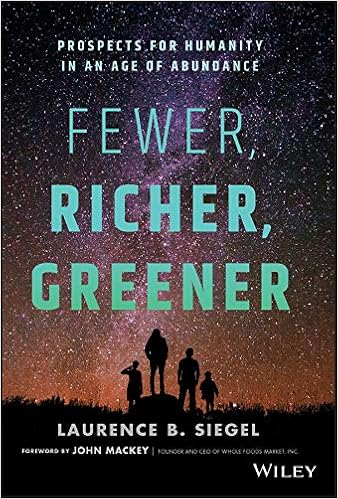
Fewer, Richer, Greener by Laurence Siegel. A graphical and anecdotal review of how well being and betterment and improvements and life expectancy have improved over the ages. A good supplement to the previous books and a guide for optimism and a caution to pessimism.
The Last Samurai by Helen Dewitt. A fantasy about raising a gifted child who loves Japanese looking for his father raised by a sexy musical and literary polymath
Books by Elmer Kelton, particularly recommended as perhaps the second best western ever The Time it Never Rained. A wonderful look at independence and adjusting to change throughout the ages. Tremendous insights on life and markets throughout. Also a great complement to Elmer Kelton is The Good Old Boys. A resonant story of life in the West in 1900 as the cowboys confront the automobile age and cling on to the old way.
Also recommended by Elmer Kelton, Joe Pepper a classic outlaw biography of a bad man who turns good and escapes the gallows at the last minute.
Sandhill Boys by Elmer Kelton, a beautiful biography of the author, voted the best western writer of all times, covering his time in World War 2, his marriage, his stints at the newspaper, his life as a sheep and goat reporter in the Wall Street Journal of the west.
Kim by Rudyard Kipling a tale of coming of age of a smart young Indian who is devoted to his Spiritual Master and turns out to be a successful spy while giving a great slice of life of India in 1890.
Many others to be continued.
Article of the Day, from Stefan Jovanovich
Greg Van Kipnis writes:
And, that story is what lay behind the censored Sen. Rand Paul question. If the question had been made public in the Senate chamber it might have resulted in wider press attention of how the Ukraingate trap was manufactured and how a small group has been working for years to find something they could ensnare the Trump administration with. To me the real big question is the scenario laid out in the article is true and will there ever be an investigation of it?
Comments
Forrest on February 3, 2020 8:16 am
Sounds like a wonderful conspiracy, Mr. Jovanovich. Thank you for bringing it to the attention of our esteemed speculator readers. I had no idea such horrible things were being done to our Lord Trump.
Lessons From GE, from Duncan Coker
If Rocky were here I wonder what lesson would be learned from GE, up 8% today. As I recall he was long calls at 12 ish (last year I think or earlier) that have come back into the money. All prices will be seen at least twice is one of them. Also, positions are bound to go way against before they go in your favor. And the cotton trader's never get out at break even after a big paper loss.
Kim Zussman writes:
Yes, but for every GE how many Enrons, Tycos, Worldcoms, Pets.com, etc?
Comments
Rocky Humbert on January 31, 2020 9:26 pm
Duncan: Rocky IS here (and not there).
Taking a DEFINED RISK position in a troubled enterprise which is undergoing a restructuring was the GE story. And if the story is still “right,” GE will double and double and double again from here. So the lesson is: the stupidest thing is risk a 100% loss and not remain with the position to potentially experience a 5x or 10x return. I noticed that MSFT has become too big in my portfolio because it was the same strategy that I used in buying Microsoft when everyone declared it dead and it’s now more than a 6x return — of course MSFT had a better balance sheet than GE. But comparing it to Enron, Tyco, Worldcom and Pets.com is no different from comparing my career to Bernie Madoff’s. He’s in prison. I’m sipping champagne on an island. “Feeling Good Louis! Looking Good Billy Ray”. RGII
none on February 5, 2020 2:48 pm
GE is a suckers buy, as investors have bought all the way down.
The massive 18-b buy back years made its CEO 720 million towards the 2000 top, and the massive gifts that Welch got at the very top (severance 417 million) was a big tell for the future.
Look for compete bankruptcy.
Massive declining values suggest something is quite wrong, not that something is just ‘under valued.’
Upcoming Payrolls, from anonymous
There are many ways to graphically represent this data. The one illustrated here is the kindest: Payroll Tax Receipts Growth

Question of the Day, from Hernan Avella
What does it say about the future of stocks returns when the big ones are advertising "riding the rally"?:
"Tepper, Druckenmiller Say They are riding the rally"
Ralph Vince writes:
Once again, I must quote Camus, "If that's what they're really thinking, I suspect they will be in for a bad surprise."
The top will be in when sentiment says so, but I cannot rule out the early Jan 18 sentiment readings as having perhaps not already indicating this, we've overshot it in price but not by a whole lot as of yet.
The invested curve of late last Aug, my prop employment indicators now showing deterioration, and earnings flat for ten months indicate an imminent recession sometime this year.
With stocks trading at the same multiples as bonds, the former is generally preferred here because the risk is perceived as being in the bonds…the asset that will mature to par at some point.
Falling Necklines & Indices, from Sushil Kedia
 Rising Hemlines & Indices is a well discussed story. Now one notices the necklines of bollywood divas have fallen so far as can ever fall, right down to the navel! Nifty is still tottering at highs for over three months now.
One certainly has the least amount of required common-sense to know necklines cant fall below the navel. Beyond that the only people to lose clothing are the men in markets. What's holding this market up is a question that has baffled too many already.
This very interesting piece of statistical event study by Ajay Shah & Susan Thomas is simple to interpret that Indian Markets tend to be too charged up emotionally before the Union Budget. Except three occasions in almost last forty budgets, the returns after the budget have been significantly negatively correlated to the returns before the budget.
This year's budget is on Saturday, 1st February. Prior two days are event-intensive days in key markets of the world.
When a Unilver sells at a 19 P/E ratio in Britain but sells at 50 P/E ratio is India & all learned men have been leaning on the liquidity hypothesis for as many as a 100 days I am unable to ignore the fact that necklines cant fall any further.
The Senator has in prior years on the list mentioned an insightful comment that has provided salubrious perspective in looking through the mumbo jumbo graphics that I do, that markets dont top because the smart guys are selling, they top because all the dumb men who could have bought have already bought. The neckline can't fall any further. The last time neckline had fallen so much was in 2000 when Jennifer Lopez came to the Grammys that year. Now Priyanka Chopra, the Indian diva, Mrs. Nick Jonas has done an encore. Twenty years is a good enough time to be a cycle?
Jeff Watson writes:
Necklines can't fall below the navel? Check out some clubs in New Orleans to quickly dispel that myth.
Which reminds me of absolutes in the markets. Some swear by them, giving them the same gravitas as they would the fundamental theorem of arithmetic, others, test them and try to eliminate falsehoods and ballyhoo.
A couple of examples:
Commodities cannot trade below cost or production, commodities cannot trade below government subsidy levels, grains cannot trade below the cost of carry, the price of onions will never go to zero. All of these have been bandied about from time to time and all have proven to untrue.
What other absolutes (old wives tales) can you think of?
The Fed Balance Sheet Ticks Up, from Zubin Al Genubi
The Fed balance sheet ticks up.
Gary Phillips writes:
And if institutions are all in, long to the max %tile, there's record low short interest, the Fed is beginning to shrink their balance sheet and buybacks are going dark, who is left to buy?
Market's reaction to the weak unemployment # may just be the beginning of a larger sell off.
Zubin al Genubi writes:
Add a hundred billion here, a hundred billion there and pretty soon you're talking some real money.
Comments
none on January 28, 2020 10:28 am
It will continue too do so, in the 1930’s while the markets move lower it increase by 12x and equities continue lower.
Article of the Day, from Victor Niederhoffer
This should be tested for our markets: "No Lead Will Be Safe in This Super Bowl"
Our Type of Guy, from Victor Niederhoffer
 Our type of guy: Max Brand
Max Brand played tennis and squash every day and based much of his writing on Homer and Shakespeare. He wrote 212 novels and was the highest paid Pulp Magazine writer of the 30s. He was larger than life, and was exceedingly generous. He lived in a Florence Villa during the 1930s before moving to Hollywood where he is best known for Destry Rides Again. Having read the book and seen the movie the book is among the best Westerns ever written. It is modeled on The Count of Monte Cristo with a man of action wrongly accused and jailed for 6 years who devotes his life to ruining and killing the 12 jurors that didn't given him a fair chance. The book ends in an Achilles Patrocles type climax. It is common to fault Brand for his westerns but I find the insight into ordinary life which Brand learned from working in every place from the Bowery in NY to dropping out as prize winner
Comments
Pete M on January 19, 2020 7:44 am
He led a courageous and authentic life. On his commendation upon receiving a posthumous Purple Heart is written: “He lives—in a way that humbles that undertakings of most men.”
https://www.blackgate.com/2010/04/20/somebody-has-to-talk-about-frederick-faust/
Impeachment Blues, a poem by Preparation H
Impeachment Blues
By Preparation H
Pelosi and Schiff looking for a crime
Issuing subpoenas as cheap as a dime
Fact witnesses can't be found
Yet bravado and innuendo abound
Nadler and henchmen wait with bated breath
Nary a Republican that they impress
It's saving the Republic they claim
But it's their lust for power for which they aim
Not Maxime Brown nor Schiff are fair in this quest
The media is complicit with the rest
The sequel to this sorry state
A Trump victory in 2020 with which we elate.
Comments
Forrest on January 23, 2020 3:17 am
Yes, agreed! They are doing this solely out of a lust for power, and have fabricated every single detail against our Savior. Woe to them.
none on January 31, 2020 11:35 am
I would suggest ‘our American government’ is working as well as ever. Though many see it differ today, is because most do not understand or had never understood what and or how American government works.
The Founding Fathers stress that no 1 part of our government manages and runs the total government, meaning ‘mob rule’ does not exist. We are not a democracy and never will be. Only at certain stages ‘rules of democracy are utilized.
————————
Constitutional Republic
Madison and Hamilton believed that crude and ambitious politicians who had played on their emotions had swayed Athenian citizens. The demagogue Cleon was said to have seduced the assembly into being more hawkish toward Athens’s opponents in the Peloponnesian War, and even the reformer Solon canceled debts and debased the currency. In Madison’s view, history seemed to be repeating itself in America. After the Revolutionary War, he had observed in Massachusetts “a rage for paper money, for abolition of debts, for an equal division of property.” That populist rage had led to Shays’s Rebellion, which pitted a band of debtors against their creditors.
Madison referred to impetuous mobs as factions, which he defined in “Federalist No. 10” as a group “united and actuated by some common impulse of passion, or of interest, advised to the rights of other citizens, or to the permanent and aggregate interests of the community.” Factions arise, he believed, when public opinion forms and spreads quickly. But they can dissolve if the public is given time and space to consider long-term interests rather than short-term gratification.
To prevent factions from distorting public policy and threatening liberty, Madison resolved to exclude the people from a direct role in government. “A pure democracy, by which meant a society consisting of a small number of citizens, who assemble and administer the government in person, can admit of no cure for the mischiefs of faction,” Madison wrote in “Federalist No. 10.” The Framers designed the American constitutional system not as a direct democracy but as a representative republic, where enlightened delegates of the people would serve the public good. They also built into the Constitution a series of cooling mechanisms intended to inhibit the formulation of passionate factions, to ensure that reasonable majorities would prevail.
The people would directly elect the members of the House of Representatives, but the popular passions of the House would cool in the “Senatorial saucer,” as George Washington purportedly called it: The Senate would comprise natural aristocrats chosen by state legislators rather than elected by the people. And rather than directly electing the chief executive, the people would vote for wise electors—who would ultimately choose a president of the highest character and most discerning judgment. The separation of powers, meanwhile, would prevent any one branch of government from acquiring too much authority. The further division of power between the federal and state governments would ensure that none of the three branches of government could claim that it alone represented the people.
According to classical theory, republics could exist only in relatively small territories, where citizens knew one another personally and could assemble face-to-face. Plato would have capped the number of citizens capable of self-government at 5,040. Madison, however, thought Plato’s small-republic thesis was wrong. He believed that the ease of communication in small republics was precisely what had allowed hastily formed majorities to oppress minorities. “Extend the sphere” of a territory, Madison wrote, “and you take in a greater variety of parties and interests; you make it less probable that a majority of the whole will have a common motive to invade the rights of other citizens; or if such a common motive exists, it will be more difficult for all who feel it to discover their own strength, and to act in unison with each other.” Madison predicted that America’s vast geography and large population would prevent passionate mobs from mobilizing. Their dangerous energy would burn out before it could inflame others.
Of course, at the time of the country’s founding, new media technologies, including what Madison called “a circulation of newspapers through the entire body of the people,” was already closing the communication gaps among the dispersed citizens of America. The popular press of the 18th and early 19th centuries was highly partisan—the National Gazette, where Madison himself published his thoughts on the media, was, since its founding in 1791, an organ of the Democratic-Republican Party and often viciously attacked the Federalists.
But newspapers of the time were also platforms for elites to make thoughtful arguments at length, and Madison believed that the enlightened journalists he called the “literati” would ultimately promote the “commerce of ideas.” He had faith that citizens would take the time to read complicated arguments (including the essays that became The Federalist Papers), allowing levelheaded reason to spread slowly across the new republic.
Twitter, Facebook, and other platforms have accelerated public discourse to warp speed, creating virtual versions of the mob. Inflammatory posts based on passion travel farther and faster than arguments based on reason. Rather than encouraging deliberation, mass media undermine it by creating bubbles and echo chambers in which citizens see only those opinions they already embrace.
========================================
Dysfunctional San Francisco Grist, from Alex Forshaw
 I moved to SF with my wife and baby 7 months ago from NYC. My wife is a member of local online mothers' club, Golden Gate Mothers' Group (GGMG), in which local moms pay $75/year to access a forum to share notes around good restaurants / neighborhoods / sites / activities / etc, and generally help each other out.
Here was a barely-surprising story related by one of the GGMG moms: We live on a very steep hill, where parking is perpendicular to the curb. Last Saturday night, we were at our neighbor's potluck party - well attended with lots of older folks and young kids, including my toddler and baby. We went home at 8 to put the kids to bed. Our car was parked in front of our house at the top of the hill. Around 10, I was asleep, but my husband heard a crash - didn't think much of it. The next day, we looked out to see my car parked at a 45-degree angle. I thought, Oh no, someone hit it. Yes, indeed. Some jerk totaled my car (which I just paid off last month). Damages are estimated to be $9,000 and the car's only worth $11K. Of course there wasn't a note. People suck. But then, the neighbors rallied and IDENTIFIED the car using security footage. A guy in an SUV was backing down the hill, rammed into my vehicle, switched drivers (probably drunk), and literally sped away back up the hill. An Uber was on the street at the same time and captured his license plate number. We filed a police report and included all this information, including the license plate number. The cop said the SF police force is understaffed, no one wants to work there, and yeah, they're not going to investigate. So this drunk driver, who totaled my car, who could have run down my children, can just go on enjoying life. So, please take note - if you hit a parked car (or a moving one, or even a pedestrian), don't worry. No one is ever coming after you. I hear this type of story a lot. "I was the victim of a property crime. I did the cops' job, tracking down who did it and collecting proof, all on my own. I presented a heap of evidence to the cops. The cops shrugged and very politely responded, 'F**k off.' AFTER I did their job for them!"
Part of SF's urban breakdown is surely due to the idiot politics of its elected officials. The SF police basically can't incarcerate anyone for anything short of attempted murder, especially after SF just elected Chesa Boudin (former Hugo Chavez speechwriter and adopted son of Bill Ayers / Bernadine Dohrn) as the new DA, whereupon he fired the 7 assistant DAs for incarcerating too many people. But the cops also just don't seem to care.
As far as I can tell, these policies and government are despised by 80%+ of working liberal San Franciscans, who strike me as fundamentally rational people, aside from attributing 90% of all weather readings to either global warming or, if it's a colder day, climate change.
But nothing changes and nobody expects anything to change.
If you live in SF, it sucks. But the moral of the story is, you couldn't dream of a better example (in the US) of the moral and intellectual bankruptcy of woke liberalism in action. Every Democrat presidential candidate outside of Biden and Bloomberg wants to do to the United States what the Democrats are doing to San Francisco. If one of the idiot Democrats wins the nomination, Trump should have a full-time staff based here to log all of the stupidity that SF puts its taxpayers through. They will come up with a very original, just shocking enough, 100%-true attack ad every week.
Comments
none on January 23, 2020 2:04 pm
Cannot understand ‘why’ so many think Trump is a conservative, he is as liberal as all those before and from the liberal NYC way of life.
The Trump Presidency is today 1170 days +/- as of 01172020.
The long term trading range in place started 01222018, 2 years in length today this is 63% of the total Trump Presidency to date.
63% of the Trump Presidency locks in the stats below:
Extremes in 2018 Buy Back Programs had top out.
Extremes in the amount of ETF ETN trading vehicles are in place.
There are now 70 times more stock market indices than listed stocks in the world.
There are nearly 3.3 million stock market indices around the world, according to new research from the Index Industry Association (IIA).
In 2018, there were 190 initial public offerings (IPOs) in the United States.
2019 produce the biggest IPO ever.
President Trump’s rhetoric on the stock market is and has been the most extreme in all American history.
The DXY top out at the Trump stock market low point 112016 to 012017 (102.050- 103.820 level) and has headed lower as the stock market had move toward and created the long 2 year trading in stock prices. Lower DXY trends suggest ‘funds leaving the USA not entering it’.
You now have 3 presidents starting with the 2nd Bush, Obama and Trump with zero interest rates to address major situations. Causing data in the Inequality chart to go parabolic!
Decades into the future we will suggest that what we saw where the 3 worst American leaders the United states has ever had.
—————–
Detroit in 1960 was America’s wealthiest city.
Forrest on January 23, 2020 3:18 pm
I have been a big fan of Vic for decades. I had almost everything that he has published, online or in print.
I am saddened that dailyspeculations features such invective (also see the “poem”) regularly.
Ranting, attacks, no logical chain to follow…. But so it is. Everything comes to an end.
Have fun devoting your lives to raving against “liberals,” whoever they may be. Enjoy stroking yourselves to your self-righteousness.
Lman3b18 on January 26, 2020 10:24 pm
You’re missing the point here. This is EXACTLY what late stage capitalism asked for, top-down. You estimate that 80+% liberal working SFers despise these policies, but you fail to recognize that SF is an extremely transient city. Most have zero skin in the game long-term so they have no incentive to work for change. Most SF workers are mercenaries looking to make a buck and get a notch on the resume before moving again to greener pastures. Then many of the people who do live there long-term are so wealthy and insulated from such instances (they don’t park on the street lol) that they also don’t give a shit. Oh well…
none on January 29, 2020 10:24 am
“This is EXACTLY what late stage capitalism asked for, top-down.”
I thought this statement was interesting, and I would suggest the ‘ending’ of long term or ‘last’ stage communism.
100 years ago 80% of the American population was ’self employed’, today we have only 20% of the population as such. This shift over decades was and still is added by a government liberal way of thinking and the programs they assist with.
‘Republicans are liberal’ and ‘Democrats are communist.’
A new wave of a long term wave in capitalism is beginning, by way of a ‘Roman fire sale.’
Article of the Day, from Alston Mabry
"An algorithm that learns through rewards may show how our brain does too"
Zubin Al Genubi writes:
You can shape a child's behavior through positive reinforcement of successive approximations of the desired behavior. Attention is the greatest re-enforcer. Unwittingly parents shape bad behavior by paying attention to bad behavior. "Now Johnny, don't hit your sister, that is not nice" is reinforcing.
Japan, from Zubin Al Genubi
 I am in Hokkaido Japan enjoying deep powder in the back country.
Japan is beautiful and the people can be friendly, but in many ways there is a stultifying social pressure to conform.
Lack of immigration leads to labor shortages.
There is a sense of slow decay out here in the backwoods.
Here is a 20 year sideways Japanese stock market going nowhere.
Comments
Russell on January 20, 2020 1:01 pm
Decay in the backwoods, I view that as a good thing , people move to the cities and let nature recover outside. Modernisation still continues in japan , I don’t see what’s wrong with a stable or declining population in this time of biodiversity and global warming . I see it as a good thing to replenish the planet . Civilisation will still move forward for the better
none on January 28, 2020 10:33 am
Japanese after this next slide near the 14k NKKI level will be the buy of the lifetime world wide. It will be as the 1945 level in the INDU.
Stock investors will continue to search for USA stocks, but the real bull market will be the NKKI.
It will be the USA turn to do as Japan had done the next decade and more.
Facial Hair, from Victor Niederhoffer
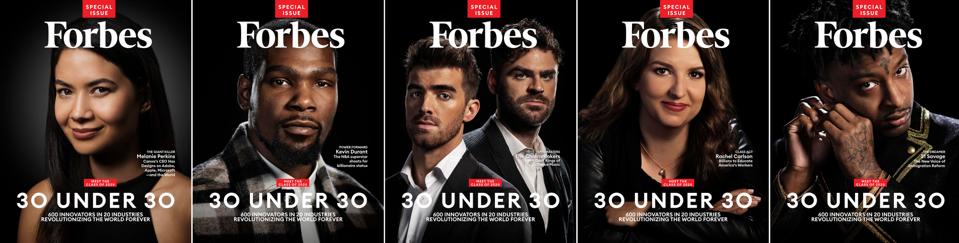 Facial hair on 100% of Forbes top 30 under 30 millionaires as a predictor of individual stocks performance.
Ralph Vince writes:
That facial hair on all these young guys (reminiscent of a rather 1850s look…hm), like those permanent cartoons on their skin…these things tell the world they never hitch-hiked from one end of I80 to the other.
Another All Time High, from Duncan Coker
The contrarian in me and I think many readers of the site tend to buy when we see red on the screen, and sell after lots of green flashes. I've thought to conduct an experiment to turn the colors off on the trading screen to see if there is a bias and just go by the numbers. In the same way certain phrases evoke a reaction, like the words "all-time-high", but it is not symmetrical to "all-time-lows". In our lifetimes it is unlikely we will ever see an all-time-low in equities or bonds, maybe in some commodities and currencies. Yet, we see ATHs quite regularly, for example in the last four year on ES SP500. ( 2016 - 27 , 2017- 65 , 2018 -16 , 2019 -33), or roughly 13% of the time. I think like the colors on the screen ATH is a meaningless phrase. I think more important is market price "x" is high or low compared to what "y"? I would vote for bond yields to go in the y variable, but the possibilities are wide. Employment, GDP. The variable one chooses for "y" has everything to with the predictions for x.
An Easy Short Today [1/16/2020], from Zubin Al Genubi
ES sliced rather easily through round with under 4k buying in night sesh. Seems like half round have more crossings.
Ralph Vince writes:
That's the thing that always gets me about shorts…it seems so, so painful waiting…but when they go they take your breath away, and take back days and days of gains in very short order.
I have to live like a monk. I can't afford any nonsense, distractions or second thoughts, my systems telling me to make the decision here, stay short, hang on suffer it out…it's coming.
Comments
Andre on January 18, 2020 10:11 pm
The thing that I don’t understand how you deal with, although I’m guessing you’re utilizing position sizing from your books, is when the trade goes back into the green how do you keep your whits about you through a subsequent lower high? How go you get out of the trade?
Andre on January 28, 2020 3:07 pm
How do you stay short now?
An Excellent Book, from Victor Niederhoffer
 A Land Remembered is an excellent book I have read that describes the growth of Florida industry and heroic family interactions.
I find it very similar in its greatness to the Elmer Kelton histories of heroism in Texas The Good Old Boys and The Time it Never Rained.
I recommend the Audible version of all three books where the narrator George Goodell shows the harmony of these lives.
.
.
Comments
Lakshmi on January 18, 2020 2:49 pm
Hi Victor - would it be possible if you could post a list of your favourite novels?
Rasmussen Numbers; PredictIt; the Bookies, from Stefan Jovanovich
Their sampling of 1,000 Likely Voters taken a week ago shows a slight edge to the Big Orange. 46% think the President will be re-elected; 33% think he will lose to the Democrat and 12% think he will be convicted by the Senate. 9% are unsure. The sample weights a Democrat preponderance 38% to 32% Republican with the remaining 30% as independent. PredictIt shows the same: 52 cents for the Republican candidate to win; 51 cents for the Democrat.
The London Bookies have a very different view.
From Oddschecker:
Donald Trump -110
Joe Biden +500
Bernie Sanders +750
Pete Buttigieg +2000
Elizabeth Warren +2000
Michael Bloomberg +2000
Hillary Clinton +5000
Andrew Yang +5000
Sports Statistics, from Victor Niederhoffer
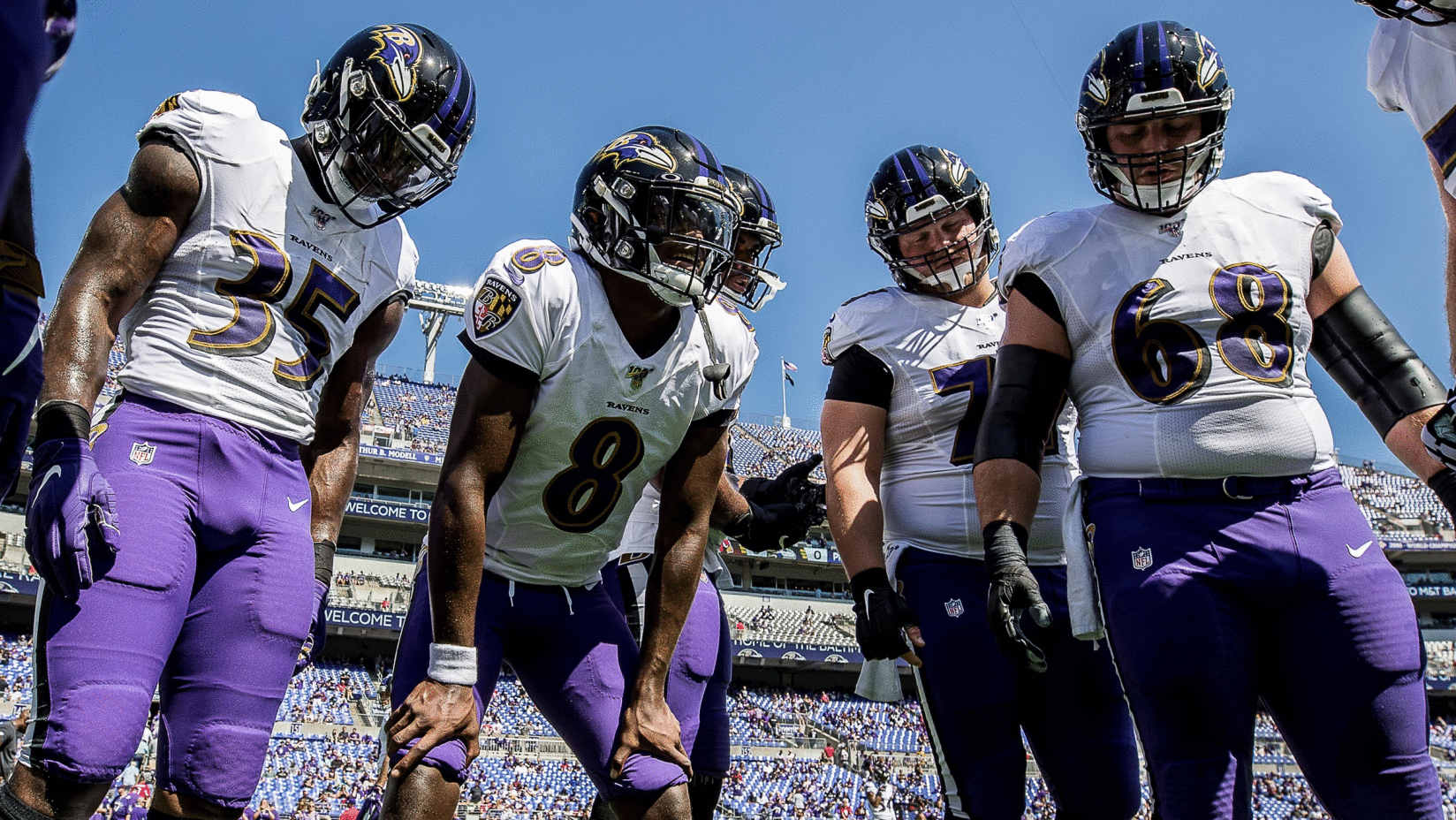 Sports statistics all show that you should go for it on fourth and short but going for it three times led to the Ravens loss. It provides a caution to those who follow market regularities religiously. There is a good thread on this at VicNiederhoffer@twitter.com.
Ralph Vince writes:
Football is peculiarly about making the wrong mathematical decisions. I'm not sure why it is, but I suspect the rapid turnover in coaches and the fact that there is an unavoidable second-guessing in the press and by fans, helps coerce these mistakes.
The most glaring example of this is the (lack of) 2 pt conversions. Mathematically, there are a host of times where this should be taken though you'll never see it. When was the last time a tea in the lead ever took one in the first half?
Russ Sears writes:
Besides second guessing by the press and the fans there's second guessing by their own teammates. The defensive team doesn't like the offense to take risk because they feel they could have stopped the other teams offense given the chance. It's like couples deferring to their partner's lack of risk tolerance.
Ralph Vince writes:
Team sports, by our definition, should ipso facto be more inherently risk-averse than individual sports.
Alston Mabry writes:
Just re the NFL, I was listening to a roundtable interview with players, and the question was, "What's harder to play, offense or defense?" And I was surprised when the unanimous verdict was defense. The explanation was that the offense knows what's going to happen, whereas the defense doesn't, which adds an extra level of stress and is one reason why you hear about the defense "getting tired" by the 4th quarter but you never hear that about the offense.
Ralph Vince writes:
In terms of expected yards per play, because players at the pro level are so good, it;s hard to argue against the fastest receivers getting out ahead of of coverage, and not throwing the ball short; the potential interference call makes the average yards per play considerably higher.
In football gambling, it is ALL about average yards per play.
Fed Balance Sheet Ticks Up, from Zubin Al Genubi
Gary Phillips writes:
And, if institutions are all in, long to the max %tile, there's record low short interest, the Fed is beginning to shrink their balance sheet, and buybacks are going dark, who is left to buy?
Market's reaction to the weak unemployment # may just be the beginning of a larger sell off.
Sultan Qaboos of Oman dies, from anonymous
Sultan Qaboos of Oman dies
-
Oman was a source of stability in the middle east.
-
He was gay.
-
Now his succession is in question. Or that is the fear.
Comments
Yash on January 12, 2020 10:59 am
His cousin Haitham bin Tariq, Oman’s culture minister, was named as Qaboos’ successor, the government said on Saturday.
Study: Does the Broad Market Rise Unusually into IPOs and Then Sell Off After, from Jared Albert
Motivated by the Saudi Aramco IPO, this study tries to answer the question: does the broad market rise into big IPO's (and then sell off after)? This is based on the theory that there is an effort to boost the market before the IPO to benefit the new issue ecosystem.
I'm surprised, but there doesn't seem to be an effect as the chart shows the usual upward drift. I took the 25 biggest US IPOs by proceeds and graphed the mean of LN changes of the SPY to the IPO date of the 20 trading days before and the 20 trading after.
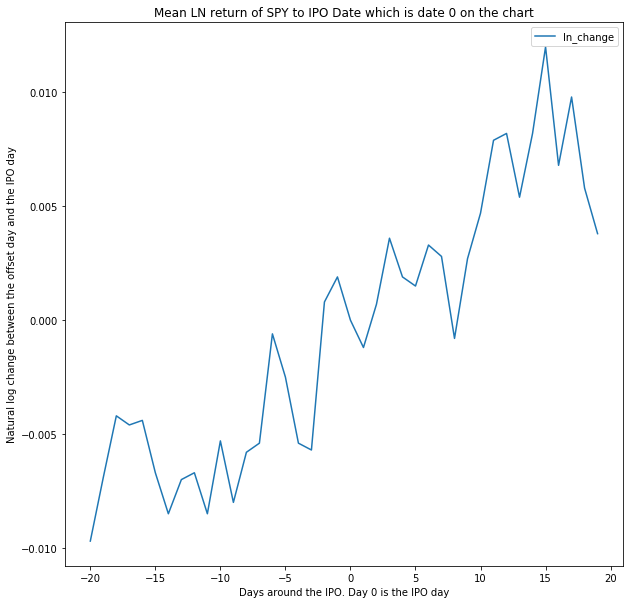
LN changes 20 days before to IPO date
count 25.000000
mean -0.009702
std 0.051080
min -0.125424
25% -0.029615
50% -0.013882
75% 0.020232
max 0.075516
LN changes from IPO date to 20 days after
count 25.000000
mean 0.004976
std 0.032097
min -0.069427
25% -0.008863
50% 0.001278
75% 0.024553
max 0.065406
IPO data is from here
SPY date is from here
script is here.
Requiescat in Pace Neil Peart, from Jeff Watson
 Neil Peart, legendary drummer for Rush and a self described "Bleeding heart libertarian" died Tuesday from complications due to brain cancer. He was a friend of liberty and one of the best drummers in the world.
Pete Earle writes:
This one hits home in a way that few others have. I had listened to their music since the early 1980s and seen them live 20, 25 times. Words and music that inspired and lifted me in every phase of my life. Neil was one of the good ones. Devastating.
It Does Make One Wonder, from Gary Phillips
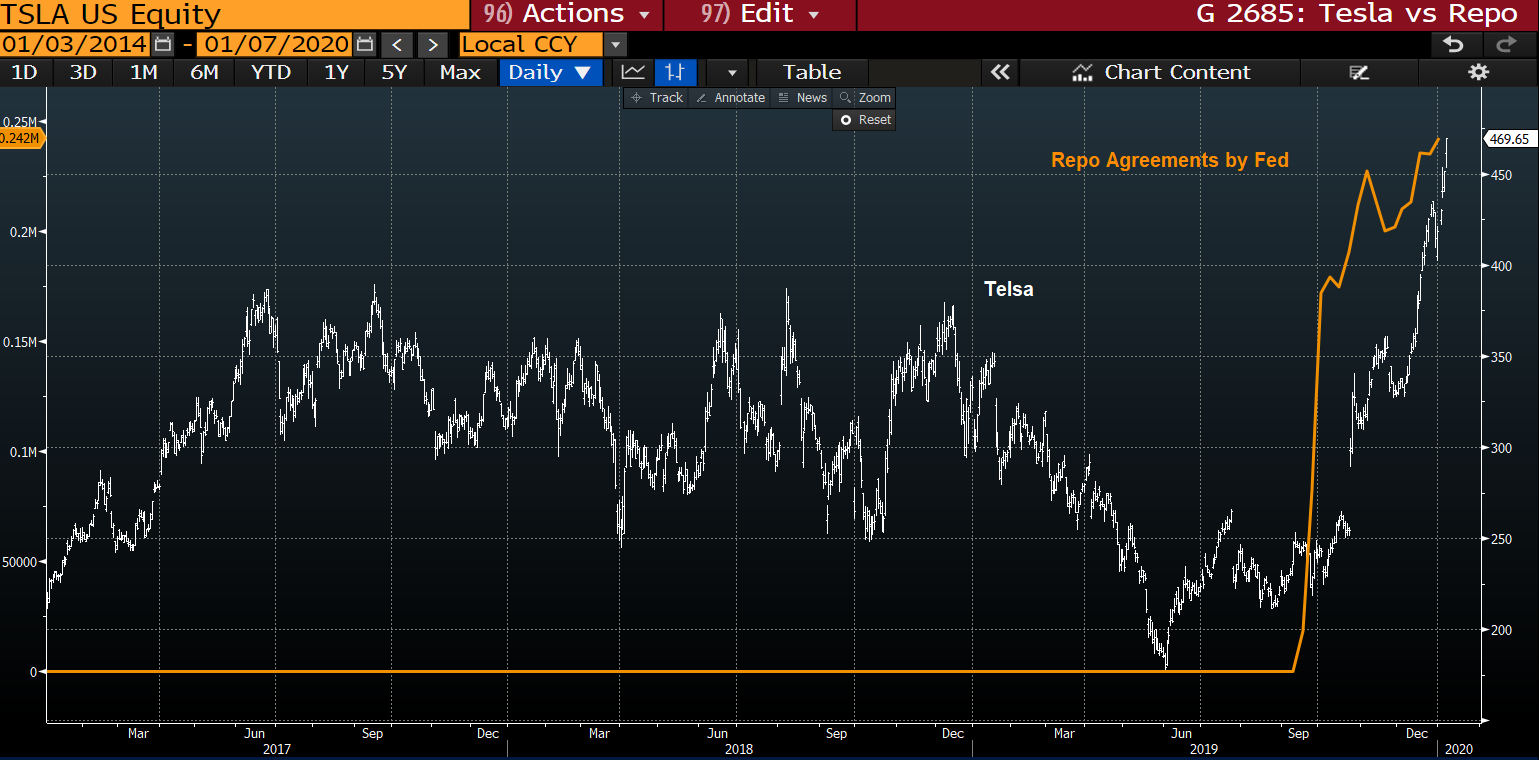 It does make one wonder: spurious correlation or not?
.
.
.
.
.
.
Cycles Say, from Kim Zussman
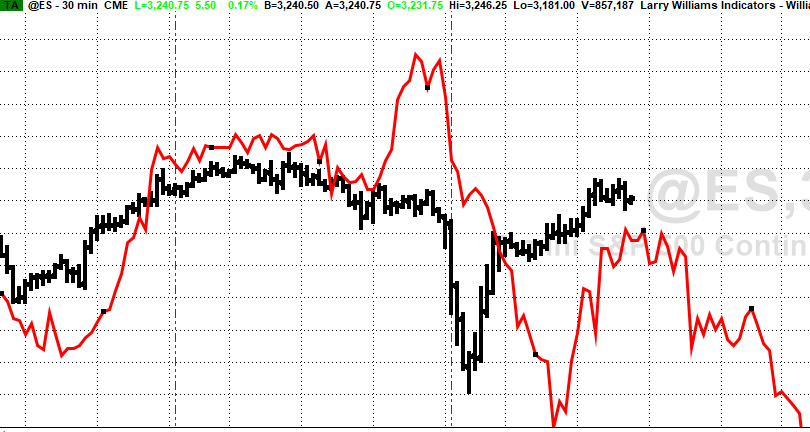 Though it is compelling to speculate, don't forget there are 1000s of possible scenarios that may have played out, none of which will we ever know with accuracy.
For example we are told the US had advanced knowledge of the attack, via "communications chatter". But maybe the attacks were pre-arranged / agreed to via back channels, in order to stage a revenge event placation without triggering a much bigger problem where both sides (and political leaders) lose. Not one casualty?
Its also possible the Iran regime was not as sorry about the terror general's passing as the photos showed.
Who knows?
The Perdicaris Affair, from Stefan Jovanovich
 Teddy Roosevelt did not win re-election in 1904 because he was a Rough Rider in the Spanish-American War. That war's political popularity had faded as the details of the Americans' actual fighting emerged. The woefulness of the Army's weapons and its rifle, in particular, had become a technical scandal. The Krag-Jorgensen's weak cartridge and stupid locking system had been an outright embarrassment compared to the Spaniard's 1893 Mauser rifle, with its higher muzzle velocity, greater accuracy, and ability to be modified for clip-loading.
What won it for Roosevelt was John Hay's rabble-rousing cable to the American consul-general in Tangier, Morocco: "We want Perdicaris alive or Raisuli dead. We desire least possible complications with Morocco or other Powers." Joe Cannon, the Speaker of the House, read the first sentence of the cable to the Republican National Convention, which was grudgingly accepting Roosevelt as its nominee. The convention went wild and "fighting Teddy" became the image for the campaign. The facts of the matter were, as always, rather different than what appeared in "the news".
Still About Artificial Intelligence in the Markets, from Newton Linchen
Hello, Specs
A while ago I was asking directions and opinions about Artificial Intelligence and Machine Learning applied to the Markets, and the answers were quite discouraging.
Nevertheless, inspired by works such as of Marcos Lopez de Prado, (who is now Head of Artificial Intelligence at AQR, if I recall correctly), I started my Masters Degree at Computer Science, with focus on Machine Learning for trading (UFRGS - Universidade Federal do Rio Grande do Sul).
The reason I'm telling you this is because what I'm learning differs from the overall view I got from the answers to my previous query.
I now see that the answers were in line with the idea of webscrapping for "market humor", and news analysis (all int he field of Sentiment Analysis), etc.
There's no dispute that this approach is not available to retail investors such as I, nor for minor asset managers. In fact, I would argue that Bloomberg and Reuters (or any other news agency) would have dominance on that.
(The same is the case with the so-called "high frequency trading"… We simply can't compete with the major players).
But, I'm also learning that Machine Learning (and Artificial Intelligence) is much broader, and I'm starting to see its relevance for trading… Specially, automated trading.
My first model developed at the Masters used an algorithm called Support Vector Machine, which is a classification algorithm.
There are three main "approaches" do Machine Learning: Unsupervised Learning, Supervised Learning and Reinforcement Learning.
SVM (short for Support Vector Machines) is an algorithm in the category of "Supervised Learning".
That's because you give it some features to work with (and learn from). These features are our own market analysis filters, whichever they are.
The thing is, the main value in this model comes not from the SVM algorithm itself, but the "feature engineering", i.e., from "which data filters should the algorithm learn".
That's useful to any (of us) who has his own trading style developed from the experience of many years: we intuitively (or through massive research) know what would be useful or not to develop a trading strategy.
Anyway, I'm still in the process of getting this Masters Degree (in Computer Science), and it's my goal to develop a new trading model from each algorithm I learn.
If you, Specs, have interest in it, I can have you posted.
Kind Regards from Brazil,
Newton Linchen Certified Analyst (APIMEC, CNPI-T 2167).
Don’t Fight the Fed, from Ralph Vince
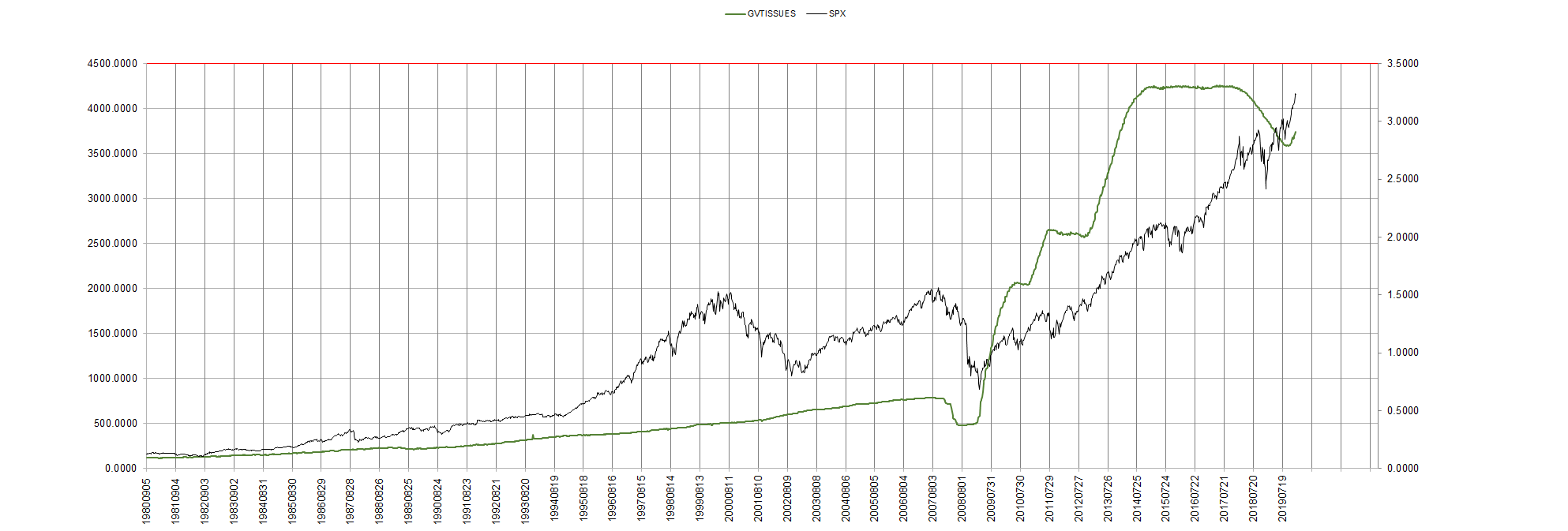 Don't fight the Fed: an expression another one of these REALLY good-lookin' kids hailing from the East Side of Cleveland, with just this past week starting to show contraction in total government issues outstanding.
Alan Abelson, from Victor Niederhoffer
Ralph Vince writes:
Agreed.
"The market is constantly seeking that point of equilibrium which induces the greatest uncertainty."
And that, at any given moment, is the greatest indicator I know of, along with drift.
Comments
Jay Pasch on January 9, 2020 2:38 pm
Find us a better ballad:
https://www.youtube.com/watch?v=uQ4ddAgykfk
Jeff Watson on January 11, 2020 10:01 pm
Jay, You want a better ballad, I’ll give you a better ballad. Hahahah!!!https://www.youtube.com/watch?v=CD8EtvWW8nw
A History of Interest Rates, from Jeff Watson
Although the book A History of Interest Rates by Sidney Homer and Richard Sylla is dated, it still provides a good history of interest rates from prehistoric times, Mesopotamia, Ancient Greece etc, all the way to the 20th century. It makes for a very enjoyable read that will help fill in the gaps with one’s knowledge of the specific subject of interest rates, commerce etc. Here’s a free copy for you to enjoy.
What Rates are Suggesting, from Larry Williams
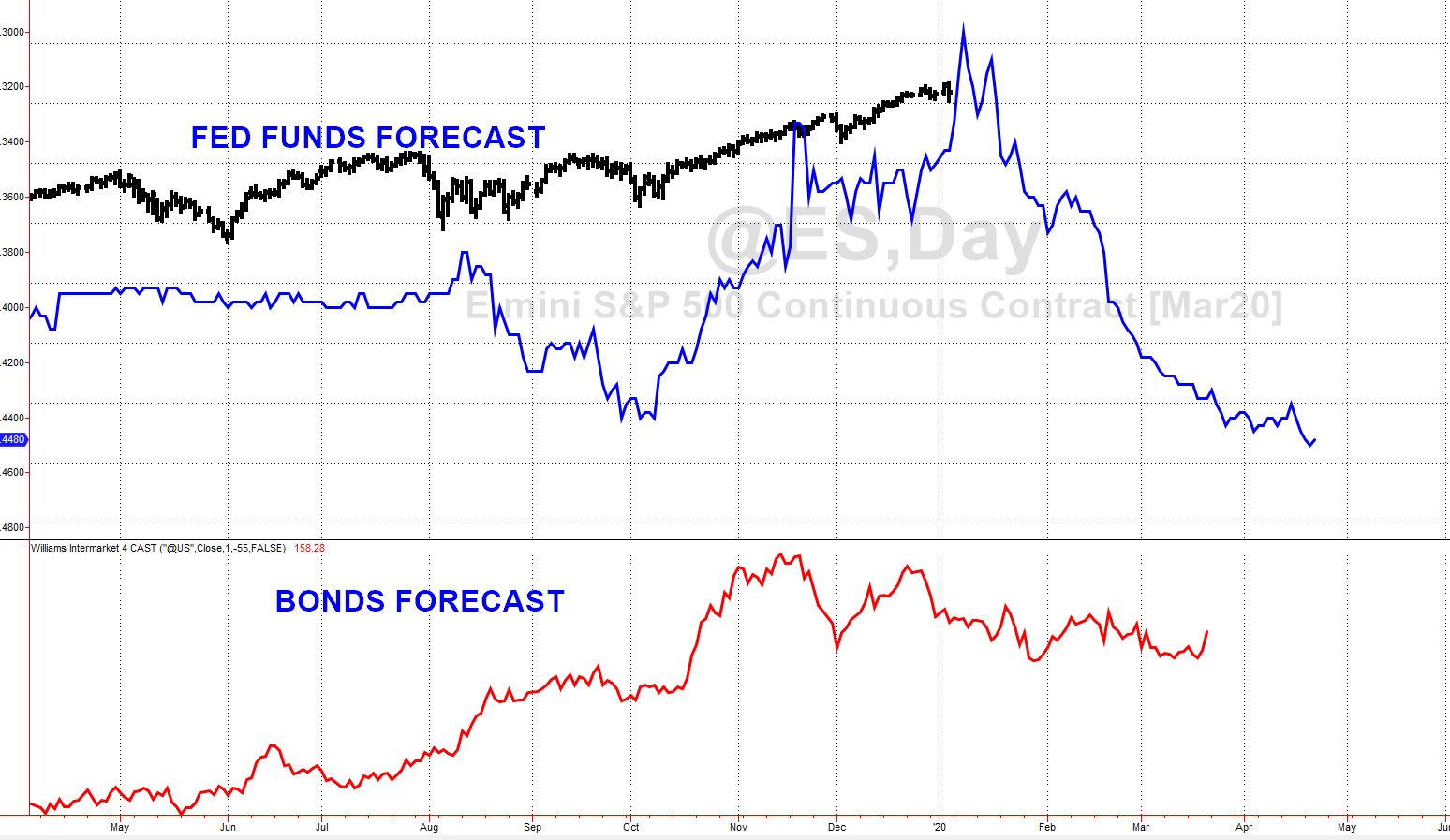 What rates are suggesting.
Ralph Vince writes:
Lot of people thinking 2020 will be another monster up year, despite earnings having flatlined for the S&P in recent months, a curve that has inverted and a deteriorating employment situation.
I'm still thinking 2020 will be a big up year (unless employment starts to hemorrhage - a 50/50 proposition right now). I'm only short because I'm looking for a serious (and technical) correction.
Incidentally, that's whats going on here–a technical, not news driven one. If it were the latter, the market would have responded on news last night, instead, it didn't, it terjiversated on the news, and the technicals ruled the night.
December 1899, from Stefan Jovanovich
Stefan Jovanovich writes:
Dec. 18, 1899
-11.99
1893, 1896, 1890, 1884, 1907, 1819 and 1873. Yet, at the time, the WSJ described the first two weeks of trading in December 1899 as "the most disastrous stock decline in the history of the New York Stock Exchange."
Russ Herrold writes:
The last pre 'Roaring Twenties' cited, 1907 would have been the bank panic quelled by J P Morgan. The quote offered from him was: The markets, they will vary.
Well, of course. This 1899 sour mood arose from heavy casualties in battles against Islamist rebels in the Philippines
"The combination of the M1911 pistol and the .45 ACP round were designed in reaction to U.S. experiences against the Moro tribesmen, fanatical (and sometimes drugged) Moslem insurgents in the southern Philippines in a 14-year rebellion immediately following the ten-week Spanish-American War."
'The .45 autoloading pistol was designed in 1904 by one of our most prolific firearms geniuses, the brilliant John Moses Browning, to be used in his newly designed Colt semi-automatic pistol.' Its predecessor, used in the 1899 rebellion, was a .38 cal, (revolver) chambered in 'Long Colt', a round originally designed during the transition from black powder to 'smokeless' nitrocellulose propellants
At the time, no general deployment pistol stopped a charging Moro like the .45 ACP. Bayonets and rifles also helped, but there had not yet been the cutover from earlier black powder designs to the Mauser inspired 1903 Springfield (which Springfield required an early engineering recall of 100 pct of fielded units, to case harden the receiver to tolerate the much greater pressure of the .30-06 cartridge)
– Russ herrold
Going Vegan, from Zubin Al Genubi
 I've been vegan for 2 weeks and feel great.
Low inflammation and congestion, clearer head, breathing and sleep is better.
Good recovery from surfing sessions.
Trying a large variety of new food, new recipes and new sauces. Will post some vegan BBQ ideas.
It might be one of the best ways to longevity.
Laurence Glazier writes:
In composing music the devil is in the detail. The final 5% can make the difference between the mundane and the ethereal.
What are the Current Presidential Odds, from Victor Niederhoffer
What are the current presidential odds. I see estimates varying from 2 to 5 to 1:1. On the other hand the increase in tension recently is highly bullish as it throws the public off from the large differential that compound interest creates between the increase in book value from the rate of return on bus investments and interest rates.
SPY Weekly Close Above 50-Period Upper Bollinger Band, from Steve Ellison
SPY weekly close above 50-period upper Bollinger band is not bullish, but not bearish either for the following week.
Average 0.0%
Standard deviation 1.6%
N 153
t -1.39
Average of all weeks since 1993 0.2%
Looking ahead 50 weeks, results are consistent with randomness with only 17 non-overlapping occurrences since 1993.
Average 10.7%
Standard deviation 11.8%
N 17
t 0.03
Average of all 50-week periods since 1993 10.7%
Gary Phillips writes:
One thing about shorting es here (3241.00 - 42) is that the market will give you pretty quick feedback as to whether you are right or wrong.
Book review: Why We Lost, by Daniel Bolger (Lt. Gen, ret.), from Alex Forshaw
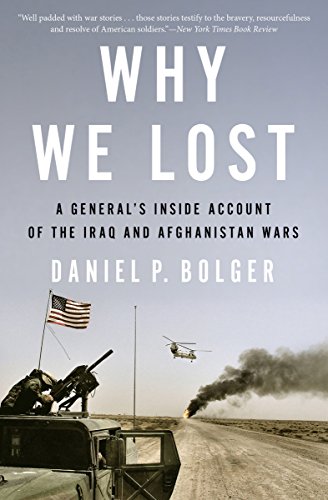 My main Christmas reading this year was Why We Lost, published in late 2014 by retired Lt. Gen. Daniel Bolger. Examining the ROI of US government spending has become a weird passion project of mine. What better place to start than the Afghan/Iraq campaigns, which have cost the US somewhere between $2.5 trillion (Pentagon) and $6.5 trillion (dedicated antiwar interest groups) over the past 17 years, all to turn Iraq into a restive Iranian satrapy?
I picked this book for several very specific reasons. One, Bolger is a prolific author with no apparent career agenda (he retired in 2013), political ambitions, or axes to grind–a combination that's unheard of within this subgenre. Two, it would've been written for publication before ISIS had really put itself on the map (late 2014/early 2015), which recast the Iraq debate into a finger-pointing exercise at the expense of dispassionate analysis. And three, the book's mere title takes the intra-military debate over What Went Wrong to a place most men in uniform won't go.
The book is very readable, and gives the feel of being the middle of dozens of episodic life-or-death firefights, each of which illustrated a larger success or shortcoming of the American strategy. For me, this vivid episodic detail bolstered the author's authority, but grew repetitive after a while.
In his strategic analysis, Bolger is much more nuanced than the title suggests, comes to some interesting conclusions, and, along the way, highlights some very surprising facts. I was astounded to learn, for example, that "the US military did not torture anyone" at Abu Ghraib. (Bolger doesn't hesitate to highlight other episodes of US torture, intentional killing of civilians, etc.) US troops did photograph some prisoners in compromising positions, strip some of them naked, have some dogs bark at them, and intimidate them. In the most infamous case, a prisoner was put on a box with fake electrodes attached to his fingers, and was told they were real and he'd be electrocuted if he stepped off the box, but the electrodes were fake and nothing actually happened to that prisoner. All of these things would fit semiawkwardly into the US military's prescribed environmental manipulation for interrogating suspects without physically harming them or placing them under such duress that they'd say anything escape the situation. According to Bolger, the worst that could be said about what actually happened at Abu Ghraib was that some of these intimidation/degradation incidents weren't related to any specific interrogation.
Bolger also refuses to point fingers at the easy scapegoats. President Bush gets measured credit until the 2006 Iraq Surge, when every general who'd fought in the Iraq theater had told Bush to a) cut American losses and get out, or b) even if the US was to stay, in many respects the larger US footprint was becoming as much of a long term liability as much as it may be a short term asset. Bolger was ahead of his time in assessing the Surge to be both an impressive tactical success and a major strategic blunder. He's more critical still of Obama's subsequent "Afghanistan surge," which recycled the same mediocre Iraqi formula into a theater where it was even less effective, had no justifiable long-term value once bin Laden had been killed (May 2011), and was badly hamstrung by idiotically restrictive revisions to rules of engagement which, up to that point, had been generally OK.
Stan McChrystal's handling of the Afghan theater gets particularly terrible reviews: ridiculously restrictive rules of engagement; McChrystal holding himself/the Coalition hostage to a treacherously ungrateful Afghan president (Karzai) who never would've existed without American backup; and a blatant protection racket in which the US was getting extorted by every side of the Afghan conflict, worst of all by Karzai.
On the issue of Iraqi war rationales (terrorists vs. WMD), Bolger writes as if the military never took WMD seriously: everyone knew that Saddam had no real, functioning nuclear program, and while chem/bio weapons play well in Hollywood doomsday scenarios, in reality, they require circumstances far too specific and consistent (in terms of humidity, wind direction, extremely stable delivery or storage en route, etc.) to be really effective outside of massive artillery barrages of chemical weapons. In terms of capable terrorist organizations, on the other hand, Bolger repeatedly notes that Iraq hosted a genuine vipers' nest of capable, well-equipped Sunni terrorist groups which the Americans had largely liquidated by 2005.
With the benefit of hindsight, Bolger writes, the US had completed 99 percent of its job in the war on terror, at a fraction of the original cost, by 2004 (or even 2003, after the Taliban had been kicked out of major Afghan population centers). Al-Qaeda itself had been completely destroyed aside from bin Laden himself and a few couriers. Many separate groups did claim allegiance to al-Qaeda and attempt to imitate it, but they weren't operationally coordinated. Over time, the Coalition footprint became its own casus belli against the US. The Americans were always occupiers, regardless of how much money they threw around for victim compensation or reconstruction. This was compounded, in Bolger's view, by chronic Sunni Arab double-dealing (always shaking America's hand while stabbing it in the back) and Afghan cultural treachery, in the sense that honesty basically has no place in Afghan culture.
It's difficult for me to take some of this criticism seriously. Was the US supposed to call it quits in Afghanistan in 2003 without killing bin Laden or al-Zawahiri? Would al-Qaeda proper have remained infirm had the US stopped hunting him down? No way. At the same time, if not surging in Iraq in 2006, and getting out of Afghanistan in 2011, were strategically such obvious calls, where was the military criticism of Obama's Afghanistan strategy? Enlisted personnel couldn't make the criticism, but retired personnel could (and in the case of the Iraq surge, loudly did).
Anyway, I'd strongly recommend the book for students of contemporary US military history.
Stefan Jovanovich writes:
If one looks at American deployments for what they are - largely bloodless training exercises, then Winning and Losing has to be evaluated by what the wargaming produced. In the first Gulf War, the U.S. military capabilities were larger in scale but no greater in technology or ability to engage at the sharp end than the French or British. The victory in Kuwait was greeted almost with relief - see, the Americans can actually win something. Now? The distance between the actual warfighting abilities of the U.S. and the rest of the world is now a chasm. The only comparison that fits is Nelson's Navy. The French, Spanish and Danish navies were still capable of challenging the British in the Caribbean and Baltic in 1780 and even 1790. By 1810 the British Navy was the largest physical and financial enterprise on the planet by a factor of 10.
I am not saying this is a good thing; I am saying this is what happened. The U.S. can win the war in Afghanistan tomorrow, as the President has said; we would just have to turn the place into Carthage. That we don't says nothing more about "victory" than the fact that the British Navy chose not to destroy every American ship on the Atlantic in 1813 because there was still the little matter of Napoleon's continental empire to deal with. Britain spent the next half century enjoying the financial dominance that its Navy had won. The dollar is the world currency now in large part because the Americans have that same military monopoly that Nelson and the Admiralty had created.
Article of the Day, from Victor Niederhoffer
 "A Clever New Strategy for Treating Cancer, Thanks to Darwin"
Relevant to big rises in a year in S&P?
Bill Rafter writes:
This is a fantastic article for anyone with cancer, particularly prostate cancer. Thanks for posting.
K.K Law writes:
A broader point is this is another excellent example of out-of-the-box thinkers and doers who create revolutionary innovations.
Dylan Distasio writes:
Unfortunately these innovations occur in spite of the current US system not because of it.
Gary Phillips writes:
Not unlike market analysis, the key to effective clinical observation is how the scientist conceptualizes the problem, and how he uses the information gathered. The dilemma presented with molecular targeted therapy using chemotherapy, is the very process that induces cell death (aptosis) can also promote (chemo)-resistance.This is quite the recursive paradox. Chemo drugs activate multiple signal transduction pathways which can contribute to either aptosis or chemo-resistance. One of the ways to circumvent this problem is to use a combination of drugs; employing another drug that targets the signal pathways that contribute to resistance. Of course, treatment varies from one patient to another, and the major challenge is to develop individualized therapy options that are tailor made to the patient.
Ever changing cycles and evolving markets dictate that traders must be agnostic and and adaptive. A tested, multi-variate approach tailored to the intrinsic nature of the current market regime will provide the best assessment of the market's context and offer the best approach to trading that particular market.
Comments
Jay Pasch on January 8, 2020 9:25 am
Ode to the Beagle:
https://www.youtube.com/watch?v=JAvWu6pILKk
10% corrections in S&P 500, from Steve Ellison
It has been more than a year since the S&P 500 went down 10%. In the nearly 17 years since March 2003, there have been 19 declines of 10% or more. There have been 82 declines of 5% or more.
Drawdown Qty Trading days Days since last
5% 82 4234 64
10% 19 4234 298
20% 5 4234 259
25% 2 4234 2731
33% 1 4234 2831
Zubin al Genubi writes:
Survivorship status is helpful.
Vegan Gains, from Zubin Al Genubi
 I became a vegan a month ago, but realized that 95% gives you 99% of the benefits and makes it a lot easier. This is true for a lot of things. The old saw says give it your all, but sometimes that is not the best.
In trading, of course, you never get it all, and trying for the last 5% can be very harmful. You never should go all in on margin and be the mouse with only one or no hole. In athletics they say give it your all, but most of the time you hold something back. You save up for the last push, for the trip home, for reserve to avoid injury, to maintain the balance of control over speed.
Few things require 110%. Dropping into a big wave requires complete commitment and going for broke. I'm sure there are others, but I can't really think of any. The margin of safety always trumps complete commitment.
In environmental clean up, the last few percent can cost more than the first 95%.
Private Jet Indicator, from Zubin Al Genubi
 There were over 55 big GS 4 and 5's double stacked up at the Kona FBO.
The overflow goes to Maui or Oahu.
There is a big sign for a another new FBO.
I only saw a couple small jets, mostly big new ones.
They all must be feeling pretty good this year.
I even heard some Air Force fighter bombers roaring around deafening everyone and burning up millions of dollars of fuel.
Just Asking, from Gary Phillips
How can anybody in their right mind go home long spooz, over the weekend?
Cagdas Tuna writes:
I can say there is no panic or risk in this market. Spooz, Nazzy all at the levels where they were yesterday.
Ralph Vince writes:
Lot of people thinking 2020 will be another monster up year, despite earnings having flatlined for the S&P in recent months, a curve that has inverted and a deteriorating employment situation.
I'm still thinking 2020 will be a big up year (unless employment starts to hemorrhage - a 50/50 proposition right now). I'm only short because I'm looking for a serious (and technical) correction.
Incidentally, that's whats going on here - a technical, not news driven one. If it were the latter, the market would have responded on news last night, instead, it didn't, it terjiversated on the news, and the technicals ruled the night.
Gary Phillips writes:
Not so sure if complacency is a compelling reason to feel good about a long position, unless we're talking about bonds or gold.
Tuesday, (NY+4) has fairly good bearish seasonality, and could be another day where we see a geopolitical type catalyst
At least, my dark passenger is hoping so.
Ralph Vince writes:
I think you just have to be patient on his one. It;s a Miami landing in a July thunderstorm. Just keep the seat belt really tight and enjoy the bouncing around as it comes in.
Comments
none on January 8, 2020 11:15 am
well your not alone.
2020 targets:
iper Jaffray 3600
Oppenheimer (Stoltzfus) 3500+
Yardeni Research 3500
BTIG (Emanuel) 3450
Canaccord Genuity (Dwyer) 3440
CFRA (Stovall) 3435
Credit Suisse (Golub) 3425
J P Morgan Chase (Lakos-Bujas) 3400
Goldman Sachs (Kostin) 3400
Evercore ISI 3400
BMO (Belski) 3400
Wells Fargo 3388
Citigroup (Levkovich) 3375
RBC Capital Markets 3350
Scotiabank 3350
Ned Davis 3325
Jefferies 3300
Bank of America (Subramanian) 3300
Barclays (Deshpande) 3300
Stifel Nicolaus (Bannister) 3265
Deutsche Bank (Chadha) 3250
Societe Generale 3050
Morgan Stanley (Wilson) 3000
UBS 3000
None 14500 INDU
Yash on January 12, 2020 11:04 am
Ralph do you have a twitter handle
Article of the Day, from Alston Mabry
Today the life expectancy, healthcare, nutrition, available resources, and standards of living in the world's poorest countries largely exceeds that of the world's wealthiest countries at the onset of the Industrial Revolution. On the morning of January 1, 1800 in Britain, life expectancy was 36.6 years and GDP was just $3,430 per capita. Today, life expectancy in Zambia, one of the world's poorest countries, exceeds 50 years, and GDP per capita is greater than $3,800.
Are Rising Earnings Bullish? And Falling Earnings Bearish? from Steve Ellison
 Reprising the analysis on page 47 of Practical Speculation with 17 years of new data, I compared earnings increases for the S&P 500 with the following year's net changes in the S&P 500.
Since full year earnings are not known until sometime in February, I used the 12-month earnings ending in September as the independent variable for a regression, with the dependent variable being the following year's net change in the S&P 500.
I found a negative correlation, but not significant as the t value was -0.7 and p was 0.49. Scatter graph is attached.
An outlier in the data was the fourth quarter of 2008 (counted as part of the 12 months ending September 30, 2009 in my analysis), in which massive bank writeoffs resulted in negative earnings for the quarter.
net earnings year-end next year
Year 12-month earnings change S&P 500 S&P 500 change
2001 28.31 1148.08
2002 30.04 0.06 879.82 0.26
2003 38.58 0.28 1111.92 0.09
2004 57.77 0.50 1211.92 0.03
2005 66.57 0.15 1248.29 0.14
2006 78.57 0.18 1418.30 0.04
2007 78.60 0.00 1468.36 -0.38
2008 45.95 0.42 903.25 0.23
2009 12.54 -0.73 1115.10 0.13
2010 71.86 4.73 1257.64 0.00
2011 86.98 0.21 1257.60 0.13
2012 86.5 -0.01 1426.19 0.30
2013 94.37 0.09 1848.36 0.11
2014 105.96 0.12 2058.90 -0.01
2015 90.66 -0.14 2043.94 0.10
2016 89.09 -0.02 2238.83 0.19
2017 107.08 0.20 2673.61 -0.06
2018 130.39 0.22 2506.85 0.29
2019 133.24 0.02 3240.02 (Dec. 27)
Romance Before Athletic Contests, from Victor Niederhoffer
 Romance before athletic contests lowers performance. I also believe that one reason the Knicks are so terrible is that they succumb often e.g. Smith and Carmelo.
Gary Phillips writes:
A friend of mine from the Bond pit befriended Michael Jordan when he first arrived to Chicago while M.J. was looking for a golf partner at Evanston. C.C. Fitz used to accompany M.J. and Charles Barkley to the NBA All-Star game every year. Fitz would always return with some hilarious tales of their antics and quotes from the outspoken Sir Charles. I can remember one distinctly that I believe is emblematic of their attitude, at least at that point in their lives. "Fitz, if you aren't thinking about pussy all the time, you're not concentrating hard enough."
Mr. Isomorphisms writes:
Do they succumb more often than the other side? ESPN had an article about the erosion of home/away advantage in the instragram era. Apparently instagram is where NBA players receive sexts and set up dates.
Jeff Rollert writes:
There's a number of Greek and Roman stories supporting the no romance before a battle concept.
Comments
nelson riddle on December 17, 2019 9:58 am
I went to a school where the women were incredibly beautiful, numerous, outnumbering the men, which fact was used to explain the poor performance of the athletic teams.
Small Wars, from Stefan Jovanovich
The only successful American military tradition - the one established by Generals Washington and Grant - is very straightforward: the U.S. should have a volunteer force that can move faster, with more force than any other military in the world and that force should only be committed under a formal declaration of war by Congress that identifies the specific enemy and seeks unconditional surrender. Any other policy/strategy/call it whatever buzzword you choose is and always has been folly.
When Eisenhower gave his warning about the military-industrial complex, he was not arguing against absolute American superiority. On the contrary, his forebodings were that strategic plans for defense were being set aside in favor of pork barrel procurement for "limited" warfare - troop deployments and weapons programs designed to match the needs of Congressional districts for Keynesian spending on activity for the sake of activity and "engagement". Those would, he feared, have the U.S. promising to help the world because, if you had the Green Berets, you would have to find places to send them. He knew, from direct experience, that counter-insurgency would always be a dismal failure. The U.S. had been, by his count, 0 for 3: in the Southern Philippines, in Haiti and in Honduras. Had he lived another half century, he would have seen us strike out again: in the Central Highlands, Iraq (excluding the initial conventional success) and now Afghanistan.
Grant had the same shrewd understanding of what was necessary in war and what the political pitfalls were. His Frontier policy remains our only successful counter-insurgency precisely because Americans stopped trying to win hearts and minds. As President Grant allowed the Army to fight without allowing either the Quakers, the land-grabbers or Sheridan to have their wishes come true. Grant succeeded in disappointing them all and in keeping the broad citizenry from forcing Congress into a policy of annihilating "the savages", even after Custer's defeat. The Sioux were defeated but neither they nor the Blackfeet nor any of the other Plains tribes suffered the absolute genocide that the Mariposa, Monache and Snake had a decade earlier. The Army did so well that, within a decade, they had to add gardening to their duties; they become directly responsible for our first national Park - Yellowstone.
Thanks largely to Grant the United States has the enviable record of having its populations of native Indians and former slaves become full citizens without their having to deny or abandon their heritage; that has happened in no other "civilized" (sic) country - not Brazil, not Mexico, not Australia, not New Zealand, not Canada. Yet, somehow, the very accomplishment that no other country in the world has managed to achieve within its own borders is one we modern Americans think we can successfully export to countries that have neither our faith nor our tolerance. As our 3rd great President/General put it: "There can be no greater error than to expect or calculate upon real favors from nation to nation. It is an illusion, which experience must cure, which a just pride ought to discard."
Peter Saint-Andre writes:
Stefan, would you mind expanding on your point about native Americans and African slaves not needing to abandon their heritage, as such people did in Brazil, Mexico, Australia, New Zealand, and Canada? An argument for this position seems important in the light of the 1491 and 1619 crowds.
Resolutions for 2020, from Stefan Jovanovich
Observe good faith and justice towards all nations; cultivate peace and harmony with all. Religion and morality enjoin this conduct; and can it be, that good policy does not equally enjoin it? It will be worthy of a free, enlightened, and at no distant period a great nation, to give to mankind the magnanimous and too novel example of a people always guided by an exalted justice and benevolence. Who can doubt that in the course of time and things, the fruits of such a plan would richly repay any temporary advantages, which might be lost by a steady adherence to it? Can it be that Providence has not connected the permanent felicity of a nation with its virtue? The experiment, at least, is recommended by every sentiment which ennobles human nature. Alas! Is it rendered impossible by its vices?
In the execution of such a plan, nothing is more essential than that permanent, inveterate antipathies against particular nations, and passionate attachments for others, should be excluded; and that, in place of them, just and amicable feelings towards all should be cultivated. The nation which indulges towards another an habitual hatred, or an habitual fondness, is in some degree a slave. It is a slave to its animosity or to its affection, either of which is sufficient to lead it astray from its duty and its interest. Antipathy in one nation against another disposes each more readily to offer insult and injury, to lay hold of slight causes of umbrage, and to be haughty and intractable when accidental or trifling occasions of dispute occur. Hence, frequent collisions, obstinate, envenomed, and bloody contests. The nation, prompted by ill-will and resentment, sometimes impels to war the government, contrary to the best calculations of policy. The government sometimes participates in the national propensity, and adopts through passion what reason would reject; at other times, it makes the animosity of the nation subservient to projects of hostility instigated by pride, ambition, and other sinister and pernicious motives. The peace often, sometimes perhaps the liberty, of nations has been the victim.
So likewise, a passionate attachment of one nation for another produces a variety of evils. Sympathy for the favorite nation, facilitating the illusion of an imaginary common interest in cases where no real common interest exists, and infusing into one the enmities of the other, betrays the former into a participation in the quarrels and wars of the latter, without adequate inducement or justification. It leads also to concessions to the favorite nation of privileges denied to others, which is apt doubly to injure the nation making the concessions, by unnecessarily parting with what ought to have been retained, and by exciting jealousy, ill-will, and a disposition to retaliate, in the parties from whom equal privileges are withheld. And it gives to ambitious, corrupted, or deluged citizens (who devote themselves to the favorite nation), facility to betray or sacrifice the interests of their own country, without odium, sometimes even with popularity; gilding with the appearances of a virtuous sense of obligation, a commendable deference for public opinion, or a laudable zeal for public good, the base or foolish compliances of ambition, corruption, or infatuation.
As avenues to foreign influence in innumerable ways such attachments are particularly alarming to the truly enlightened and independent patriot. How many opportunities do they afford to tamper with domestic factions, to practice the arts of seduction, to mislead public opinion, to influence or awe the public councils! Such an attachment of a small or weak, towards a great and powerful nation, dooms the former to be the satellite of the latter.
Against the insidious wiles of foreign influences (I conjure you to believe me, fellow-citizens), the jealousy of a free people ought to be constantly awake, since history and experience prove that foreign influence is one of the most baneful foes of republican government. But that jealousy, to be useful, must be impartial; else it becomes the instrument of the very influence to be avoided, instead of a defence against it. Excessive partiality for one foreign nation, and excessive dislike of another, cause those whom they actuate to see danger only on one side, and serve to veil and even second the arts of influence on the other. Real patriots who may resist the intrigues of the favorite, are liable to become suspected and odious; while its tools and dupes usurp the applause and confidence of the people, to surrender their interests.
The great rule of conduct for us, in regard to foreign nations, is, in extending our commercial relations, to have with them as little political connection as possible. So far as we have already formed engagements, let them be fulfilled with perfect good faith. Here let us stop.
Europe has a primary interests, which to us have none, or a very remote relation. Hence she must be engaged in frequent controversies, the causes of which are essentially foreign to our concerns. Hence, therefore, it must be unwise in us to implicate ourselves, by artificial ties, in the ordinary vicissitudes of her politics or the ordinary combinations and collisions of her friendships or enmities.
Our detached and distant situation invites and enables us to pursue a different course. If we remain one people, under an efficient government, the period is not far off when we may defy material injury from external annoyance; when we may take such as attitude as will cause the neutrality, we may at any time resolve upon, to be scrupulously respected; when belligerent nations, under the impossibility of making acquisitions upon us, will not lightly hazard the giving us provocation; when we may choose peace or war, as our interest, guided by justice, shall counsel.
Why forego the advantages of so peculiar a situation? Why quit our own to stand upon foreign ground? Why, by interweaving our destiny with that of any part of Europe, entangle our peace and prosperity in the toils of European ambition, rivalship, interest, humor, or caprice?
It is our true policy to steer clear of permanent alliances with any portion of the foreign world; so far, I mean, as we are now at liberty to do it; for let me not be understood as capable of patronizing infidelity to existing engagements. I hold the maxim no less applicable to public than to private affairs, that honesty is always the best policy. I repeat it, therefore, let those engagements be observed in their genuine sense. But, in my opinion, it is unnecessary and would be unwise to extend them.
Taking care always to keep ourselves, by suitable establishments, on a respectable defensive posture, we may safely trust to temporary alliances for extraordinary emergencies.
Harmony, liberal intercourse with all nations, are recommended by policy, humanity, and interest. But even our commercial policy should hold an equal and impartial hand; neither seeking nor granting exclusive favors or preferences; consulting the natural course of things; diffusing and diversifying by gentle means the streams of commerce, but forcing nothing; establishing with powers so disposed, in order to give trade a stable course, to define the rights of our merchants, and to enable the government to support them, conventional rules of intercourse, the best that present circumstances and mutual opinion will permit, but temporary, and liable to be from time to time abandoned or varied, as experience and circumstances dictate; constantly keeping in view, that it is folly in one nation to look for disinterested favors from another; that it must pay with a portion of its independence for whatever it may accept under that character; that, by such acceptance, it may place itself in the condition of having given equivalents for nominal favors; and yet of being reproached with ingratitude for not giving more. There can be no greater error than to expect or calculate upon real favors from nation to nation. It is an illusion, which experience must cure, which a just pride ought to discard.
George Washington's Farewell Address, 1796
Battling the Bull, from Gary Phillips
One should never dismiss information without reason, especially if it's information which contradicts one's preexisting beliefs in some way. Like Dexter, I have always had a "dark passenger" when it comes to trading, a diametrical tension between reason and reinforcement. It is not difficult to hold two contradictory beliefs about the direction of the market. It's the nature of the beast, not unlike Cerberus, the multi-headed dog that guards the gate to Hades.
But I'm afraid I may be addicted to this sense of being at odds with myself. Conflict can easily become a narcotic. When I attempt to forecast the future, my biases assume control and expose the flaws in my decision process. Luckily when I am trading my instincts and discipline assume control and rein in my ambiguous emotions. Somehow I still mange to make money in spite of my dichotomous self.
They say not to allow your strengths to become your weaknesses, but in my case, the real challenge is to transform my weaknesses into my strengths.
What are the Chances, from Victor Niederhoffer
What are the chances by randomness that a market with 55% up days and 250 trading days will end at the high, and does that have any evolutionary significance e.g. the battle of males to be at a maximum relative to competitors in other fields?
Gary Phillips writes:
The "unsinkable" S&P is reminiscent of Molly Brown. Her husband's fortune made in silver was lost, but resurrected in his discovery of gold. She even survived the sinking of the Titanic! If disaster were to befall the S&P, it would most certainly survive; and present one a buying opportunity, once again.
Ralph Vince writes:
It will have 3 1/2 market days to recover what it will give up tomorrow in order to do that.
Alston Mabry writes:
Just to see some stats on the SPY days YTD:
249 trading days
149 Up days, or 59.8%
mean Up day: +0.57%
mean Up day: 1.61 pts
sd: 1.32
mean Dwn day: -0.57%
mean Dwn day: -1.63 pts
sd: 1.83
Jared Albert writes:
Using with gratitude Big Al's numbers:
up =np.random.normal(1.61, 1.32, 138)
down = np.random.normal(-1.63, 1.83, 112)
Total number of max high finishes divided by total runs: 0.1357 on 10,000 runs
from random import sample, seed
import numpy as np
seed = 10
55% of 250 give 137.5, so to avoid half days went with 55.2% up days
'''249 trading days
149 Up days, or 59.8%
mean Up day: +0.57%
mean Up day: 1.61 pts
sd: 1.32
mean Dwn day: -0.57%
mean Dwn day: -1.63 pts
sd: 1.83'''
up =(np.random.normal(1.61, 1.32, 138))
down = np.random.normal(-1.63, 1.83, 112)
total_days = list(np.concatenate((up,down)))
win_count = 0
total_runs= 10000
for _ in range(total_runs):
m=0
running_total = []
test_population = sample(total_days, len(total_days))
print(test_population)
for i in test_population:
m = m + i
running_total.append(m)
print(f'running_total,{running_total}')
if max(running_total) == running_total[-1]:
win_count += 1
print(f'win_count: {win_count}')
print(f'Total number of max high finishes divided by total runs: \
{win_count/total_runs}')
My Shortcoming, from Gary Phillips
Along with all my other shortcomings, I have a very strong tendency to aggressively add and hold onto my winning positions for what I believe is "the really big move". Most traders exit their winning trades too early because they trade for average and lack the discipline to watch their profits erode. Markets usually do go further than one thinks, however these excesses can evaporate quickly also.
For me at least, managing a losing trade isn't fraught with much angst. I don't overstay my welcome. I just get out! Paradoxically managing a winning trade is much more emotionally demanding and realizing a large winning trade can be more emotionally destabilizing than a losing trade.
Gunsmoke: A Christmas Story, from Victor Niederhoffer
Here's a story I like almost as much as Stubby Pringle.
Comments
Jeff Watson on December 24, 2019 6:05 pm
Thank you for sharing and happy holidays to all.
Given That the S&P is Up Big, from Victor Niederhoffer
Given that the S&P is up big with approximately 7 days remaining and 2 that S&P has been up 10 of last 12 days, both events can be independently quantified with very positive expectations until end of year.
Gary Phillips writes:
Difficult to argue against that kind of momentum. I would expect to see dealers come in buying tomorrow a.m., to hedge their deltas on options positions, rolled up-in-strike and out-in-time. But I also see a possible bearish divergence in Ralph's most-watched SVXY and an uptick in implied correlations.
Back in the Saddle, from Gary Phillips
After a 4 year hiatus from trading, #7 is now four; and as Steven Tyler (and yes, Sleepy Joe), Gene Autry once sang, "I am back in the saddle again". Not much has changed. News and algos drive the market in the short term; and as a prominent spec-lister once stated, "momentum and sentiment" drive the market in the long term. Of course, so do stock buybacks and an acommodative Fed!
The current trend among marketnistas, academics, and dilettantes in social-media, appear to only "view the market through the lens of volatility". Short vol strategies are nothing new, but the obsession with dealers' counter-party options positions and their attendant gamma exposure, is herd like. But, nothing has really changed. It's still the drift driving price, albeit on steroids.
The transition back was nearly seamless. Trading is forever ingrained in my mind, my heart, and my soul; which is why I couldn't keep from returning to the screens. Unfortunately, all my bad habits appear to be ingrained in my psyche, also. Once again, nothing has really changed! Confirmation bias, and fomo/over-trading, systematically pervades my decision making.
Emotionally-neutral, logic based reasoning is the ideal we all seek. But, climbing out of that valley between perception and reality has always been a trek for me. Even after +45 years of trading, I am still fighting those cognitive demons.
Nevertheless "my get up and go hasn't got up and went"… quite yet. And trading is still my "Sweet Emotion".
Comments
Shyam on January 10, 2020 11:42 am
Really happy to see you back. We learned trading from your ES spoo thread on forums. So excited to see you again in the markets. Keep posting.
10 of my Thoughts, from Gary Phillips
-
My favorite articles on Daily Speculations are not about trading. They are the Chair's recollections of his father Artie.
-
New Jersey's only redeeming quality is the full service gas stations
-
Large families are more than worth the expense and attendant tribulations.
-
I miss the hackneyed, but fervent pitches, from the Long Island penny stock hustlers.
-
The shorter the time-frame (when trading), the more random the price action, the greater the capacity issues, and the greater the model risk.
-
Is there a way to keep the current generation from repeating "Sure" instead of "Yes, Please", and "No Problem" instead of "Your Welcome"?
-
"A happy wife IS a happy life". Place her on a pedestal and keep her there!
-
Sitting will kill you just as assuredly as cigarettes!
-
The attitudes of today's athletes have ruined my love of sports.
-
Try your best to avoid…getting stuck driving behind a Prius!
Comments
John Lamberg on February 23, 2020 5:37 pm
Although I’ve been out of contact for many years, I will use Gary Phillip’s Thought #7 (”A happy wife IS a happy life”. Place her on a pedestal and keep her there!) as a reminder that a) Some events are simply out of your control, and b) some events are indeed guaranteed to happen.
One of my wife’s final wishes, and I believe a sincere one, as I was about to become a widower was, “Find someone to make you happy.”
Now what are the odds that eight years latter while showing my fiancee some of my old posts on Daily Speculations that she would read my June 30, 2009 post? It was a reply to Marco Bolton’s Engagement Ring question.
“John Lamberg looks back:
A word of advice: When your wife to be picks out a wedding ring, no matter what price, run, do not walk, to the counter and purchase it. Do not repeat the mistake I made many years ago and say, “let’s think about it…”. Some mistakes are never forgotten.”
The timing was extraordinary as she is shopping for wedding dresses and the wedding ring has not been selected yet.
And yes,there is much truth in the saying, A happy wife Is a happy life.
Amazingly, from Victor Niederhoffer
Amazingly the probability of the Prez winning the election is still less than 50% according to betting markets. It's a bet of 100 that gives you 125 profit.
Comments
nelson riddle on December 17, 2019 9:57 am
I went to a school where the women were incredibly beautiful, numerous, outnumbering the men, which fact was used to explain the poor performance of the athletic teams.
Jim on December 18, 2019 2:10 pm
Dr. V December 6 show bonds -22. I think it should be -2.
It Often Happens, from Victor Niederhoffer
It often happens (although not tested) that a sports team (like the Knicks last night) makes a comeback only to lead to a heartbreaking loss. I tested this for S&P and found that moves from noon to 3:30 of 10 points or more, but still a deficit or small lead of 4 points or less, leads to victory in the market, i.e. continuation. Thus another seeming a dramatic comeback in the second half from a big deficit in the first half and moves out to close to a lead or a small lead. And then they lose. A comeback that leads to a loss just the same. I tested this for the market for comebacks of 10 or more points from noon leading to a small deficit of 4 or a small lead of 4. I found that in the market unlike my supposition of sports these comebacks lead to victories or continuations.
Noah Webster’s Take on the EU and “Global Warming” as a Religious Catechism, from Leo Jia
America sees the absurdities—she sees the kingdoms of Europe, disturbed by wrangling sectaries, or their commerce, population and improvements of every kind cramped and retarded, because the human mind like the body is fettered 'and bound fast by the chords of policy and superstition': She laughs at their folly and shuns their errors: She founds her empire upon the idea of universal toleration: She admits all religions into her bosom; She secures the sacred rights of every individual; and (astonishing absurdity to Europeans!) she sees a thousand discordant opinions live in the strictest harmony
Comments
Anonymous on December 14, 2019 6:13 pm
don’t see the connection
nelson riddle on December 14, 2019 6:14 pm
whaaat?
Flies are Tenacious in North Africa, from Leo Jia
 In Egypt, Tunisia and Morocco alike, they come to you with the most determination. As you wave, they go around and still come to you from other angles. On you, even when you shake, they don't fly away simply. It's very different from elsewhere.
Not getting it this time? — No problem, I will do it again!
What if not again next time? — No problem, I will do it again!
What if not getting it all the times? — I will get it eventually!
What if getting killed? — I will die anyway!
So they have in instinct what we humans learn about success?
How did they get that?
Well, maybe because they take you as a cow or a sheep who pose no danger to them.
Or maybe because there have simply been far more cows and sheep than humans in the region.
Or maybe because the people here have not been active in battling them.
Or because the people here are not as determined.
Or simply because they are enlightened.
On another perspective, look at the statuses of the flies around the globe, maybe we can learn something more. In developed world, flies are very much suppressed. In other somewhat less developed areas, Asia or East Europe for instance, flies are very wary. Is that an indication factor of human success? Can't we say on an evolutionary basis that the determinicity of the people vs that of the flies in the region reflects the success of the people (or of the the flies).
A Useful Tip, from Mr. Isomorphisms
It's useful to think about things being more or less predictable, with mathematical chaos being an extreme limit and a Gaussian being relatively certain (and very smooth) about a particular point.
More Poll Numbers, from Stefan Jovanovich
Firehouse Strategies has released a new poll for Michigan, Wisconsin and Pennsylvania. They are more than good news if you are a MAGA fan and very, very bad news if you are loyal to the party of the Great Society. Firehouse is a Republican-leaning consulting firm so their data deserves to be viewed with even more than the usual scepticism. On the other hand, they are far more forthcoming about their methodology than most of the "non-partisan" polls that get most of the media attention.
The Dangers of Automation, from Peter Saint-Andre
 Crew costs of $3,299 a day account for about 44 percent of total operating expenses for a large container ship, according to Moore Stephens LLP, an industry accountant and consultant.
Rolls-Royce's Blue Ocean development team has set up a virtual-reality prototype at its office in Alesund, Norway, that simulates 360-degree views from a vessel's bridge. Eventually, the London-based manufacturer of engines and turbines says, captains on dry land will use similar control centers to command hundreds of crewless ships.
Jeff Rollert writes:
As a sailor, I highly doubt that in my lifetime at least for the 0.02% of the time a ship is in a storm.
There's enormous sensory information that come from standing on a ship and feeling how it takes a wave. You'd have to create something akin to a flight simulator which would be really expensive.
Plus, if your comment link goes down, you have an unguided missile.
Peter Grieve writes:
Plus, there will be less damage control ability and motivation on the crewless ship.
Maybe it's just an old man talking, but these newfangled AI contraptions seem crazy. The deployment predictions seem wildly optimistic. As you imply, things can get pretty routine when the sun is shining and traffic is light, but I can't believe that the AI will be as flexible as the human mind in dealing with emergencies. Not for 20 years, anyway.
I just attended a colloquium on neural shrubs, a modification of neural nets. The main point was that we won't know how neural nets make their decisions. It will practically take psychiatry rather than software engineering to understand the machine.
I'm worried that there will be disasters which will be covered up, to retain the cost savings. And who takes responsibility for machine decisions? Someone with no skin in the game, because they're not in the car or on the ship. Do failed captains have to drown themselves in a special room in the control center?
Peter St. Andre writes:
In his book The Glass Cage: Automation and Us, Nicholas Carr argues that if you don't stay engaged with the routine aspects of a task then you won't be able to handle an emergency.
For instance, perhaps you just sit back and watch your AI-powered car as it drives you around in clear weather on paved roads in a well-ordered city, but what happens if you end up on a narrow dirt road in a snow squall?
I suspect that, more and more, reality and the humans within it will need to conform to the expectations of the machines.
Zubin al Genubi writes:
I’ve just experienced several VR experiences in LA. It is truly amazing. Very realistic.
Money, Trade and Freedom, from Stefan Jovanovich
I can understand why Austrian school economists love sociological explanations for the origins of money. If, as von Mises presumes, capitalism is the a priori wiring of our species (like a kind of Chomskian embedded grammar), then money had to evolve out of the rational need for a medium of exchange. The difficulty is that there is absolutely no historical evidence for the notion that "money emerges as a consequence of economic actors being better off using a medium of exchange than engaging in direct barter"; and there is a great deal of evidence for the fact that money develops as the unit of account for the people with edge weapons who collect bribes aka taxes from people who do not have them.
People in authority needed money to buy things that they could not extort and to bribe the supporters who might otherwise become rivals. The negotiations between authority and the people who could not be wholly intimidated, who had some degree of personal freedom, were the beginnings of trade and money. The promises to pay and to obey made by the parties were the beginnings of credit.
The struggles ever since have been about the quality and quantity of money and credit and the limits, if any, on the monopoly authority has over the question of what will be the unit of account for taxes.
Comments
Reid Wientge on December 16, 2019 2:28 pm
Speaking of the Austrian school I am working my way through “the Marginal Revolutionaries” by Janek Wasserman. It’s the history of the Austrian school and it’s contributions to economic theory, and it’s contribution to the war against Marxist/socialist theories.
What could be dry and academic storytelling is entertaining and inspiring.
Tragic that we have to fight the war over and over though so many battles have been won.
Reid
Mean Reversion Christmas Trees, from Zubin al Genubi
 Each year Christmas trees arrive on our island in containers.
One year they ran out right after Thanksgiving and there was a scramble for trees.
The next year everyone brought in an extra supply of trees.
That year the lots were full of trees on Christmas.
And so it goes back and forth every year.
This year the prices shot up noticeably.
And so it goes with markets as well.
Comments
Rod Clifton on December 11, 2019 3:55 pm
One might think it should be fairly easy to estimate demand for Christmas trees on an island, assuming the population is fairly stable.
Tom on December 13, 2019 1:36 pm
this is the cobweb theorem at work!
Human Underground Dwellers (HUD’s) of Mexicali, from Bo Keely
 The Mexicali tunnels are the Grand Canyon of Human Underground Dwellers. They extend for miles beneath the city and under the border to the USA. The network makes the Manhattan subway tunnels and Michigan State Steam tunnels I have also visited diminutive in comparison. They support more HUD's than the San Francisco underground Chinatown and the Paris catacombs.
I entered with the wife of a building owner through a back room, and down steep steps to the first level. On the north side she pointed to a vertical slab of fresh concrete over an earlier entrance that coursed beneath the border to the U.S.
Our entrance, among dozens throughout the city, is unique in housing Central American immigrants who have arrived and are waiting for a coyote to sneak them into the Promised Land. They live beneath the streets and businesses cheaply and undiscovered for days or weeks in queue for their coyote. It costs about $5000 just to get to the other side, and up to $8000 for guaranteed delivery to the American cities of their choice.
The Central Americans I saw were on drugs, as seems anyone who enters the tunnels. Their tastes range from marijuana to a preponderance of methamphetamine slammers with a needle. Mattresses were strewn off the main tunnels in small cul-de-sacs while the occupants wandered zombie-like in the network.
It is safe because they pay $.50 a day rent to the owner, my guide.
She speaks fair English in relating the history of the tunnels. ‘The Chinese immigrants from the 1920s into the 1970s built the tunnels to house the immigrants. Like now, they lived here safely waiting to escape into the USA. It was a subterranean town with homes, bars, and a casino with still roulette wheels and empty card tables. Now…’
She pulled aside a square of rotting plywood into a dark so black it was as though the little light around us was consumed. I whipped out my flashlight. Before me lay miles of passages piled with stinking garbage and hopping rats. I wanted to continue, but she demurred, ‘Not without someone with a gun.
‘Last year a man entered to scavenge the tunnels. He went in night after night for a month. Each time he brought out something or a story. Once it was human bones. Another time it was the report of a large room with dozens of concrete beds that used to house the Chinese refuges. One night he didn’t exit and was found thrown on the streets from another entrance a half-mile south of here. He had wandered too far into La Chinesca. He was bound and had been hung by his feet and tortured.’
The Chinesca is a neighborhood located five blocks from here that is home to about 15,000 people of Chinese origin, historically the largest Chinese community in Mexico. Early in the 20thcentury Mexicali was numerically and culturally more Chinese than other immigrant groups. Even today, anyone on the streets above will tell you that China runs the town.
The Chinese arrived to the area as laborers and political refugees. They were hired to dig the Coachella Canal that feeds from the Colorado River past Slab City that is our Nile of the Sonora desert. With that thanks to China, we descended to another level in the network beneath Mexicali.
I don’t know how anyone’s eyes could adapt to that dark. A few people stumbled away when I shined the penlight. The lady said she was nervous, and I was glad to hear it. We ascended to the bright streets.
I’ve visited other entrances including one a mile to the south from a restaurant that led from the kitchen down steps into the network and to this place where the door to USA was cemented up two years ago after the Border Patrol discovered its exit a half-mile to the north in a Calexico sympathizer’s basement.
‘This is the northernmost entrance of the Chinesca complex,’ she said. ‘Since they cemented up the tunnel to the US the human trafficking has taken to the fences. It’s more expensive and riskier. The underground Chinesca has become a holding tank for the immigrants.’
As near as I can figure, the Chinese arrived to find a thriving downtown with basements beneath their hundreds of shops and restaurants. They dug and connected some forty basements that eventually led north to the border. As the settlement grew, the subterranean Chinatown extended. Some archivists have speculated that the tunnels were also used to supply alcohol to the U.S. during prohibition. It housed brothels and opium dens.
There was an earthquake a week ago beneath my feet where I type that sounded like a lightning crack through the concrete tunnels.
The pursuit of this Chinese puzzle led me above to Chinesca near the Chinese 8 restaurant. The food is authentic and cheap. I ate with a San Felipe fisherman who asked the waitress if they served Totaba. She replied with an inscrutable grimace. Totaba is endemic to the Sea of Cortez and is on the endangered species list. It grows to 7-feet and one pulled my tablemate out to sea after he had bear-hugged it and refused to let go. He nearly drown for the swim bladder that fetches $13,000 USD from Chinese smugglers who serve it as a delicacy. ‘It makes your dick four inches longer, for starters,’ he said. Five months ago, Chinese ‘tourists’ were caught on the U.S. side with $3.7 million of fish bladders from Mexicali.
I still had a yen for the HUDs but the waitress refused us entrance. There are about forty basements that make up La Chinesca and each of the buildings has a different owner. The Chinese underworld is still a doorway away.
Comments
Pete M on December 10, 2019 7:58 am
Interesting Bo! Love these stories, keep them coming.
Grant, Lincoln, Race and Heritage, from Alston Mabry
One of the great history 'what ifs' is what Reconstruction would have been like if Lincoln hadn't been assassinated.
S&P Outperformance, from Alston Mabry
At the March '09 low, the S&P total market cap was about $5.3T (if I'm doing the math right).
Since then, according to Yardeni, the S&P has returned about >$4T to investors via buybacks and dividends.
Zubin al Genubi writes:
Bonds moving with equity rather than opposite.
Financial Transaction Tax + HFT Revenue, from Mr. Isomorphisms
"Financial Transaction Taxes - the ghost in the machine"
Mr Hurd, who made markets in KOSPI options, knows a bit about US hft as well.
2 points:
- the USA already has a financial transaction tax, SEC self-reg fees of $2000mmm last year.
- Virtu's quarterly revenue is "only" $127mm. This puts a heavy limit on what an HFT tax could be estimated to raise. And, to Mr Williams' point, speed isn't everything. The total amount people make in the markets makes $half a billion usd of yearly revenue look small.
(sorry, I saw an estimate of the total size of the asset management industry on some slide somewhere not very long ago, but I'm too lazy to look it up.)
Cannonball Run Record Smashed, from Jeff Watson
"These Guys Just Drove an E63 AMG Across America in a Record 27 Hours 25 Minutes"
It's amazing the high tech that is used to smash the cross country speed record. This article provides a look at that most illegal race in the country and the massive preparation and planning it takes to break records.
Chris Cooper writes:
I wonder…has anybody ever seen evidence that experts at video driving games are any better (or worse) drivers than their non-expert peers? For that matter, are race car drivers any safer on the roads than non-racers?
Comments
Jack Stevison on December 9, 2019 5:47 pm
I see a trading metaphor in this story. How many attempts at the Cannonball Run resulted in death or injury or were merely too slow, and were not reported as an attempt over all those years between successful record breaking runs? Failed traders and Cannonball drivers die in obscurity.
Optimal Parking Strategy, from Andrew Goodwin
A recent study receiving some attention on this Black Friday weekend looks to find the optimal parking strategy in a lot without full visibility. The paper in the Journal of Statistical Mechanics compares an optimistic strategy of driving past empty spots straight to the ideal entrance area to look. The pessimistic strategy parks in the first empty space spotted. The prudent strategy looks to pass an empty spot before taking a subsequent open one en route to the ideal entrance area spots. Hope some on the list intuited the solution and got to their prizes before the stores ran out.
James Simon, from Amardeep Somal
 The Man Who Solved the Market: How Jim Simons Launched the Quant Revolution is a great book.
In addition to this book, I'd recommend taking the time to watch the MIT fireside series feat James Simons.
The link is the 2nd in a three part series which cover the following:
Talk 1. His academic and personal history
Talk 2. Focuses on RenTec
Talk 3. Discusses his interests outside of finance.
Comments
Jay Pasch on December 2, 2019 11:54 am
With ES -30 this morning, there is a matter of that gap at 3111.75:
https://www.youtube.com/watch?v=8uirXFig0IQ
Jay Pasch on December 2, 2019 12:47 pm
ES 3111, you go down there:
Book Recommendation, from Zubin Al Genubi
 Training for the Uphill Athlete: A Manual for Mountain Runners and Ski Montaineers by Steve House and Killian Jornet is a great book which discusses the necessity of long low intensity training to build up increased metabolic function.
Highly recommended.
.
.
4, from Mr. Isomorphisms
I'm late on this, but Alexandre Laumonier's next book 4 has been out for practically a year.
Go Champion Retires, from Jeff Watson
/cdn.vox-cdn.com/uploads/chorus_image/image/65783969/515689380.jpg.0.jpg) A Go grandmaster has retired because he believes that computers can never be defeated. What does that portend for individual, human participation in the markets? Are humans who manually enter trades destined to go the way of open outcry? Can humans have an edge over algorithms?
A Go grandmaster has retired because he believes that computers can never be defeated. What does that portend for individual, human participation in the markets? Are humans who manually enter trades destined to go the way of open outcry? Can humans have an edge over algorithms?
Bill Rafter replies:
The following is guesswork. Anyone with a different voice is welcome to comment. (i.e., no need to flame)
I believe that the AI trading of the markets to date has centered on trades that have an almost zero risk of failure. Thus they have mainly worked in the extreme short run, mostly by picking off the marketmakers or the spread. There are many trading shops who do not permit their traders to take a position overnight.
Therefore if you wish to beat the algorithms you must pick a different venue, specifically longer-term trading. Maybe that's 4 days, and maybe it's 400 days, but it must be different from what the AI shops use. That of course means greater risk, but specs are in the business of taking risks.
Sooner or later, some of the AI people will invade this longer-term space, and they will do so by picking portfolios rather than individual stocks. But they cannot eliminate risk, and as long as risk remains, profit opportunities remain for the individual.
Larry Williams writes:
The basis of all profits is trend.
Trend is a function of time.
The more time in a trade the more potential for profits.
As long as losing trades are stopped out so they are not turned to big ones by time/trend.
Zubin Al Genubi writes:
I believe humans can still beat computers in trading. Maybe one human can't beat one computer, but the computers as a group will have a distinct behavior that can be regularized and gamed. Its the group dynamic, as even computers will tend to a group think. This is especially true if they are learning, and if they are reactive. The fixed systems are still pretty easy to beat because they are still beating the same old dead horses. I've found, as Larry mentioned, that a longer time horizon seems to work better now days. Hard to out speed the computers. Probably easier to out wait them. For example I seem to use 4 hour / day bars now rather than 5 min/30min bars in years past.
Laurence Glazier writes:
Such factors lean me more seriously to composing music than playing chess. What defines us as human?
Ralph Vince writes:
I posit that about 50% of all human action is a feint, a misdirection of the opponent, a lie. Camouflage is the dress code on the planet, and we have a several million year jump at the game of deception the machines must learn, must catch up on.
The machines are so-far, trusted–trusted not to lie or deceive. Once they do, how will they be able to compete with us i that higher arena?
Even in music, Laurence, a variation on them, a little bending around of a melody, is a feint, an indirect lie, as it were.
Laurence Glazier writes:
I've found fractal mathematical techniques of structuring music that have a ring of truth, however writing from inspiration, like painting from nature, must be a battle and a humbling one, with no concession to vacuous prettiness - nature's colour schemes seem always to work in the visual world, and I posit also in music, though I try to figure out more accurate methods of transcription.
Comments
Jay Pasch on December 2, 2019 3:06 pm
Mr. Vince,
Is she feigning at 3111? The wager is, no.
Christmas in Kona: The Private Jet Indicator, from Jim Sogi
Usually around Christmas and New Years I like to count the private jets at our Kona airport on the theory that the captains of industry have a good read on the economy. Surprisingly, and not the norm, is the large number of private jets (over 50) currently parked at the FBO for Thanksgiving. I saw lots of overflow jets flying to Honolulu to park. Of course with all time highs in the market, their options are giving the rich the wealth effect. Charles Schwab, Roberts of KKR, Go Daddy guys, Bill Gate, Paul Allen, and many other of the richest have homes here. It is a nice place!
Kim Zussman replies:
Agree completely. The hungry contractors that gave good deals a few years ago don't return calls now. This week I delivered some gifts to a few referrals, and even the usually unpopular ones have full parking lots.
The man in the White House knows how to stay there.
Comments
Anonymous on December 2, 2019 8:12 am
Tax cuts for the job creators means greater investment in creating goodies for them.
Nelson on December 2, 2019 8:14 am
Tax cuts for the job creators means greater investment in creating goodies for them.
Able to Leap Tall Service Lines in a Single Bound: Rich Wagner, from Bo Keely
 Rich Wagner was one of the early racquetball pioneers to make his way from Anywhere, USA by thumb and bus to the San Diego racquetball mecca. The only private club in the USA at the turn into the 1970s was Mel Gorham's Sports Center on Turquoise Street … a forehand with the small racquet from the Pacific beach. Wagner, and dozen of others, gathered at the club in the morning, ran the beach at low tide, partied late into the night, and slept in their vehicles or crammed into beach flats.
Handball legend Paul Haber was the club manager. There were no money tournaments but hospitality provided girls in bikinis and banquets. The draw sheets reached out the club lobby into the street with up to a thousand entrants. This is called the Golden Era of Racquetball spawned by its three originators: Bud Muehleisen, Carl Loveday and Charles Brumfield, all San Diego world champions of various racquet sports.
I started an anonymous sponsorship for arriving players like Wagner and hooked the superior ones up with the two budding racquet manufacturers Leach and Ektelon. Bud Leach and Bud Held, respectively, were cranking a handful of racquets per week out of a garage and shed. Wagner signed with the Leach stable and ran 4th-8th nationally through the Golden Era 70s. His style was dive and shoot.
(From the upcoming book 'Racquetball Stars of the Golden Era'. Photo by Art Shay with permission.)
I Recently Ran Some Tests, from Victor Niederhoffer
I recently ran some tests to see if using % adjustments were better than absolute. You will recall we had a heated debate on this. I found that the number of declines more than 10 S&P were as frequent during the early years of the last decade as during the recent years.
Comments
Andre on November 27, 2019 1:55 pm
https://news.yahoo.com/grandmaster-says-computers-cannot-defeated-104015667.html
Andre on November 27, 2019 1:59 pm
Can human’s beat computers in longer term trades ie weeks months. Obviously you use computers to backtest and maybe even develop a strategy, but are humans beating computers on longer time horizons? If humans can’t beat computers at poker then how can they at trading any time horizon?
Jay Pasch on November 30, 2019 11:11 am
What happens after she welds the thing shut with pig iron: